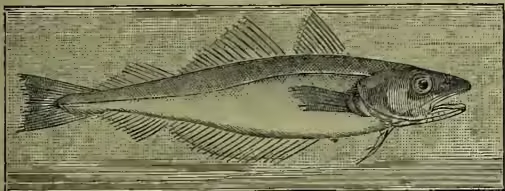
Whiting (Gadus merlangus, Linn.), a species of fish of the family Gadidae. Like the cod, haddock, pout, and poor cod, this species has the upper jaw longer than the lower, but it is distinguished among the species possessing this character by the fact that it has no barbule on the chin. Other specific characters are the pellucid silvery colour of the sides, the presence of a dark mark at the base of the pectoral fin, and the white border of the ventral and dorsal fins. The posterior edge of the tail is straight or but slightly emarginate, the depth of the body moderate; the anus is situated beneath the middle of the dorsal fin. As in all species of Gadus there are three dorsal fins and two ventral. The scales are small. The range of the whiting is the European coast from Scandinavia to the Mediterranean. It is abundant on British coasts, especially on the south and west coasts of England and Ireland, comparatively rare on the northern coasts of Scotland. It has been recorded as large as 16 inches in length and 3 to 4 lb. in weight, and some specimens are said to have reached 8 lb., but the usual size is about 1 or 2 lb. It is a voracious fish, feeding both on the bottom on crustacea and in midwater on small fish, such as sprats, young pilchards, &c. It also feeds on molluscs and worms, but to a less extent. It is caught both by the trawl and by hand-lines, and in Scotland also by long-lines. In Scotland mussels are chiefly used as bait; in England, pilchard, squid, herring, or mackerel.
The whiting breeds in spring, from March to May; the eggs, as in other Gadidae, are transparent and buoyant and dispersed separately in the water. It is in high esteem for the table, and is regarded as particularly delicate and easy of digestion. The flesh is of a pearly whiteness, whence the English name. It very soon suffers change, however, and is in good condition only a short time after being caught; but great numbers of small whittings are sent to market, salted and dried, under various names.