Windsor, a town of Berkshire, on the right bank of the Thames, opposite Eton, miles W. by S. of London by rail, 43 by river. The exact meaning of the name is unknown. Its ancient form is Windleshores. The kings before the Conquest appear to have had a hunting-lodge here, and Edward the Confessor granted the manor to the abbey of Westminster. Harold, before he assumed the crown, had a castle in the adjoining parish of Clewer, on the summit of a chalk bluff, and after the Conquest the king exchanged Old Windsor with the abbot, but resided occasionally at the castle in Clewer, to which the name of New Windsor was given. This name was also acquired by the town which grew up round the walls of the castle. In the course of centuries the timber defences, which are probably all that Harold left on his mound in Clewer, grew into the stately palace we see now. Henry I. resided much here, and married his second queen in the chapel. Henry II. made additions, especially in the Upper Ward, where some remains of Norman architecture have been identified. John was at Windsor after the granting of Magna Charta. Edward III. was born in the castle, where, in later years, he established what is now the oldest order of chivalry. To receive the knights of St George, or the Garter, the Round Tower was built on Harold's mound. The Black Prince married at Windsor the lady who was called 'the fair maid of Kent,' though she had been twice married and had four children. Froissart mentions the castle where he saw King Edward in mourning for Queen Philippa. David Bruce and James Stuart, kings of Scotland, were prisoners at Windsor. Henry VI. was born here in 1421. Edward IV. built St George's Chapel, in which, with his predecessor, he lies buried. Henry VII. completed the chapel and built the so-called Tombhouse, part of which is, however, of the time of Henry III., who built it in honour of St Edward the Confessor. Henry VIII. gave the chapel of St Edward to Wolsey, who had a magnificent tomb of black marble made for himself. This was stripped of its ornaments at the Commonwealth, and was finally sent to St Paul's for the funeral of Nelson. Henry VIII. was buried in St George's Chapel, beside Jane Seymour. Queen Elizabeth loved Windsor, and built some chambers which still remain on the north side of the Upper Ward, and are now comprised in the royal library. James I. also was much at Windsor. Charles I. is buried in the grave of Henry VIII. Charles II. employed Wren to build the state apartments. James II. turned Wolsey's Tombhouse into a Roman Catholic chapel, and received the papal nuncio here in July 1687. William III. came to Windsor in the winter of the following year, on his famous journey from Torbay to London. Queen Anne used to hunt in the park in a chaise, but lived in a small house on the south side of the castle. It was not much affected by George I. or George II., but George III. made it his principal residence, adding considerably to the Queen's House, and also using the state apartments. Madame D'Arblay has amusingly described court life at Windsor. George III. passed his declining years of dotage and blindness in the lower chambers of Queen Elizabeth's building. Queen Charlotte left the Queen's House for Frogmore; she died in 1818, and in 1823 the Queen's House was pulled down. The royal stables were built on the site in 1839. Meanwhile Wyatville had transformed the castle, under George IV., who came from his lodge in the Great Park to take up his residence in 1828. He died at the castle in 1830, his successor, William IV. in 1838, and the Prince Consort in 1861, all three, by a coincidence, in the same room. Many royal marriages have taken place in St George's Chapel. Prince Leopold, Duke of Albany, is buried in the Wolsey Chapel, and the tomb of the Duke of Clarence is in the same place, which has been magnificently decorated, and contains a cenotaph to the Prince Consort.
As we see it now Windsor Castle consists of an Upper and a Lower Ward, between which is the Mound and the Round Tower. In the Upper or eastern Ward are the Library, the state apartments, the Long Corridor, and the private apartments. Wyatville ingeniously connected all the isolated towers and the curtain wall between by means of this corridor, which is 520 feet in length. The state apartments contain many good pictures and other works of art. In the Lower Ward is St George's Chapel, with its cloisters, the Deanery, and the Canons' Houses. The last named contain remains of the palace of Henry III. Adjoining to the westward are the Horseshoe Cloisters, which contain the houses of members of the choir. Next to them are the barracks, including the Curfew
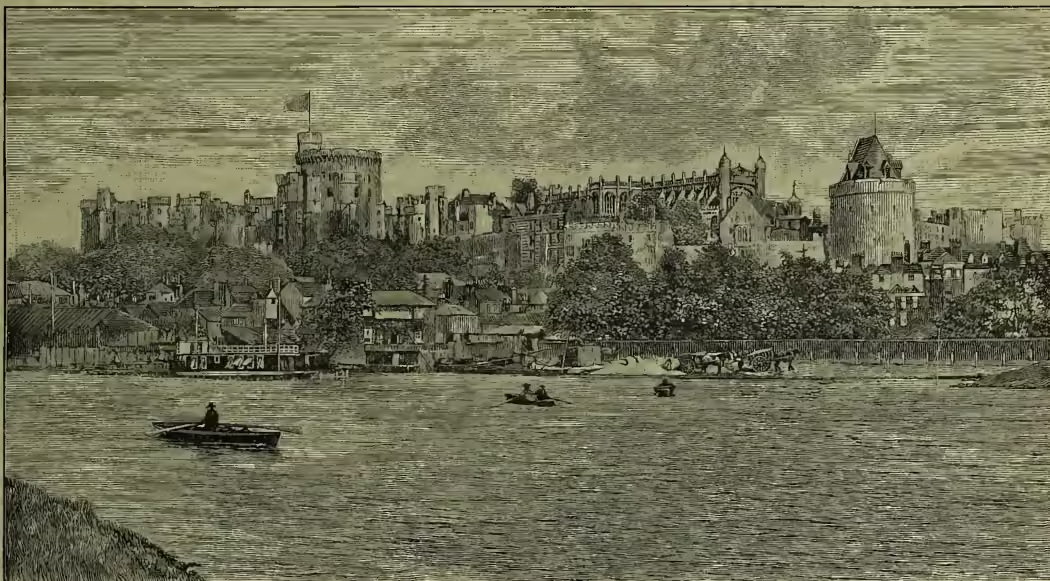
Tower, built by Salvin. On the south side is the principal gate, called after Henry VIII. In a line with it are the houses of the Military Knights, a band of pensioners. The Round Tower is the residence of the constable, and from it floats the royal standard. Wyatville lived, till his death in 1840, in the Winchester Tower, called after William of Wykeham. Wyatville made Windsor what it is, and, though we may find fault with his details, his proportions and his eye for a grand scenic effect place him far ahead of any other architect of the so-called Gothic revival.
The town of New Windsor was chartered by Edward I. It contains some interesting old houses, but nothing that can with certainty be dated back to the time of Shakespeare, whose Merry Wives of Windsor is said to have been written for Queen Elizabeth. Sir C. Wren, who was M.P. for the borough in the Convention Parliament which elected William and Mary, built the town-hall in the market-place. The town is pleasantly situated close to the Home Park, and the famous Long Walk, an avenue of elms 3 miles long, which leads to the Great Park. East of the Long Walk are the tombs of the Duchess of Kent and of the Prince Consort, in domed chapels; also Frogmore, the royal gardens, the farm and the dairy. The Great Park contains a church, Cumberland Lodge, and Virginia Water (q.v.), which is nearly 5 miles from the castle. The number of Windsor's parliamentary members was reduced from two to one in 1867.
Tapestry works established here in 1872 succumbed in 1888. Pop. (1851) 9596; (1891) 12,327.
See Tighe and Davis, Annals of Windsor (1848); G. M. Hughes, History of Windsor Forest (1890); and Windsor Castle, by the present writer (3d ed. 1891).