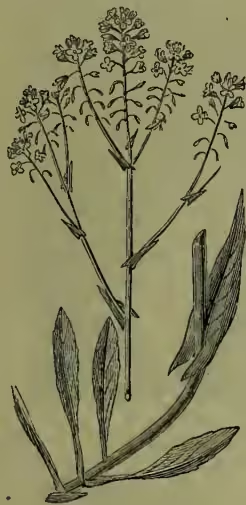
(Isatis tinctoria).
Woad (Isatis), a genus of plants of the natural order Cruciferae, containing only a few species, mostly natives of the countries around the Mediterranean. Dyer's Woad (I. tinctoria) was formerly much cultivated both in England and Scotland for the sake of a blue dye obtained from its root-leaves. The use of this dye was practically superseded by indigo. Dyer's woad is a biennial plant, with oblong crenate root-leaves about a foot in length, on pretty long stalks; an upright, much branched leafy stem, about 3 feet high; small yellow flowers, and large seed-vessels, about half an inch long and 2 inches wide, hanging from slender stalks. The leaves when cut are reduced to a paste, which is kept in heaps for about fifteen days to ferment, and then formed into balls which are dried in the sun, and which have a rather agreeable smell, and are of a violet colour within. These balls are subjected to a further fermentation before being used by the dyer. When woad is now used, it is always in union with indigo, which improves the colour. Even by itself, however, it yields a good and very permanent blue. In 1896 woad was grown at only three places in England, all near Boston; the price, formerly £25 a ton, had sunk to £9. It is supposed that woad was vitrum, the dye with which Cæsar said almost all the Britons stained their bodies. See Arthur Young's Agricultural Survey of Lincolnshire (1799); and an article and letters in Nature, November 1896.