Wolf, the vernacular name of certain species of the genus Canis; for a general account of which see DOG. The principal forms included in this section are as follows. (1) The Common Wolf (C. lupus) has very much the appearance of a large, long-legged, bare-boned dog, with a long tail, which hangs over its haunches instead of being curled upwards. Distinguishing characters are to be found in the lank body, length of the snout in proportion to the head, sloping forehead, oblique eyes, and erect ears. The fur varies according to the climate with respect both to its nature and colour. In the north it is long and thick—longest on the belly and legs, bushy on the tail, and erect on the neck and sides—whilst in the south it is generally shorter and rougher. The colour is usually pale yellowish gray mingled with black, lighter, often whitish gray below. It undergoes some change with the season, inclining to red in the summer, in the winter to yellow, which becomes white in the north; it is of a darker hue in the south. The forehead is whitish gray, the snout yellowish gray, always mingled with black, the lips whitish and the cheeks yellowish, sometimes indistinctly striped. A full-grown wolf measures 5 feet 5 inches in length, whereof 18 inches belong to the tail; its height is 33 inches, and its weight 50 kilos (over 100 lb.). The wolf's natural voice is a loud howl, but when confined with dogs it will learn to bark. Wolves inhabit a great variety of country, both hill and plain, especially thick forests and broken ground, with alternate morasses and dry patches, and in the south the steppes. They shelter in woods, marshes, cane-brakes, and maize-fields, roaming over wide areas, often suddenly appearing where none have been seen for years, and as quickly vanishing—nor is this wonderful when it is remembered that they will cover from 25 to 40 miles in a single night.
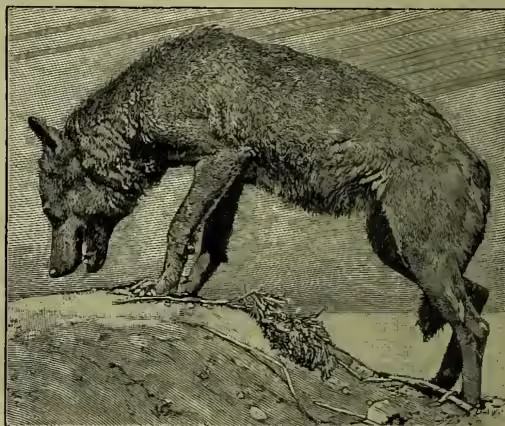
(From a Photograph by Anschütz.)
In the neighbourhood of dwellings they only appear after twilight, but in secluded places carry on their hunting all day. Their food varies according to the season, consisting in summer almost exclusively of wild animals—foxes, hedgehogs, mice, birds, reptiles, and even vegetables; of larger animals, elk and deer, whilst hares are soon exterminated where wolves abound. They follow the herds of lemmings in their migrations, and will devour carrion with avidity; but they do not appear to attack man unless in large numbers or pressed by hunger. In winter they approach nearer to human habitations, doing much damage to flocks and poultry yards; they come into the outskirts of St Petersburg and Moscow, and even pass through the streets of such towns as Agram. When in packs they will attack horses and horned cattle. In the chase the wolf exhibits all the cunning of the fox, and in addition courage and the capability of hunting in packs. These will even divide into parties, one following the trail of the quarry, the other endeavouring to intercept its retreat. In mental qualities the wolf is in every respect the equal of the fox; his caution is so great that he regards every unfamiliar object with suspicion, will not pass through a door if he can leap over the wall, and will not, unless famished, attack a tethered animal lest it should be the bait of a trap. When he sees himself captured his courage and ferocity at once forsake him, so that we may readily credit Conrad Gesner's story of an old woman, a wolf, and a fox falling successively into a pitfall, and each keeping aloof from the others. The loss in life and property caused by wolves is in many places considerable; in Russia, where their number is estimated at 170,000, 203 persons were recorded in 1889 as having fallen victims to them, whilst the annual damage done to live-stock has been variously stated at from 7 to 15 million roubles (say from £700,000 to £1,500,000), and to useful wild animals at no less than 50 million roubles. In Lapland the word for peace is synonymous with security from wolves.
Hence it is not wonderful that these animals are universally detested, and that the chase for them is vigorously pursued, 10 roubles being paid for each one killed in Russia. In France, where they are found chiefly in the central and south-western departments, £4 is paid for the destruction of a full-grown animal, and £1, 12s. for a cub; and in 1883 as many as 1316 were killed; in 1889, 515; in 1890, 461; and in 1891, 404 (149 full-grown, 255 cubs; premiums paid, £1013—including extra sums for females big with young).
In spring and summer wolves are solitary or in pairs, in the autumn in families, and in winter in packs. The pairing season is in December and January, when the males fight savagely together; those who are fortunate enough to secure a mate remain with her till the young are well grown. The period of gestation is sixty-three days, and from three to nine (usually four to six) cubs are found in a litter; these are blind for twenty-one days, and are suckled for two months, but at the end of one month are able to eat half-digested flesh, disgorged for them by the mother. They quit the parents in November or December, but many remain together six or eight months longer; they are full grown in three years, and live from twelve to fifteen years. The stories of children having been brought up by wolves (Sleeman's Journey through Oudh, 1858, gives several such) require further confirmation. Wolves can readily be tamed when taken young, and then exhibit all the characteristics of domestic dogs. F. Cuvier tells of one presented by its master to the Jardin des Plantes, which recognised him with every manifestation of joy after intervals of one and a half and three years.
Notwithstanding the spread of civilisation, the wolf is still widely distributed. Excluding thickly populated regions, it extends over almost the whole of Europe; it is not unfrequent in Spain, Greece, and Italy, as well as France. So recently as 1885-86 no less than thirty-nine were killed in Alsace-Lorraine and two in the Rhine Provinces. It is rarer in Switzerland, and in mid and north Germany has been exterminated, as in Britain. Eastern Europe, Russia, and Scandinavia are the only parts where it now occurs in any large numbers. It never seems to have existed in Iceland, or in the islands of the Mediterranean. In Asia it is spread over all the centre and north-east, over Afghanistan and Beluchistan to Sind, and possibly over the higher Punjab. The distribution of the North American variety will be given below. In Britain it appears from geological evidence that the wolf must have existed in almost every county. Hunting it was a favourite pastime among the ancient Britons and Anglo-Saxons. In the reign of Athelstan one Achehorn built a refuge for wayfarers near Filey in Yorkshire; and the tribute of 300 wolf-skins annually levied by Edgar on the Welsh is a matter of common repute, though it did not cause the extermination of these animals, as is sometimes stated, for we find that Henry III. granted lands on condition of the wolves being destroyed. Three shillings were paid for three wolves killed near Lichfield in 1334; Nottinghamshire was infested as late as the eleventh year of Henry VI.; but no mention of them in England occurs after the reign of Henry VII. (1485-1509). In Scotland we have the well-known story of Sir Ewen Cameron of Lochiel killing the last in the country in 1680; but there is reason to believe that individuals existed in Sutherlandshire, as also on the Findhorn River till 1743. In Ireland we have a proclamation forbidding the export of wolf-dogs in 1652, and the ultimate disappearance of wolves has been placed about 1766.
The following forms, which appear to be varieties of the common wolf, have been at different times described as distinct species: (a) C. niger is based on two specimens, formerly in the possession of the Zoological Society, obtained by Lieutenants Kinloch and Biddulph in Tibet in 1887. Their distinctive marks are said to be shaggy fur, which is black, except for a white muzzle, feet, and patch on the breast. (b) C. chanco (probably = C. laniger, Hodgson) is a pale variety from Chinese Tartary. Hodgson says it is common in Tibet. (c) C. pallipes is said to be smaller and lighter than the typical form, with little or no under-fur; but undoubted examples of C. lupus differ as much from each other as this does from them. It inhabits the plains south of the Himalayas, but is rare west of the Indus. It does not hunt in large packs, but in numbers of six or eight at most. The superstition of the people prevents its destruction, for they imagine that its blood will diminish the fertility of the fields. It is seldom heard, not howling like the European wolf. It is remarkable even among wolves for speed and endurance. (d) C. occidentalis (the American Wolf) is less red and blacker on the back, though not to so great an extent as many Spanish wolves. Formerly it was very numerous in the plains, hanging on to the herds of bison, killing weaklings and calves. Sometimes it is very ferocious, even attacking man, but nevertheless has been known to satisfy its hunger with berries. It inhabits burrows with several openings. As late as 1870 it was found in Massachusetts, but at the present day it is found east of the Mississippi and south of Canada only in unsettled parts of south New England, New York state, the Alleghanies, and the south of Florida, and possibly the south of Ohio; it is abundant only in remote districts of Maine. North of this it is still quite common, extending as far as Greenland. Its southern limit seems to be the province of Guanajuato in Mexico. (e) C. hodophylax (the 'Jamaina' of the Japanese) inhabits the woody and mountainous parts of Japan, where it hunts in small packs or families, and is much dreaded by the natives. It is of small size, and has short legs and an elongated muzzle. (f) C. lycaon is a name which has been given to the European black variety.
The following may be regarded as distinct species: (2) C. simensis (Abyssinian Wolf), described by Rüppell from specimens captured in the mountains of Senyen (Simen), is as large as a big sheep-dog, and has a very long muzzle. It is of a pale reddish brown, lighter below; white round the mouth and eyes, the margins of the ears, chest, and forepaws; the end and upper part of the tail are black. It does not appear ever to attack man.
(3) C. antarcticus (the Antarctic Wolf) is an inhabitant of the Falkland Islands, and much alarmed the early explorers by its bold approach, which was, however, merely the confidence due to unfamiliarity. Darwin tells us that at the time of the visit of the Beagle they would steal meat from under the head of a sleeping man, whilst the gauchos would kill them by holding out a piece of meat in one hand and a knife in the other. They feed on the native geese, and burrow like foxes. They are solitary, and are silent except in the breeding season. The fur is moderately long, of a yellow colour speckled with black, paler below; the lips, chin, and throat are white, but the most characteristic mark is a black patch just above the heel.
(4) C. jubatus (Maned Wolf) is the largest of its family in South America. It occurs in Paraguay and adjoining regions, and is easily distinguished by its long limbs and large ears. It has longish hair of a bright yellowish red, and a stripe of black down the middle of the neck, which, however, scarcely deserves the name of 'mane.' There is a black patch below the jaw and on each foreleg; the front of the throat and end of the tail are white. It inhabits low moist localities, and is said not to be dangerous to man or to domestic animals, except perhaps sheep. Its local name is 'A-gua-a,' perhaps from its cry.
(5) C. latrans (Prairie Wolf or Coyote) has now been extirpated over large tracts in Kansas, Nebraska, &c., but it may still be found where the common wolf has disappeared, owing to its smaller size and less dangerous character. It extends as far as 55° N. lat. and southwards to Costa Rica, and is abundant in northern Mexico, New Mexico, and Texas. Its colour varies with the season, being a bright tawny brown in summer and grayish or quite gray in winter. It has black stripes along the back and across the shoulders and hips; it is dingy white below, and tawny above the muzzle and outside the ears and legs. It is really a slender animal, but looks stout by reason of its thick coat. It causes much annoyance by its howling in the night, two or three producing the effect of ten by their numerous notes and their uninterruptedly succeeding each other. It eats all kinds of animal substances, and is the scavenger of hunting and travelling parties. In autumn it devours the prickly pear fruit, and in winter cranberries. Its cunning is so great that it is difficult to trap, and hence is killed by poisoning a bait, made more attractive by asafœtida. It will not attack man unless wounded. It breeds in retreats among the rocks, five or six, rarely ten, young being born in May or June.
C. lupus has been found fossil in Pleistocene deposits in various parts of Europe. An allied extinct form is C. eantleyi of the Indian Pliocene, probably the ancestor of C. pallipes. C. neschereus, from the Upper Pliocene of France, is a smaller form; and Lycœrus, from the French Pleistocene, is evidently a wolf, though it has only three premolar teeth.
For further information, see FURS; Mivart, Dogs, Jackals, Wolves, and Foxes (1890), with admirable coloured figures; Huxley, 'On the Cranial and Dental Characters of the Canidae,' in Proc. Zool. Soc. (1880); Harting, British Animals extinct within Historic Times (1880). For a discussion of the rearing of children by wolves, see V. Ball's Jungle Life in India (1879).