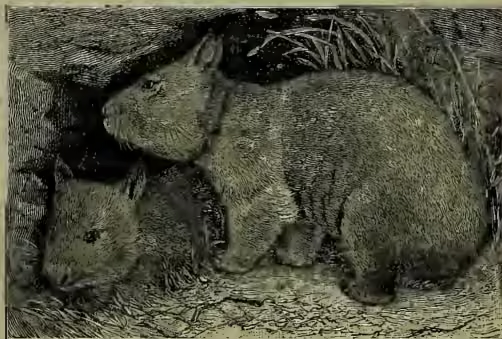
Wombats (Phascolomylæ), a family of marsupial mammals, resembling in many characters the rodents. There are no canines, and the incisors are large and with enamel only on the front surface; there are only two in each jaw, growing, like all the teeth, from persistent pulps. The molars are ten in each jaw. The limbs are stout and short, with five toes, all provided with long curved claws, except the very short first toes of the hind feet, which are nailless. The tail is rudimentary. In their general form and actions the wombats resemble small bears, having a similar shuffling plantigrade walk; but they are even shorter in the legs and broader in the back than those animals. They live on the ground and in burrows or holes among rocks, feeding on roots, grass, and other vegetable substances. They sleep in the day, seeking their food at night, and are usually gentle in their habits, though their large chisel-like incisors enable them to bite strongly if provoked. There is one existing genus, containing three species. The wombats of Tasmania and the islands of Bass Strait (P. ursinus) and the larger species (P. mitchelli) of the southern mainland of Australia have rough and coarse fur, a smooth muzzle, and short rounded ears. The larger species is very variable in colour, ranging from pale yellowish brown to black. P. ursinus is brownish gray, like the third species, the Hairy-nosed Wombat (P. latifrons), which differs from the other two in having smooth silky fur, a hairy muzzle, and large pointed ears. It inhabits Southern Australia. The largest living wombat (P. mitchelli) is about 3 feet long, but remains of a large extinct genus (Phascolonus), which must have been nearly as large as a tapir, have been found in Queensland. See Gould's Mammals of Australia.