Wood-engraving, or XYLOGRAPHY (Gr. xylon, 'wood,' and graphō, 'I write'), the art of engraving designs on wood, differs from copper and steel plate engraving by having the parts intended to print on the paper in relief. While plates are printed from the engraved lines by a laborious and necessarily slow process (see ENGRAVING), wood-engravings, having the object to be represented on the surface, in the manner of a type, may be printed along with the matter they are intended to illustrate in the ordinary printing-machine. This, of course, is an important point in the illustration of books, on the grounds of cheapness and expedition. Another advantage wood-engravings possess is that they can be multiplied to any extent by means of the electrotype process (see ELECTRO-METALLURGY).
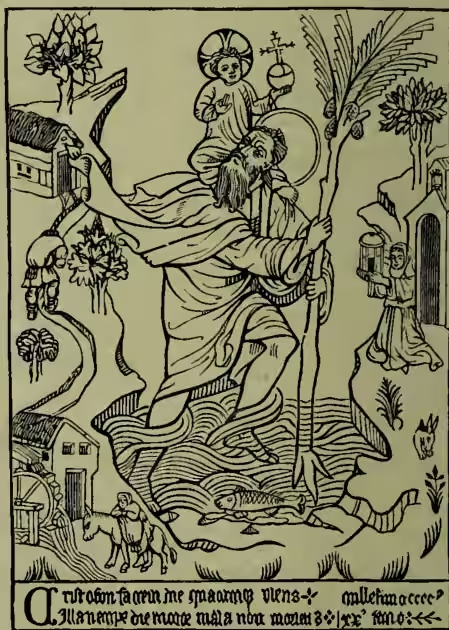
The invention of wood-engraving, like that of gunpowder, has been claimed for the Chinese, whose books have certainly been printed from engraved wood-blocks for ages. It has indeed been asserted that the art of cutting figures in relief, and printing impressions of them on paper, was known and practised by that nation as early as the reign of the renowned Emperor Wu-Wang (1120 B.C.). There is no doubt that wood-stamps were used by the ancient Egyptians and Romans for stamping bricks and other articles of clay; and that wood and metal stamps of monograms, &c., were used in various European countries, for attesting deeds and other documents, at a very early period, when the ability to write was an extraordinary accomplishment even for princes. It is not, however, until the beginning of the 15th century that we find any evidence of the existence of wood-engraving, as we now understand it. It appears to have been used in Germany at that time for printing playing-cards and figures of saints. The earliest print of which any certain information can be obtained was discovered in one of the most ancient convents of Germany—the Chartreuse of Buxheim, near Memmingen in Bavaria—pasted within the cover of a Latin MS.; it represents St Christopher carrying the infant Saviour across the ferry, and is dated 1423. Fig. 1 is a reduced fac-simile of this curious engraving. It is a work of some merit, notwithstanding its apparent roughness; the infant Saviour and the drapery of the saint being drawn with considerable skill and vigour. The Latin inscription at the bottom may be thus translated: 'In whichever day thou seest the likeness of Christopher, in that same day thou wilt, forsooth, die no evil death.—1423.' Shortly afterwards a series of books, printed entirely from wood-engravings, called block-books, were issued. They consisted principally of religious subjects, with short descriptions engraved on the same block. The most important of them were the Apocalypsis, seu Historia Sancti Johannis; the Historia Virginis ex Canticis Canticorum; and the Biblia Pauperum (q.v.). The illustrations, of which Mr Jackson in his treatise on the History and Practice of Wood-engraving gives an elaborate account and several specimens, seem to be drawn with a supreme contempt for perspective and proportion, but bear evidence of the draperies, and hands and faces, having been carefully studied. Fig. 2 is a copy of one of the engravings in the Apocalypsis. It represents St John preaching to three men and a woman, with the inscription: 'Conversi ab the pressman have produced. They have been imitated in modern times, but not excelled.' It is worthy of note that, although printed upwards of 400 years ago, the freshness and purity of the colours remain unimpaired.
As printing spread, the publication of illustrated books became general in Germany and Italy, and reached England in 1476; in which year Caxton (q.v.) published the second edition of the Game and Playe of the Chesse, with figures of the different pieces. They are very rude compared with the earlier German works. Fig. 4 is a reduced copy of the 'Knight,' and is interesting as one of the first wood-engravings executed in England. Several works followed, all, however, executed in the same rude manner. The first attempt at something finer than simple lines appears in the frontispiece to the Latin edition of Breydenbach's Travels, printed at Mainz by Erhard Reuwich, 1486. It is by an unknown artist, and is an elaborate and really very beautiful specimen of the art. It is also remarkable as being the first engraving introducing cross-hatching to represent dark shadows. The Hypnerotomachia Poliphili, printed at Venice by Aldus in 1499, is worthy of mention for the extreme beauty of the designs, which have been ascribed by some authorities to Raphael, and by others to Mantegna. About the beginning of the 16th century a complete revolution in the art of wood engraving was accomplished by the genius of Albert Dürer. His productions exhibit not only correct drawing, but a knowledge of composition and light and shade, and attention to the rules of perspective, which, with the judicious introduction of subordinate objects, elevated them to the rank of finished pictures. Dürer, however, in common with most of the German artists of his day, paid very little attention to the propriety of costume in his religious subjects; one of his drawings in the History of the Virgin (1511), for instance, representing the birth of the Virgin, shows the interior of a German burgomaster's house of his own day, with a number of gossips drinking from flagons and otherwise enjoying themselves. There has been considerable discussion as to the probability of Dürer having also engraved his drawings. Most of the best authorities on the subject, including Bartsch, Jackson, and Firmin Didot, agree in the negative. Mr Jackson, who speaks with the experience of a practical engraver, says: 'In most of the woodcuts supposed to have been engraved by Albert Dürer we find cross-hatching freely introduced: the readiest mode of producing effect to an artist drawing on wood with a pen or a black-lead pencil, but which to the wood-engraver is attended with considerable labour. Had Albert Dürer engraved his own designs I am inclined to
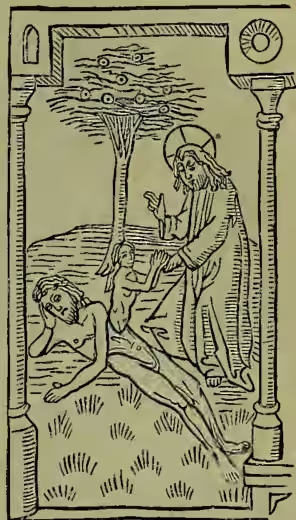
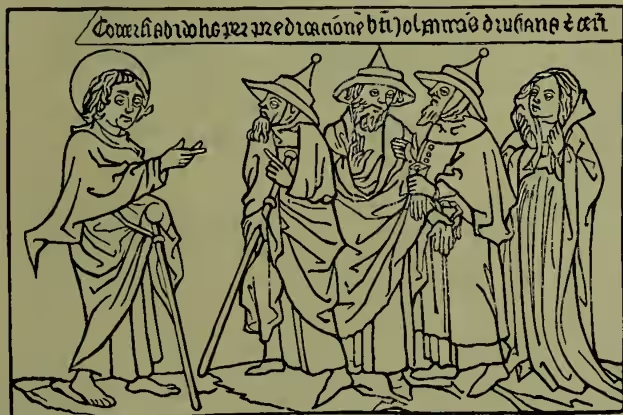
idolis, per predicationem beati Johannis, Drusiana et ceteri' (By the preaching of St John, Drusiana and others are converted from their idols). Fig. 3, from the Biblia Pauperum, is curious as showing the general manner of representing the creation of Eve during the 15th century, the same subject frequently occurring previous to 1500. Both have the appearance of careful drawings rather roughly engraved. Previous to the invention of movable types whole books of text were also engraved on wood, and the impressions had evidently been taken by rubbing on the back of the paper, instead of steady pressure, as in the printing-press, the ink used being some kind of distemper colour.
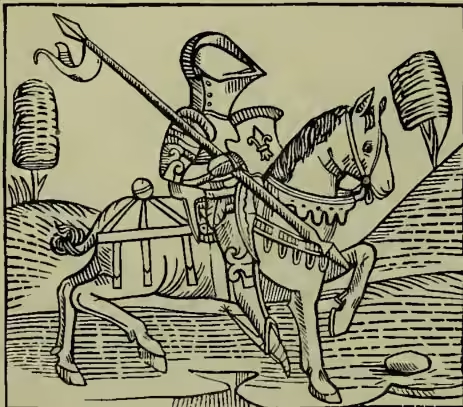
The Psalter printed by Fust and Schöffer at Mainz in 1457 is illustrated with initial letters engraved on wood, and printed in two colours, blue and red, which Mr Jackson considers 'the most beautiful specimens of this kind of ornament which the united efforts of the wood-engraver and the pressman have produced. They have been imitated in modern times, but not excelled.' It is worthy of note that, although printed upwards of 400 years ago, the freshness and purity of the colours remain unimpaired. As printing spread, the publication of illustrated books became general in Germany and Italy, and reached England in 1476; in which year Caxton (q.v.) published the second edition of the Game and Playe of the Chesse, with figures of the different pieces. They are very rude compared with the earlier German works. Fig. 4 is a reduced copy of the 'Knight,' and is interesting as one of the first wood-engravings executed in England. Several works followed, all, however, executed in the same rude manner. The first attempt at something finer than simple lines appears in the frontispiece to the Latin edition of Breydenbach's Travels, printed at Mainz by Erhard Reuwich, 1486. It is by an unknown artist, and is an elaborate and really very beautiful specimen of the art. It is also remarkable as being the first engraving introducing cross-hatching to represent dark shadows. The Hypnerotomachia Poliphili, printed at Venice by Aldus in 1499, is worthy of mention for the extreme beauty of the designs, which have been ascribed by some authorities to Raphael, and by others to Mantegna. About the beginning of the 16th century a complete revolution in the art of wood engraving was accomplished by the genius of Albert Dürer. His productions exhibit not only correct drawing, but a knowledge of composition and light and shade, and attention to the rules of perspective, which, with the judicious introduction of subordinate objects, elevated them to the rank of finished pictures. Dürer, however, in common with most of the German artists of his day, paid very little attention to the propriety of costume in his religious subjects; one of his drawings in the History of the Virgin (1511), for instance, representing the birth of the Virgin, shows the interior of a German burgomaster's house of his own day, with a number of gossips drinking from flagons and otherwise enjoying themselves. There has been considerable discussion as to the probability of Dürer having also engraved his drawings. Most of the best authorities on the subject, including Bartsch, Jackson, and Firmin Didot, agree in the negative. Mr Jackson, who speaks with the experience of a practical engraver, says: 'In most of the woodcuts supposed to have been engraved by Albert Dürer we find cross-hatching freely introduced: the readiest mode of producing effect to an artist drawing on wood with a pen or a black-lead pencil, but which to the wood-engraver is attended with considerable labour. Had Albert Dürer engraved his own designs I am inclined to think that he would have endeavoured to attain his object by means which were easier of execution.' The reader is referred to the article DÜRER for an account of some of his numerous works. The best of Dürer's contemporary artists on wood were the painters Hans Burgkmair (q.v.), Lucas Cranach (q.v.), and Hans Schäufflein. A series of works projected by the Emperor Maximilian were illustrated by these artists; but they are not equal to those of Dürer.
During the first half of the 16th century the publication of books illustrated with wood-engravings still increased, and prevailed to a greater extent than at any other time, with the exception of the present day. The superiority of talent, both in drawing and engraving, however, still remained with the Germans. In France, although their figure-subjects were inferior to those of their German neighbours, their ornamental borders in prayer-books, &c., of which a great number were printed at this time, were extremely beautiful. In Italy and England the art was very far behind. The most remarkable work published at this time was the Dance of Death (q.v.), issued at Lyons in 1538. The original edition of this curious work contained forty-one engravings, representing the struggle between Death, generally in the form of a skeleton, and different individuals, such as the Pope, the Emperor, a Judge, Monk, Doctor, Duchess, Old Man, &c. The drawings, which are characterised by great vigour and skill, are generally understood to have been executed by Hans Holbein (q.v.); but whether he also engraved them, as has been alleged, is more than doubtful. Towards the conclusion of the century, however, the art had made considerable progress in Italy, where some of the best productions of Germany were equalled, if not excelled. In England it did not make much progress. John Daye published almost the only illustrated books of the time, notably Queen Elizabeth's Prayer-book, which contains a tolerably well executed portrait of Her Majesty. There is no certain knowledge about any of the artists or engravers, although John Daye is supposed to have engraved some of his blocks himself. At this time also the practice of printing wood-engravings in colours from different blocks became somewhat common, although the attention of artists in that line was mostly confined to ornamental subjects. From the beginning of the 17th century the decline of wood-engraving may be dated, Germany, the cradle of the art, being the first to forsake it; the only works worthy of notice were a series of blocks on various subjects—designed by Rubens, and engraved by Christopher Jegher of Antwerp, one of the best wood-engravers of that period—some of which are of great beauty. From this time the art fell into a state of great neglect, not apparently for want of engravers, for woodcuts of a certain kind were always produced, but for want of artists able or willing to make drawings worthy of preservation.
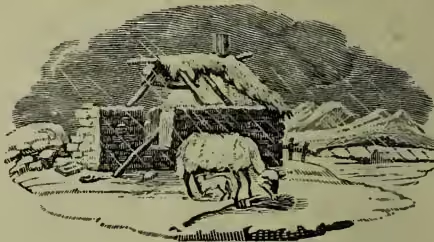
Nothing particularly deserving of notice occurred until 1766, when John Michael Papillon, an enthusiastic professor of the art in France, published an elaborate history of the subject in an unsuccessful attempt to restore it to its former importance. But it was not until the genius of Thomas Bewick (q.v.) was brought to bear on it that wood-engraving received that impetus which has made it what it now is—one of the most important of the illustrative arts. Bewick's most important works are his History of British Quadrupeds (1790) and of British Birds (1804); all the quadrupeds and almost all the birds were drawn and engraved by himself. The birds especially are executed with a truthfulness and skill which has rarely if ever been equalled. These works are also famous for their collection of tailpieces, which display an infinite amount of humour and pathos. Fig. 5 is a reduced copy of one of them—a poor ewe, in the starvation of winter, picking at an old broom in front of a ruined cot—a scene, trifling as it seems, which tells a woeful tale of suffering. He entirely abandoned the elaborate system of 'cross-hatching' which prevailed so much in the works of the older engravers, and produced his light and shade by the simplest possible means. The above example affords an excellent specimen of a wonderful effect being produced by a few simple lines.
Since Bewick's time wood-engraving has continued to flourish without interruption. He left behind him several pupils, the most successful of whom were Nesbet, Clennell (who engraved some of the tailpieces in the British Birds), and William Harvey. Harvey, however, forsook the burin for the pencil; and his drawings illustrating Milton's Paradise Lost, Thomson's Seasons, &c., especially such as were engraved by John Thomson (perhaps the most skilful engraver that ever lived, and a pupil of Robert Branston, a self-taught engraver), still retain a first-class place as specimens of wood-engraving. The establishment of the Illustrated London News (1842) tended greatly to familiarise the public with the beauties of wood-engraving. In the pages of that periodical appeared the first drawings on wood of (Sir) John Gilbert and Birket Foster. The spirited figure-subjects of the former and the exquisite landscapes of the latter did much to raise the art to the very high place it now occupies in England.
The closing quarter of the 19th century has been an important period in the history of wood-engraving, from the rise of what has been called the American school, which has had a considerable effect and many followers in England. It is typified in many of the finer illustrated magazines published in the
United States and England, and much of their work is very beautiful.
At first their tendency was to use the burin to imitate something else, such as chalk or pencil drawings, which they certainly did with great fidelity; but this could scarcely be called the proper province of wood-engraving. W. J. Linton (q.v.), the veteran wood-engraver, in several works rated them soundly for what he considered their mistaken notions, and advocated a simpler style of line, such as used by himself with masterly skill. Though his advice was ridiculed, an undoubted change in this direction gradually took place, and as specimens of pure wood-engraving much of the more recent work is as near perfection as we may expect to see it. The professors of the arts of drawing and engraving on wood in the present day are so numerous, and their works generally so well known, that it would be needless, even if our space permitted, to attempt even to enumerate them.
Practice of Wood-engraving.—The wood used for engraving is boxwood, which has the closest grain of any wood hitherto discovered. It is principally imported from Turkey for the purpose, as the English box is too small to be of much use. It is cut across the grain in slices, which are dressed to the same height as type for convenience in printing. Inferior kinds of wood, such as American rock maple, pear-tree, plane-tree, &c., are used for coarser purposes; and for very large and coarse subjects, such as posting-bills, common deal is used, and cut on the side of the wood with chisels and gouges. When blocks—as the pieces of wood are termed—are required of a larger size than a few inches square it is necessary to join two or more pieces together, as the amount of sound wood to be got out of even a large slice is extremely limited. There is, however, for all practical purposes no limit to the joining process, as blocks have been printed consisting of from 50 to 100 pieces. The wood having been made very smooth on the surface, and squared to the required size, the surface may be prepared with water-colour Chinese-white, and the subject to be engraved drawn upon it in the usual way with brush and pencil; or it may be photographed on the wood from a drawing made on paper (see PHOTOGRAPHY, p. 153). The latter method has many advantages, and is almost universally employed. The drawing is not destroyed in the process as if executed on the wood, but can be used to refer to, in touching up the engraving, and it may be sold separately if of value. When the block is prepared with the drawing, or photograph, it is given to the engraver, who, previous to commencing, carefully covers it with paper, fastened round the edges with beeswax; this is necessary, to avoid rubbing the drawing out in the process. As the engraving proceeds he gradually tears the paper off.
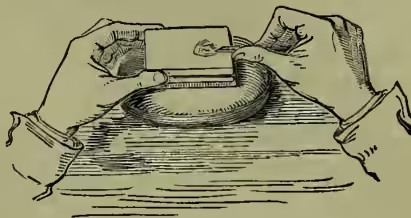
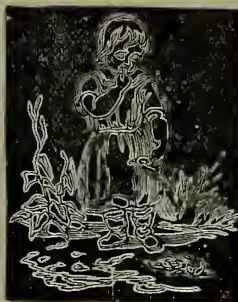
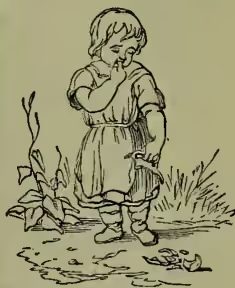
The tools or gravers necessary in wood-engraving are of many varieties, from those with fine points to cut fine lines, ranging through all sizes up to small chisels to cut out the wide white pieces. Fig. 6 represents the method of using the graver. Most engravers use a glass of slight magnifying power, more for the purpose of relieving the eyes from the strain of fixing both eyes closely on a small object than for magnifying the work. When gas or other artificial light is used a glass globe filled with water, slightly tinted with blue (to neutralise the reddish glare of the light), is placed between the flame and the work: this serves the double purpose of concentrating the light on the block and keeping it out of the eyes. When the drawing is in outline, or mostly so, the engraving is very simple; the process consists of engraving a line along each side of the pencil lines, which are, of course, to be left in relief, and afterwards cutting out the pieces between. It will thus be understood that every part of a woodcut which prints on the paper is the surface of the wood left untouched, and that every white part is cut or hollowed out. Fig. 7 represents a little subject outlined; fig. 8 is the same subject finished. When it is complicated with much shading, trees, &c., it becomes much more difficult, and brings into play the artistic talents of the engraver to preserve the proper shades, or colour, as it is technically termed, and texture of the different objects, the most skill being required where the drawing has been executed entirely or mostly by brush-work, and the execution is left entirely to the engraver. By a judicious
use of his various tools, cutting out or leaving the lines thicker or thinner, marvellous effects may be produced by very simple means. Some of the finer portraits entirely engraved from photographs from life, which may be seen in many of the better-class magazines, are wonderful instances of this skill, and are worthy of careful study.
When the drawing is all engraved, a proof is taken by inking the surface gently with printing-ink on a dabber (a ball of cotton covered with silk or leather), and, a piece of India-paper being laid on it, by rubbing the paper with an instrument called a burnisher until it is all printed, or, where the block is large, printed in a small press. The engraver then sees what touching up it requires before it is finished and ready for the printer.
When large blocks are to be engraved the pieces of wood are joined with screw-bolts, and the drawing prepared in the usual manner; after which the pieces can be taken separate for convenience in engraving, and also for the purpose of getting it quicker finished by having an engraver working at each piece—a matter of some consequence in many cases, as, for example, in the large engravings in the illustrated newspapers.
For mechanical processes of reproducing drawings, see ILLUSTRATION OF BOOKS. See also ENGRAVING, PHOTOGRAPHY, PRINTING, &c. See Hamerton's Graphic Arts (1882); Woodberry's History of Wood-engraving (1883); Marx's Wood-engraving (1881); Linton's Wood-engraving in America (1882); Jackson and Chatto's History and Practice of Wood-engraving (new ed. 1861); Papillon's Traité de la Gravure en Bois (1766); Bartsch's Peintre-graveur; Ottley's Inquiry into the History of Engraving on Copper and Wood; Firmin Didot, Essai sur l'Histoire de la Gravure sur Bois (1863); and W. J. Linton, The Masters of Wood-engraving (1891).