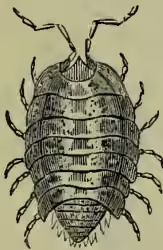
(Oniscus murarius).
Wood-lice (Oniscidæ), a family of terrestrial Crustaceans included in the order Isopoda. The body is more or less oval in outline and flattened; the head bears a long pair of antennæ, another rudimentary pair, a pair of lateral eyes, and jaws; the thorax bears seven pairs of walking legs; the abdomen has six pairs, of which the first five overlap like tiles, and the most anterior are modified to contain air. All live on land, in more or less damp places, hiding during the day, seeking their food in the darkness. The reproductive processes are very complex. When the female is impregnated in spring, she receives the male elements in two sperm-sacs; these burst into the closed oviducts; a moulting takes place, and a genital aperture is formed on the body-wall; the fertilised ova burst from the oviducts into the body-cavity, and pass out by the genital slit into brood-chambers on the legs; when the hatched young leave the brood-chamber another set of ova are squeezed into it; after all is over the female moults again and acquires its original characteristics. About 18 genera and 250 species are known—e.g. Oniscus murarius (known in Scotland as Slater), common under stones; Porcellio scaber, equally common; Armadillidium vulgare, able to roll itself up into a ball; Ligidium personii, frequent among damp moss and rotten wood; Ligia oceanica, on rocky shores. The wood-lice are vegetarian animals, eating both fresh and decaying plants, and some do harm in gardens.