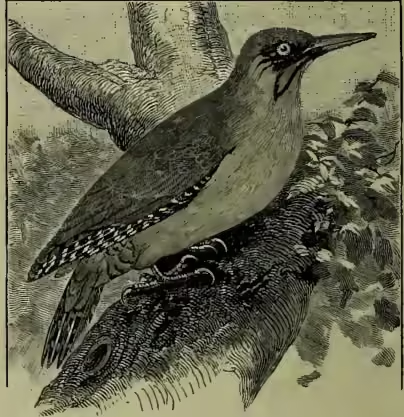
Woodpecker (Picidæ), a family of birds in the order Picarie, remarkable for the structural modification of the skull in adaptation to its use as an axe, and for the long, flexible tongue, which is used for extracting insects from holes and crevices of trees. The family embraces at least 250 species, which are most numerous in South America and the Oriental region, less abundant in Africa and North America, and altogether absent from Australia. The members of the typical sub-family Picinæ have stiff tail-feathers; the bill moderately long, broad at the base, hard and pointed at the tip; the toes in pairs, two in front and two behind, with strong, sharp, hooked claws; the tongue capable of being protruded far beyond the bill, and furnished at the tip with horny, barbed filaments. The food consists for the most part of timber-haunting insects, and it is in the effort to discover and dislodge these that the characteristic tapping sound is made. But the woodpecker does not confine itself entirely to trees; it feeds occasionally on ground-insects, and some species are known to eat nuts and berries. The nest is simply a hole pecked out in a tree, such as the beech, of which the wood is comparatively soft, and no lining, except a few chips, is placed inside. Only three species of woodpecker occur in Britain, and none of these is very abundant except in a few localities. The best known is the Green Woodpecker (Gecinus or Picus viridis), often called the Yaffle, Woodweele, or Rainbird—the last name referring to its most frequent note, 'a loud, laughing pleu, pleu, popularly supposed to foretell rain.' This species is found in wooded districts in England; it is rare in Scotland, and almost unknown in Ireland. The adult bird measures 12 inches; the prevailing colour of the plumage is green—dark olive on the upper, pale green on the under parts; the crown and back of the head are bright crimson. The Great Spotted Woodpecker (Dendrocopos major) and the Lesser Spotted Woodpecker (D. minor) are chiefly confined to the southern and midland counties of England. The former species is about 9 inches in length, the latter only 5; in both the prevailing colours of the plumage are black and white, the male having crimson markings about the head.
Of the numerous American species the Flickers (Colaptes), the South American Ground-flickers (Soroxenus), which live chiefly on termites, and the Great Ivory-billed Woodpecker (Campephilus principalis) may be specially noted. The last-named species, which inhabits the dense forests of the southern states, is one of the handsomest of the group, and was called by Linnæus the Prince of Woodpeckers, but as it is nowhere abundant, and is very wary, comparatively little is known of its habits. The Piculets (Picumninæ) form a distinct sub-family. They are very small, and the tail is short and not stiffened. About twenty species occur in South America and several in the Oriental region. As far as is known their habits resemble those of the woodpeckers proper. Also allied are the wrynecks (Jynx), which are restricted to the Old World.
It has been much discussed whether woodpeckers are injurious or not, but no general statement can be made, their habits varying with the species, the country, and the season. They are blamed for attacking trees, stealing seeds and fruits, and eating useful insects, such as most ants; but the trees they attack are usually not sound, and they destroy enormous numbers of injurious insects.
In Roman mythology Picus was supposed to have been turned into a woodpecker by Circe because of his love for Pomona.