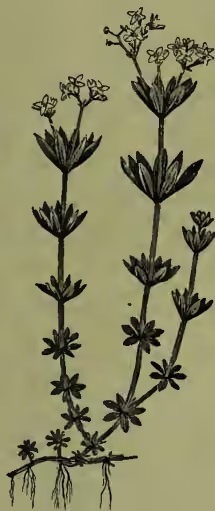
(Asperula odorata).
Woodruff (Asperula), a genus of plants of the natural order Rubiaceæ, containing a number of annual and perennial species, with whorled leaves, natives of the northern parts of the Old World, and distinguished by a funnel-shaped or bell-shaped corolla, a bifid style, capitate stigma, and dry didymous fruit. The Sweet Woodruff (A. odorata) is common in shady woods in Britain and all parts of Europe. It has a creeping root, a stem 5 to 10 inches long, weak and sub-erect, four or five whorls of lanceolate leaves, six to eight in the whorl, rough at the edge and keel, and small white flowers. The plant, when dried, has a very agreeable fragrance, similar to that of Anthoxanthum odoratum (see VERNAL GRASS) under similar circumstances. It forms an agreeable herb-tea, and enters into the composition of the popular May-drink of the Germans.
—Dyer's Woodruff (A. tinctoria) is a native of the continent of Europe and of Siberia, a perennial, with reclining stems about a foot in length, whorls of six or four linear leaves, the upper leaves opposite, the flowers whitish. The root is used in Dalmatia and elsewhere instead of madder; but the crop obtained from a field is inferior in quantity to madder.
Woods and Forests.
In ancient times the principal part of the royal revenues of England consisted of the rents and profits of the crown-lands, which were composed of numerous lordships and honours, with forests and chases. The dimesne lauds reserved to the crown at the Conquest were at one time very extensive; but while they were often added to by forfeitures, they were also so largely encroached on by grants to subjects that from the 12th to the 14th century parliament had often to interpose to compel the resumption of grants thus made. The confiscation of the property of the monasteries under Henry VIII. greatly increased the real estate of the crown; and, notwithstanding alienations by that monarch, and by Queen Elizabeth, who disposed of part of the royal domains to avoid application to parliament for supplies, the crown at the accession of James VI. owned very extensive estates all over England. The profusion, however, of James and his successors reduced the royal estates to insignificance, and no effectual restraint was imposed on their dilapidation until statute 1 Anne, chap. 1, prohibiting all alienations of the crown-lands, except by leases not exceeding thirty-one years, or three lives. From the reign of Henry VIII. to that of George III. the crown revenues were subjected to repeated changes of management; and under George III. the system was first introduced of surrendering the greater part of them to be consolidated with the rest of the public revenue, out of which the royal civil list is paid. The modern administration of the land revenues of the crown is founded on a statute of 1810, establishing a Board of not less than two or more than three Commissioners, called 'The Commissioners of His Majesty's Woods, Forests, and Land Revenues.' The law relating to the management of the crown-lands was consolidated by an act of 1810, which, repealing a number of previous enactments on the subject, placed the whole hereditaments of the crown in England, Wales, and Ireland, except advowsons and vicarages, under the management of the Commissioners of Woods and Forests, with large power of selling and leasing them; and provided that the annual land revenues should, subject to certain deductions, be carried to the Consolidated Fund during the king's life. This transfer to the Consolidated Fund, the result of a special agreement terminating with the life of the sovereign, has been renewed with his successors. In 1832 the Treasury was empowered to transfer to the Commissioners of Woods and Forests the management of the crown-lands of Scotland. In the same year parliament abolished the office of Surveyor-general of His Majesty's Public Works and Buildings, and entrusted to the commissioners the management of the public works. This union, however, was afterwards considered inexpedient, and in 1851 the department of Public Works was placed under separate control. An act of 1866 introduced various alterations in the details of management. The Commissioners of Woods and Forests act under the control of the Treasury, and are required to transmit annual accounts of the receipt and expenditure of their department, to be audited by the Commissioners for auditing Public Accounts. The net yearly receipts from this source amount to about £430,000. See WORKS (BOARD OF).