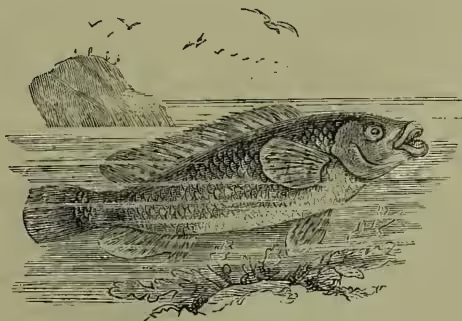
Wrasse (Labrus), a genus of bony fishes representative of the large family Labridæ, and including many species on European and north African coasts. The body is covered with cycloid scales; the form tends to be oblong; there is a single dorsal fin with a long spinous and shorter soft portion; the teeth on the fused lower pharyngeal bones are adapted to crush the shells of molluscs and crustaceans; the teeth on the jaws are conical and disposed in a single series. The colours are frequently brilliant. The flesh is not much esteemed. The Ballan Wrasse (Labrus maculatus) is common and widely distributed, often occurring among the seaweed in deep pools on rocky coasts. It measures 18 inches or more in length; is brightly coloured, often with a red back, an orange belly, orange-red paired fins, and bluish-green unpaired fins; feeds on crustaceans and worms; spawns in spring and summer. The Cook Wrasse (Labrus mixtus), also known as Red, Striped, and Spotted Wrasse, is not unfrequent on the southern coasts of England. The adult male is dark greenish above, yellow to orange beneath, with stripes of blue; the female is markedly different, being red with black blotches. In length the male measures about 14 inches, the female about a foot. In summer they live near the rocks, feeding on crustaceans; in autumn they seek deeper water. Nearly related to the genus Labrus is the Corkwing (Crenilabrus melops); and the allied genera Ctenolabrus, Acantholabrus, Centrolabrus are also represented on British coasts. A common American fish (Ctenolabrus adspersus), known by a variety of names, such as burgall, blue-fish, sea-perch, and nipper, belongs to the same set; and also related is the large Tautog (q.v.) or Black-fish (Tautoga onitis). Several species of Wrasse are known as Rock-fish. The Parrot-fish (q.v.) or Parrot-wrasse is the genus Scarus.