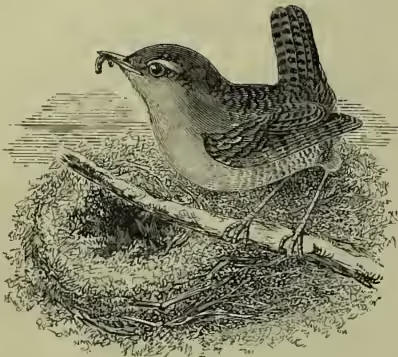
Wren, a genus (Trogloxytes) and family (Trogloxytidae) of birds, having a slender, slightly curved, and pointed bill; the wings very short and rounded; the tail short, and carried erect; the legs slender, and rather long. Their plumage is generally dull. They are abundant in the neotropical region, less common in the nearctic, palaearctic, and parts of the oriental regions. They live on or near the ground, seeking for insects and worms amongst low bushes, and in other similar situations. The Common or European Wren (T. parvulus, europaeus, or vulgaris) is found in all parts of Europe, and in Morocco and Algeria, and in Asia Minor and northern Persia. In central Asia it is represented by T. borealis, and in the southwest of Norway a species has been found, known as T. bergensis. The common wren is more abundant in the northern than in the central and southern parts of Europe. It is a very small bird, only about inches long, reddish brown above, with narrow transverse bars of dark brown, yellowish white below, the greater wing-coverts with three or four small bead-like spots of white. From its peculiarity of form, and its active, lively habits, it is one of the most familiarly known of British birds. It frequents gardens, hedges, and thickets. Its flight is not long sustained; it merely flits from bush to bush, or from one stone to another, with very rapid motion of the wings. It sometimes ascends trees, nearly in the manner of creepers. The male has a loud sweet song. The nest, which is comparatively large, is oval, domed above, with a small opening in the side, and is composed of leaves, hay or moss, sometimes lined with feathers, and generally of materials such that it resembles in colour the objects beside it, and is not easily discovered. It is often placed under the thatch of a building, under the turf of a turf-topped wall, against the side of a moss-covered tree, or under an impending bank, always so as to be sheltered from rain. The eggs are usually from six to eight in number, and the male is assiduous in his attentions to the female in supplying her with food during incubation, and afterwards assists her in the care of the young. Two broods are produced in the season. Imperfect nests, known as 'cocks' nests,' are often found near an occupied nest. In severe winter weather a number of wrens often take shelter together in an old nest, or in a hole of a wall; sometimes they roost in byres, to enjoy the warmth proceeding from the cattle. When driven from bushes, the wren is easily run down; and the hunting of the wren (the 'king of all birds') on St Stephen's or Christmas Day is an old custom in the south of Ireland. A similar custom obtained on other days in other localities. Its origin is unknown. In general, however, the wren is almost as much a popular favourite in Britain as the redbreast. The name Kitty or Jenny Wren is popularly given to it in many parts of the country. The North American species of wren are numerous; but many of them are ranked under different genera. The House Wren (T. domesticus or ædon) is larger than the European wren, being about 5 inches long. It is reddish brown above, barred with dusky, and pale fulvous white below, with a light brownish tinge across the breast. It is abundant in the eastern parts of the United
States. It is less shy than the European wren, and often builds its nest near houses, and in boxes prepared for it. The nests are made to fill the boxes; and to effect this a large mass of heterogeneous materials is sometimes collected. The song of the house wren is very sweet. The male is a very bold, pugnacious bird, readily attacking birds far larger than itself, as the blue-bird and swallows, and taking possession of the boxes which they have appropriated for their nests. It even attacks cats when they approach its nest. The Winter Wren (T. hyemalis) is so similar to the European wren that it is not easy to state a specific difference. It is common throughout North America, from Labrador to Louisiana, and partially migratory. Several other species, common in North America, all agree very nearly in their habits with the common wren. See also GOLDEN-CRESTED WREN.