Wryneck (Yunx), a genus of birds of the Woodpecker family (Picidae), having a short, straight, conical beak; a long extensible tongue, with a horny point; wings of moderate size; a rather short and rounded tail; the feet with two toes in front, and two behind. One species, the Common Wryneck (Y. torquilla), is a regular spring visitor to England and the north of Europe.
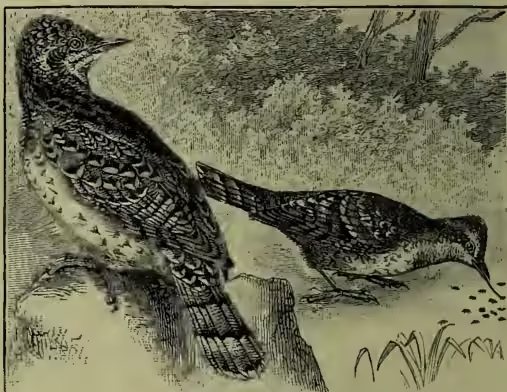
From its appearing at the same time with the cuckoo, it has acquired the name of Cuckoo's Mate, or Cuckoo's Leader. It has been found as far north as Caithness, the Orkneys and Shetlands, and the Faroes. It has also been found in Ireland. It is about 7 inches long, of a rusty ash colour, irregularly spotted with brown and black. It feeds on caterpillars and insects, and is often seen on the ground near ant-hills, feeding on the ants and their 'eggs.' The construction of its tongue resembles that of woodpeckers, and enables it to seize its insect prey with wonderful celerity; the tongue, which is covered with a glutinous secretion, is darted out and retracted so that the eye can scarcely follow it, the two posterior branches of the bones of the tongue being much elongated, and muscles for its extension attached to them.
The wryneck generally makes almost no nest, but deposits its eggs on fragments of decayed wood in a hole of a tree. The young birds are easily tamed, and are great favourites with boys. In France boys tie a string to one of the legs of the bird, and allow it to climb trees in search of insects. The name wryneck is derived from the bird's habit of writhing its head and neck quickly in various directions, with an undulating snake-like motion, which it does particularly if found in its hole in a tree, making at the same time a hissing noise, to alarm the intruder; but on his drawing back it suddenly darts out and escapes.