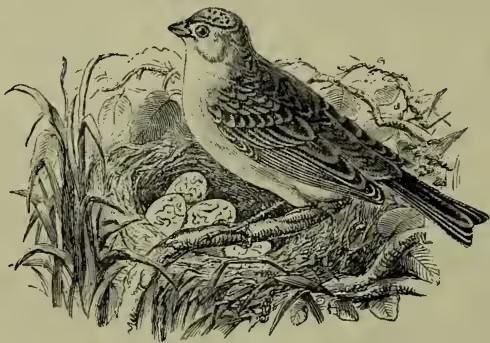
Yellow-hammer, or YELLOW-BUNTING (Emberiza citrinella), a species of Bunting (q.v.), common in the British Isles, most parts of Europe, and Asia Minor and Persia. It is of a somewhat short, thick form, about inches in entire length. The male's summer plumage is brilliant, bright lemon yellow (especially on head, cheeks, chest, &c.), contrasting with chestnut and dusky black. The tail is slightly forked, and is shorter than that of the common bunting. The female has much less yellow about the head than the male, and her plumage is altogether much less vivid. The bird's food consists of insects, blackberries and other wild fruits in summer, and seeds and grain in winter. It generally makes its nest on or near the ground, under shelter of a bush or a bank, forming it of moss, dry grass, and hair. The song of the male is very sweet, and consists of few notes, which have been jocularly set to the words, 'Little-bit-of-bread-and nō ché-cse.' He is remarkably attentive to his mate, and takes his turn in incubation. In many parts of Britain boys who would think it wrong to rob any other bird's nest esteem it a permissible kind of duty to rob that of the yellow-hammer. In Italy great numbers of yellow-hammers are caught, and fattened like ortolans for the table. It is a noteworthy circumstance that this bird is more rare in insular situations, in the islands of the Mediterranean, as well as the Orkneys. The name is a corruption of yellow-ammer; the Anglo-Saxon amore (cf. Ger. ammer). In Scotland the yellow-hammer is known as the Yoldrin or Yite.