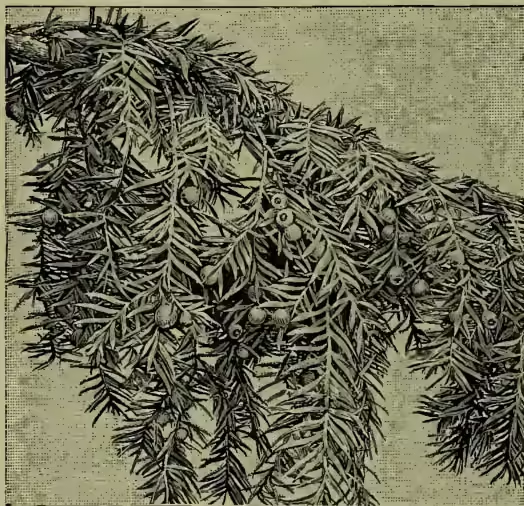
Yew (Taxus), a genus of the natural order Taxaceæ (generally regarded as a sub-order of Conifereæ), characterised by solitary and terminal fertile flowers, with a solitary ovule sessile in the centre of a fleshy disc, forming a sort of drupe when in fruit. The genus Taxus is distinguished by a solitary terminal seed, surrounded by a succulent cup. The species are diffused over the whole northern parts of the world, and are large and beautiful evergreen trees, with narrow lanceolate or linear leaves. The Common Yew (T. baccata), a tree of 30 to 40 feet, and a trunk sometimes of great thickness, branching a few feet above the ground, and forming a large and dense head, is a native of the middle and south of Europe and of Siberia. Noble specimens of it are to be seen in many parts of Britain. It attains a great age, at least 300 or 400 years: for one in Darley Dale churchyard, Derbyshire, an age is claimed of 'as much as three thousand years,' this tree being 33 feet in girth; and an equal longevity is ascribed to the Fortingal Yew, near Aberfeldy, in Perthshire, which is now a mere wreck, but in Pennant's day (1772) girthed 56 feet. The wood has been much used from very early times for making bows, for which it is preferred to every other kind of wood. It is very hard, and reckoned almost equal to box-wood for fine work. Like the box, it occupies an important place in the old 'topiary' style of landscape gardening, being clipped into dragons, peacocks, and the like, and forming close, trim hedges. The heart-wood is of an orange-red or deep-brown colour. The fruit is red, and was long reputed poisonous, but the pulpy part is not so; the seed, however, is a dangerous poison. The leaves are a powerful narcotic, and are sometimes given as a vermifuge. The Irish Yew (T. fastigiata of Lindley; T. hibernica of Hooker) is by many supposed to be a mere variety of the common species, with upright fastigate habit, but it differs also in having the leaves scattered, whilst those of the common yew are in two rows. The North American Yew (T. canadensis) is of a humbler growth. The name Japan yew is sometimes given to the nearly allied Podocarpus macrophyllus. Other species of Podocarpus are natives of the warmer parts of Asia, of Chili, Australia, &c. P. nucifer is a lofty tree of the northern provinces of Japan and mountains of Nepal, from the seed of which a culinary oil is extracted. To the order or sub-order Taxaceæ belong also the genus Salisburia (see GINGKO), the genus Dacrydium (q.v.), and Phyllocladus, a genus in which the foliage, as in Salisburia, has a remarkable resemblance to the fronds of ferns.