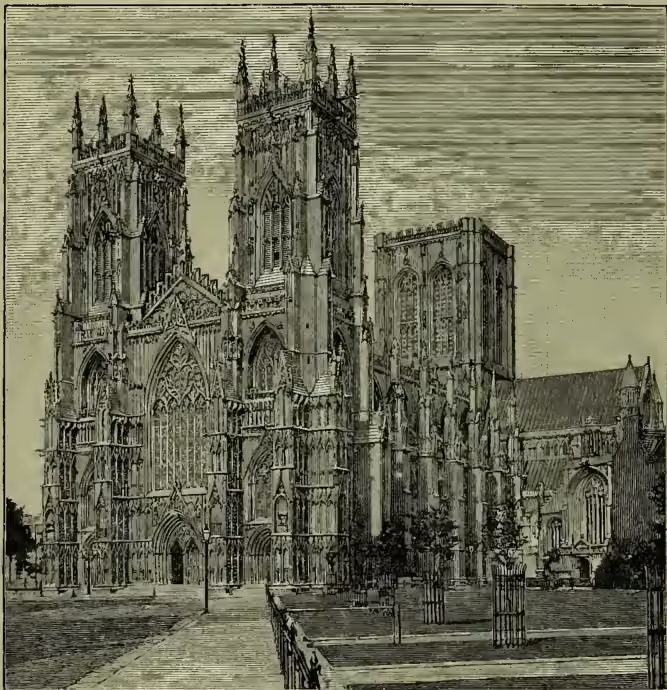
York, THE DUKEDOM OF, has been frequently conferred by the king of England on his second son. Edward III. bestowed it on his fourth son Edmund, who founded that House of York which formed the one side during the Wars of the Roses (see ROSES, WARWICK, and Sir J. Ramsay's Lancaster and York, 1892), and which in the persons of Edward IV., Edward V., and Richard III. occupied the throne of England. Henry VIII. and Charles I. were dukes of York while their elder brothers were alive; James II. till his accession. The Old Pretender conferred the dignity on his son, afterwards Cardinal York (see STEWART, p. 726). George I. honoured with this title his brother Ernest Augustus, prince-bishop of the secularised see of Osnabrück (d. 1728); and in 1760 the rank fell to Edward Augustus (1739-67), George III.'s brother. George III. gave it to his second son, Frederick Augustus, prince-bishop of Osnabrück (1763-1827), who showed his military incapacity in command of an expedition to the Netherlands against the French in 1793, and again in 1799, having in 1795 been made commander-in-chief of the British army. He had to resign that post because of the shameful traffic in military appointments carried on by his mistress, Mrs Clarke, but was reinstated (1811). The title was next in abeyance till May 1892, when the dukedom was conferred on Prince George Frederick Ernest Albert, second son of the Prince of Wales, who by the death of his elder brother the Duke of Clarence and Avondale in January of the same year had become heir to the crown of England. Born at Marlborough House on 3d June 1865, Prince George was trained as a naval officer; and his brother's and his own diaries of their cruise on length of the Minster is 524 feet, of the transepts 250, and the breadth of the nave is 140 feet, the height of the central tower is 216, and of the western ones 201 feet.
The Benedictine Abbey of St Mary possessed great wealth and importance. It was founded in the reign of Rufus, but was largely rebuilt towards the end of the 13th century. In 1132 a small body of the monks, wishing to adopt the stricter Cistercian rule, seceded in spite of violent opposition, and finally founded the great Abbey of Fountains (q.v.). The existing ruins are principally those of the beautiful abbey church, while the old Guest-house has now been appropriated as a storehouse for Roman and other antiquities. At the Reformation York contained forty-one parish churches, of which twenty-two now remain, several new ones having been added. There is a fine Roman Catholic pro-cathedral (1864). The present walls, 2½ miles in circuit, are mainly of the time of Edward III., though in many parts they follow the line of the Roman earthwork. They are pierced by picturesque gates, locally called Bars, of which Bootham Bar and Micklegate Bar are especially well preserved. The castle, with its picturesque Clifford's Tower, is situated close to the river, and is believed to date from the time of Edward I., though older portions may be included in the structure, which suffered severely during the siege of 1644. The Assize Courts are now held in a portion of the
H.M.S. Bacchante (1879-82) were published in 1885. He was appointed to the command of the Thrush in 1890, and in 1891 became a commander.