Yucca, a genus of plants of the natural order Liliaceæ, natives of the United States, Mexico, and Central America, some of which are often cultivated in gardens on account of the singularity and splendor of their appearance. Y. gloriosa is a native of Virginia and the countries to the south of it, but is quite hardy in England, so as to sometimes flower luxuriantly in the open air. It has a stem about 2 or 3 feet high, the upper part of which produces a great tuft or crown of large sword-shaped evergreen leaves, each terminating in a sharp black spine. From the centre of this crown of leaves arises the flower-stalk, of 3 feet or upwards in height, branching out on every side so as to form a great panicle. The flowers are white with a purple stripe. The other species, of which there are some twenty, have a general resemblance to this in habit and appearance. Some of them reach a height of 50 feet, with a stem 5 feet thick. The Y. filifera or Y. vaccata is called Spanish Bayonet or Mexican Banana, and yields an edible fruit. The fibre of the Yuccas is similar to that of the Agaves and Bromelias, and is used for coarse cloth and cordage.
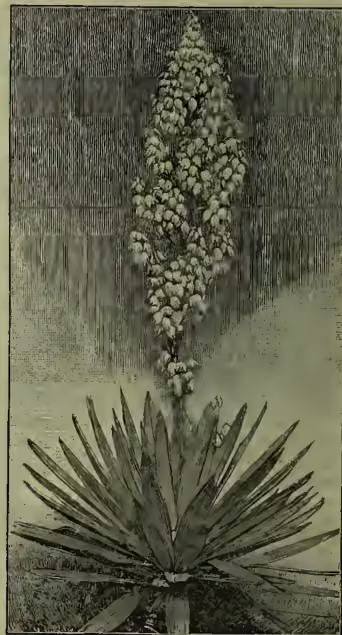
(From a Photograph taken in the open air near Edinburgh in 1890.)