Zincite, or Red Oxide of Zinc, is a mineral usually found massive with either a lamellar or a granular texture.
Its crystals are hexagonal, but they are rarely found, and its colour is either red or orange. It contains about 94 per cent. of oxide of zinc and 6 of protoxide of manganese. It is found associated with Frankinite in New Jersey.
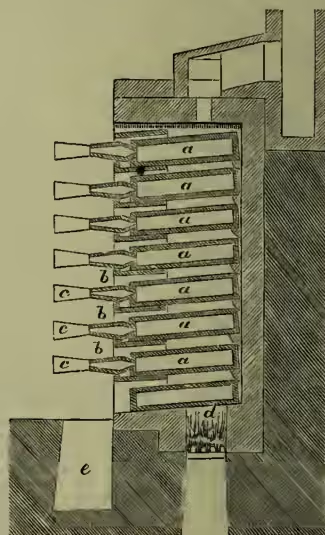
SMELTING.—The temperature at which roasted zinc ore (either carbonate or blende) is reduced is nearly the same as that which volatilises the metal, so that it requires to be smelted in closed retorts or muffles. There were formerly three kinds of closed-vessel furnaces in use for reducing the ore—the English, the Belgian, and the Silesian, but the first of these is little if at all employed. The furnace employed in the Belgian Process is an arched chamber, or recess, open in front. It is built of brick, and is shown in cross section in fig. 1. The retorts a, a, a, which fill the chamber, and into which the charge of ore and coal is put, are made of fireclay, each being about 3 feet 3 inches long and from 5 to 6 inches in internal diameter. In an ordinary sized furnace, four of which are built in one stack or group, the chamber contains forty-six retorts arranged in eight parallel rows, but some have about double this number. These are supported at back and front in such a way as to allow the heat from the fire to play freely round them. Each retort has in front a bellied fireclay nozzle or adapter (b), on which fits a sheet-iron cone or receiver (c) having a small opening at the end. The fireplace (d) stretches across the width of the furnace under the lowest row of retorts, and the spaces between the retorts at the front are filled up with fireclay.
Each retort is charged with 13 lb. of roasted blendé and an equal weight of non-caking coal, both powdered and intimately mixed. When the temperature of the furnace becomes high enough the blue flame of carbonic oxide appears at the end of the clay adapter, but by-and-by when zinc vapour begins to escape the flame becomes opaque and white in colour. As soon as this is noticed the sheet-iron cone is put on, in which zinc oxide collects. In a couple of hours, or it may be considerably longer, the bellied portion of the adapter, in which the zinc vapour condenses, contains a sufficient quantity of zinc to be removed. The oxide of zinc and zinc dust which accumulate in the iron receiver are also removed, and either added to the next charge or turned to some other use. The operation of emptying the adapter and receiver is repeated at intervals till in about twelve hours the distillation is complete—i.e. till all the ore supplied at one time to the retorts of a single furnace is reduced. The zinc collected from the adapters is cast into oblong plates weighing fully cwt., and known commercially as spelter. It is necessary before again charging the retorts to take off the adapters and scrape out the residue as well as any adhering slaggy matter, for the reception of which the pit e is provided.
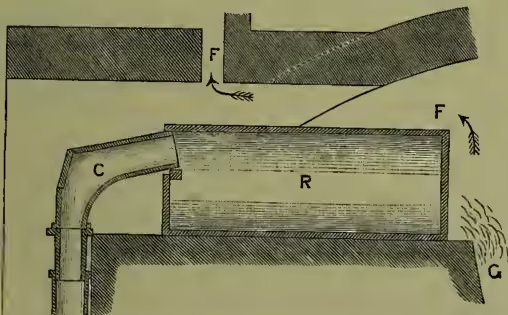
In the Silesian Process larger fireclay retorts (muffles) are used than in the Belgian. They are differently arranged in the furnace, and are shaped like an oblong chest with a semicircular top (fig. 2). Each retort is internally 3 or 4 feet long, about 18 inches high, and 8 inches wide. An elbow-shaped nozzle is attached at the top of one end, and from this a pipe descends into a suitable receptacle. As the distillation goes on the zinc vapour passes over, and, when it condenses, falls into this receptacle in the form of drops of metallic zinc. Sometimes a nozzle like that for the Belgian retorts is used. The retorts, from ten to twenty or more in number, are all on one level in a low arched chamber of a rectangular shape. They are placed on two opposite sides with a fireplace between them. In preparing the charge for these retorts the amount of powdered coal or other fuel mixed with the ore varies from 25 to 50 per cent. It is greater for such zinc minerals as are difficult to reduce, or are easily fusible, than for other ores. A charge is worked off in twenty-four hours, the distillation commencing in six hours or rather more. In Silesia the calamine smelted does not contain on an average more than 15 per cent. of metallic zinc; 40 per cent. is the yield of a rich calamine carefully dressed.
The Belgian furnace takes up less room and consumes about one-fourth less fuel than the Silesian.
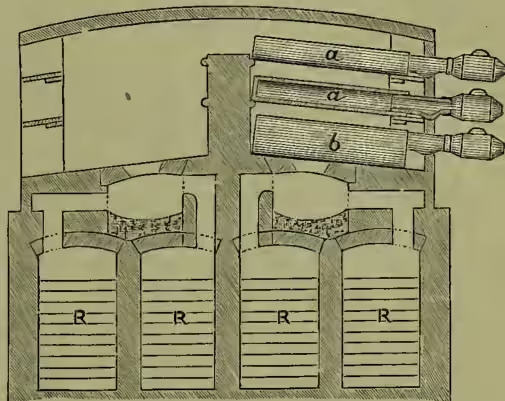
On the other hand, there is greater expense for retorts in the former owing to their being more fully exposed to the heat of the fire. Fig. 3 shows a Siemens' furnace adapted to smelting zinc with both Belgian and Silesian retorts. In smelting zinc there is a loss of from 15 to 24 per cent. of the metal in the ore with English blendé, and the amount of this loss is also considerable in the case of foreign ores. Zinc is obtained in an almost pure state by redistillation in clay retorts, if the first portion which comes over is rejected. But if required quite pure the oxide purified as above described under zinc carbonatæ must be reduced by pure carbon, such as charcoal from sugar.
Until it became known early in the 19th century that raising zinc to the temperature of 300° F. or somewhat less rendered it fit to be worked by machine tools the metal was used for little else than to make Brass (q.v.). It is still very largely employed to, produce this and other alloys, but zinc itself is now extensively manufactured into many different kinds of objects. Among these may be mentioned sheets and other forms for roofing purposes, baths, plates for engraving upon, light screens with open patterns, and numerous kinds of stamped ornaments and articles of utility. In Paris and elsewhere it is largely used for the cheaper kinds of 'bronzé' statuettes and like decorative objects, as it can be easily darkened to imitate bronze (see BRONZING). One of the most important applications of zinc is in galvanising iron to protect it from rusting, especially in such cases as roofing sheets, water vessels, and telegraph wires. Zinc has not a good reputation as a structural material other than for covering purposes.
The average annual produce of the zinc-mines of the United Kingdom during the five years ending 1899 was about 20,000 tons of ore (value £76,000), yielding nearly 7500 tons of metallic zinc, the value of which varied from £15 to £21 per ton. The half of this total was obtained from Welsh mines, the blende of Cornwall being apparently for the present exhausted. The average yearly imports of zinc and its manufactures for the same period had a value of £1,756,000.
In the United States, where the production of zinc has of late been rapidly increasing, the yield in 1889 was 58,860 (value £1,158,365) and in 1898 115,399 short tons (value £2,077,180); and this was mostly smelted in the states of Illinois, Kansas, and Missouri. Taking the yield of all countries into account, the total amount of zinc produced has for some years been gradually decreasing.