Bed, an article of furniture on which to sleep. In ancient Palestine, the bed seems to have been a simple kind of couch for reclining on during the day, and sleeping on at night, and readily removable from place to place, as is referred to in different parts of Scripture. About the heat of the day, Ishbosheth lay on his bed at noon (2 Sam. iv. 5). In receiving visitors, the king bowed himself upon the bed (1 Kings, i. 47). Jesus saith, 'Take up thy bed, and go unto thine house' (Matt. ix. 6). Yet, in these early times, beds or couches must, in some instances, have been highly ornamented: thus, 'I have decked my bed with coverings of tapestry, with carved works, with fine linen of Egypt' (Prov. vii. 16). In Persia, even at the present day, every person sleeps on a rug or piece of carpet laid on the floor, or commonly, during the summer, laid on the flat roof of a house. The pillows are similar to those used in Europe, but rather larger. It is the custom in India, on the other hand, to sleep on a bed or couch raised on four feet, called a charpoy. In hot climates few bed-clothes are used—there being in general only a single sheet employed; care is taken, however, to use mosquito-curtains, without which rest would be impracticable. See MOSQUITO.
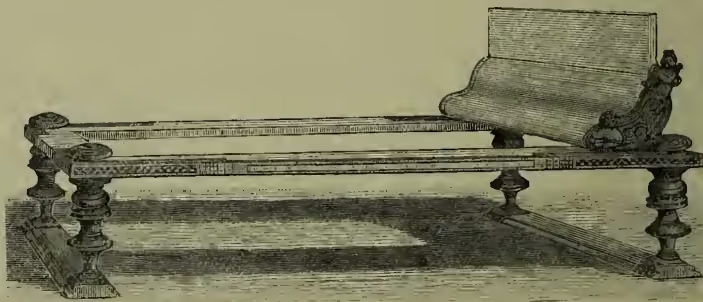
Greek and Roman Beds.—Representations of ancient Greek beds and sofas are found on painted vases and on some pieces of sculpture. These beds plainly differed but little from the simpler modern forms, while the sofas or couches were in shape, in some cases at least, exactly like those now used. We are enabled to form a more perfect idea of ancient Roman beds than can be got from pictures and bas-reliefs. In the wonderful collection of Pompeian bronzes forming part of the great museum at Naples, there are three of these beds. They are partly of bronze and partly of wood, but the wooden portions, which were originally of walnut, have been restored. Fig. 1 shows one of these. It will be seen that it is of the couch form, and very elegant. Its length is 7 feet 6 in., its breadth 4 feet, and its height 1 foot 5 in. Curiously enough, an ancient trundle or truckle-bed was also found at Pompeii so recently as 1868; it is shown in the museum under one of the three larger bedsteads. The Etruscan Museum in the Vatican at Rome contains an ancient bronze bed on six feet, with a bottom formed of strips of metal exactly like those put on brass and iron beds at the present time, only they are placed diagonally in the old example. In short, the bedsteads we now prefer are more closely like those made in Italy nearly 2000 years ago than any which have been in use during the long interval.
In Homer's time the bedding even of the richer classes consisted of a long fibred woollen blanket or mattress, and that of the poor of a simple hide spread on the hard floor. Linen sheets were used as covers. Later on, when Greece had introduced more luxurious habits from Asia, mattresses stuffed with wool or feathers became common, and of the same materials pillows were made. The Romans also stuffed their bedding with wool as well as with the soft down of geese, swans, and other birds. Their blankets and sheets were sometimes elaborately ornamented with patterns in colours either woven or embroidered.
Medieval and later Beds.—In Anglo-Saxon times, ordinary beds appear to have been plain wooden benches fixed in recesses, and having sometimes at least curtains in front—a kind of bed not yet entirely obsolete in Scotland. The bedding consisted, no doubt, of a large sack filled with straw, together with a sheet or sheets and coverlet. Mr T. Wright, in his Homes of Other Days, gives an illustration of a Saxon double bed of this nature with curtains. He also gives two woodcuts, after drawings in the Harleian manuscript, No. 603, of two Saxon bedsteads, box-shaped, with short corner pillars terminating in balls, and with the head end like that of a couch, but rather higher. The sides of one have thin balusters, but in the other they are plain. It is believed that these bedsteads were only used by persons of rank. The same author gives two figures of Norman beds. One of these so far resembles the isolated Saxon bedsteads, but it has a high panelled foot-board, and the sleeper lies on a slope with an oval disc at his head. The second illustration shows that the tent-bed with a top frame and side curtains was now in use. Louandre's Les Arts Somptuaires contains pictures of five beds, taken from a French illuminated manuscript of the 12th century. In these the bedstead takes the oblong form, with four short posts and balls, and much resembles the Anglo-Saxon ones referred to above. Except in the deep closed sides, and that in two of them the sleeper lies in a sloping position, these scarcely differ in general appearance from many plain modern beds; but at the top end there is a large flat disc, apparently swung on pivots, to enable the head to rest at any angle.
In the 13th century, beds were furnished much as at present, with a stuffed quilt, bolster, pillows, sheets, and coverlets. Among the rich, down was used; but feather-beds did not come into general use till the 15th century. All classes appear to have begun in the 13th century to take a pride in the appearance of the bed, while those who had sufficient means furnished it with handsome curtains and coverings. In the 14th century, Chaucer (Derme, v. 250) describes a luxurious feather-bed with rich coverings. Illustrations of beds in the following century show that the canopy, curtains, and other parts had together the general appearance of a modern half-tester or canopied bed; but the tester or back and the eclure or roof were fixed to the wall and ceiling of the room.
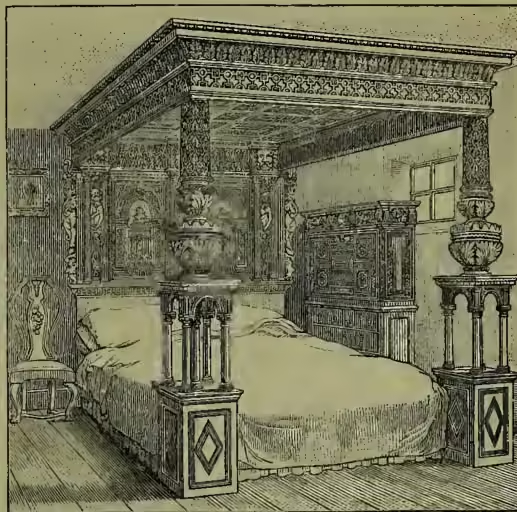
The large four-post bed was introduced in the 16th century, and continued in use till the middle of the 19th. Many of these beds, especially of the earlier time, were elaborately and beautifully carved, and furnished with rich hangings. Interesting examples of them are still preserved in old mansions and castles in England and on the Continent. The Great Bed of Ware, in Hertfordshire, now at Rye House, is of this age, and is one of the curiosities of England. It is referred to in the Twelfth Night of Shakespeare. It measures 12 feet square (see fig. 2). A kind of camp-bed was also in use in the 16th century, which was carried about on journeys, and was frequently used in residences in place of a stationary bed. Some of these beds were luxuriously decorated. Francis I. made a present to Henry VIII. of England of a rich camp-bed of crimson velvet, embroidered with bands of leaves in gold, and with fruit of large and small pearls, which had cost him 13,500 livres.
Modern Beds.—The heavy four-post bed, which was so long characteristic of a well-furnished English bedroom, is becoming a thing of the past. The comparatively recent and scarcely less massive half-tester bed, which suited so well for the display of the more handsome furniture-woods, has also gone out of fashion. Even the much lighter four-post tent-bed, or its later form without the curtained roof, called the French bed, that was so recently to be seen in nearly every well-to-do working-man's house in Great Britain, is fast disappearing.
For the past fifty years, bedsteads of iron and brass have been slowly gaining ground, and they are now all but universal in newly-furnished houses. Birmingham, the great British centre of light metal goods, furnishes us with some curious statistics concerning this branch of the trade. For that town and its neighbourhood, some 400 metallic bedsteads represented the weekly production in 1849. This number had increased to 5000 per week in 1865, while in 1885 the weekly output was but little short of 20,000. London, Manchester, Glasgow, and Bristol have also extensive manufactories of these bedsteads, which are exported in large numbers to most British colonies, as well as to South America, Egypt, China, and Japan. Some are shipped to the United States, but they are now being made there in considerable quantities. Nearly all the continental nations of Europe manufacture these metallic bedsteads extensively for their own use. Beds in Germany are almost always made of a width suitable for one person only. This is largely the case in most countries of continental Europe.
An iron bedstead is very simply constructed. The strong iron bars forming the sides have simple dovetail joints at the corner pillars, which, as well as the rails for the top and bottom ends of the bed, are made of iron or brass tubing, or of both. The exposed portions used to be decorated with painted flowers and gilding, but more usually now the ornament consists of polished surfaces, more or less relieved with brass, nickel, or silver-plated joints and mountings. The price of these varies from six shillings for a plain stump bedstead, to £50 or even £100 for a canopied bedstead with much silver-plating. An excellent bedstead of this kind can, however, be had for £8.
Alarum Bedsteads.—At the Great Exhibition of 1851 two 'Alarm Bedsteads' were exhibited. One of these was shown in operation, and caused much amusement, since it was so contrived that by the removal of a pin the foot end fell to the ground and threw the occupant on the floor. Such a bedstead has attached to it a clock with an alarum dial-plate which can be set to any hour. When the proper time comes round, the clockwork, acting upon levers and wires, causes the legs of the bedstead to be drawn from under it by means of a weight attached to the clock. It was expected that these bedsteads would be used by hotel-keepers and others for wakening servants in proper time, but very few appear to have been made.
Mattresses.—Hair and straw mattresses are too common to require any description. Covered spring mattresses filled with wire springs, held in position by chair-web, are now a good deal used. Some years ago a woven wire-spring mattress was invented in America, and of it large numbers have been made. In this, thin wire is twisted into small coils, which are interlocked by a process known as double weaving. About 8000 feet of wire are required to make one of these of ordinary size. It is considered soft and comfortable, and has been found serviceable in cases of protracted sickness (see also AIR-BEDS and WATER-BEDS). Stronger spring mattresses, which are really spring and chain mattresses, one kind of which is called 'the Excelsior,' are also coming much into use. These spring mattresses are usually covered with another thin mattress stuffed with hair or wool, feather-beds being now rarely used.
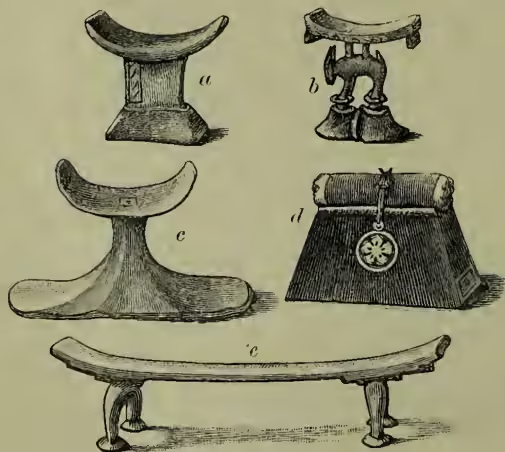
Mats and Pillows in Warm Countries.—In most parts of Africa, and the tropical and subtropical islands of the Pacific Ocean, it is a common custom to sleep on mats of some vegetable fibre, but sometimes skins are used for this purpose. Many South American Indians sleep on hammocks suspended from the roofs of tents or from trees. At least one form of the ancient Egyptian bedstead appears to have been like the one still common in that country, namely, a low frame formed of wicker-work of palm-sticks. Much more curious, however, is the pillow used in Egypt in ancient times, since it forms the type of many used at the present time in far-distant countries. These Egyptian pillows or head-rests were generally made of wood, but sometimes of alabaster or earthenware. Fig. 3, c, represents one of wood, from the Tombs of Thebes. The same kind of wooden pillow or support for the head is still found in Abyssinia, the delta of the Zambezi, and in that direction as far south as Swaziland. It is also used in the country around Lake Tanganyika, in Ashanti, and in other parts of Africa. Much the same form of head-rest is made in the Fiji Islands, in Tahiti, and in New Guinea; while in China and Japan we find a somewhat similar pillow of wood, lacquered it may be, with a small cylindrical cushion on the top. The preceding figures show several of these pillows.
In geology, bed is synonymous, or nearly so, with STRATUM (q.v.); and see GEOLOGY, also the articles BALA BEDS, BEMBRIDGE BEDS, MAESTRICH BEDS, PURBECK, EOCENE, &c.
Bed-sores are the subject of a separate article (see p. 16); and Bed of Justice is dealt with also on page 16 below.