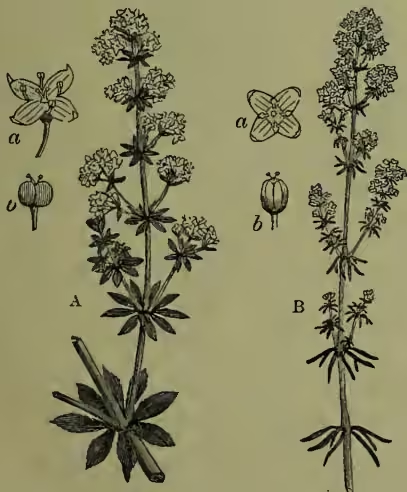
B, Yellow Bedstraw (Galium verum).
a, flower; b, fruit.
Bedstraw (Galium), a genus of Rubiaceæ (q.v.). The species are very numerous, natives chiefly of the colder parts of the northern hemisphere, or of mountainous regions within or near the tropics. About eleven species are found in Britain, some of them very common weeds. Amongst these is the Ladies' Bedstraw, or Yellow Bedstraw (G. verum)—sometimes called Cheese
Rennet, because it has the property of curdling milk, and has been long used for that purpose (whence the generic name from Gr. gala, 'milk')—a small plant with linear deflexed leaves and dense panicles of bright yellow flowers, very abundant on dry banks. The flowering tops, boiled in alum, furnish the Icelanders with a bright yellow dye; while the Highlanders used to employ the root-stock for dyeing yarn red. Their colour being essentially that of the allied madder, the cultivation of the plant was attempted many years ago. Certain North American species, especially G. tinctorium and G. septentrionale, have been used in the same way. Like madder, they possess the property of imparting a red colour to the bones and milk of animals which feed upon them. Medicinal virtues were ascribed to some of the species, as G. rigidum and G. molugo. The roasted seeds of some, as G. aparine, the troublesome Goosegrass, or Cleavers, of our hedges—remarkable for the hooked prickles of its stem, leaves, and fruit—have been recommended as a substitute for coffee; but it does not appear that they contain any principle analogous to caffeine. Its expressed juice is in some countries a popular remedy for cutaneous disorders, and is used as a safe and efficient diuretic. The roots of G. tuberosum are farinaceous, and it is cultivated in China for food. The name bedstraw is due to the old legendary name of one of the species, 'Our Lady's Bedstraw,' analogous to 'Our Lady's Garters, Mantle, Slippers,' &c.