Bee. Bees form a family of insects belonging to the order Hymenoptera, and to the same sub-order as the wasps and ants. Like other Hymenoptera, they possess four membranous naked wings with well-developed nervures, and mouth organs, in part at least, adapted for biting. The head is freely attached to the middle part of the body—the thorax, and the first ring of the latter (the prothorax) is much reduced. The life-history exhibits a complete metamorphosis. In the special sub-order to which bees belong (Aculeata), the imperfect females (workers) have a poisonous sting at the posterior end of the body, and their feelers or antennæ have twelve joints, one fewer than in the males. The posterior part of the body—the abdomen—is distinctly stalked; the legs and mouth-parts are modified in relation to their diet of nectar and pollen. The larvæ are footless grubs, and are usually hatched in special cells. A high degree of social life and intelligence is very frequent.
History.—Bees must have been among the first insects to engage human attention. Their comparatively large size, abundant occurrence, social life, and honey-storing habits appear to have been from very early times facts of common observation. Aristotle has gathered up some of the opinions of his contemporaries in regard to bees—opinions, however, in which much fancy is mingled with some acute observations. Virgil has described the habits of bees in his fourth Georgic with all the license of a poet and the enthusiasm of a lover of nature. Pliny repeats, as he was wont, all the floating bee-gossip of his time, but without criticism or analysis. For about fourteen centuries after Pliny, bees were unmolested by the naturalist, and were, as far as we know, only thought of as the sources of occasional luxury. With the Renaissance, however, the natural history of bees became again the subject of study. Works by Edward Wotton and Conrad Gesner contain numerous trustworthy observations, and were the preface to a series of careful studies by various naturalists in the latter half of the 17th century. Conspicuous among these are the works of Swammerdam (General History of Insects, 1669); the memoirs of Maraldi (1712), who is said to have been the first to use glass-hives; and the clear observations of John Ray and his friend Willughby. On a higher plane of detailed anatomical research stands the immortal work of Réaumur (Mémoires pour servir à l'Histoire des Insectes, 1732-44), from which the systematic and thoroughly scientific study of bees may be said to date. His contemporary Bonnet also was the author of numerous important observations; while among the crowd of naturalists who have worthily continued the researches of Réaumur, the patient and ingenious Hüber is undoubtedly pre-eminent (Nouvelles Observations sur les Abeilles, 1814). The more modern experimental method of investigation is well represented by Sir J. Lubbock's researches (see Ants, Bees, and Wasps).
Form and Structure.—Before noting the more important features in the anatomy of the bee, it is necessary to recall the familiar fact that many kinds of bees are social, that is to say that they live in communities. The following observations apply to the hive-bee. As in the case of ants, various sets of members have come to discharge special functions, and the result of this division of labour has been difference of form, or polymorphism. In fact, the result of restricted function has been the establishment of castes. Thus the ordinary hive contains (1) a single queen-bee—the fertile female and mother of the next brood, (2) the males or drones, and (3) the vast majority of workers or imperfectly developed females, which only exceptionally become fertile. In describing the anatomy, the ordinary hive-bee (Apis mellifica, L.) will be principally referred to. Like that of other insects, the body of the bee is readily divisible into three portions—head, thorax, and abdomen. The head is well defined from the body, and bears the organs of sight, touch, mastication, and honey-collecting. There are two compound eyes, borne on the sides of the head. They are largest in the males, and meet on the crown. Besides these there are, on the top of the head, three eye-spots or ocelli, concerning the exact function of which there is some difference of opinion. Below the eyes are (1) two jointed feelers or antennæ, most essential organs of sensation. The basal joint is much the largest, and the stalk formed from the eleven or twelve smaller ones extends outwards at a sort of knee-like angle (geniculate). In the antennæ of the males there are thirteen joints; in those of the females, twelve. (2) Next come the horny, toothed mandibles, freely articulated to the head, and well adapted for cutting the resinous cement or propolis into shapes, for the finer work of handling the pollen, for biting through the corollas and other obstructions of flowers, and the like. The other two pairs of head appendages are greatly modified for collecting the nectar from the flowers. (3) The first pair of maxillæ are much elongated flattened blades, embracing the second pair, and forming the outer sheath of the proboscis, as the entire collecting organ is called. They form the outer wall of a sort of suction-tube. The tips of these blades, however, remain sharp, and act as efficient piercing organs. The external portions of this first pair of maxillæ, the so-called maxillary palps, degenerate, and only remain as much-reduced structures with a few joints. (4) The fused basal portion of the second pair of maxillæ, the mentum, as it is called, is in movable membranous and elastic connection with the cardines or bases of the first pair.
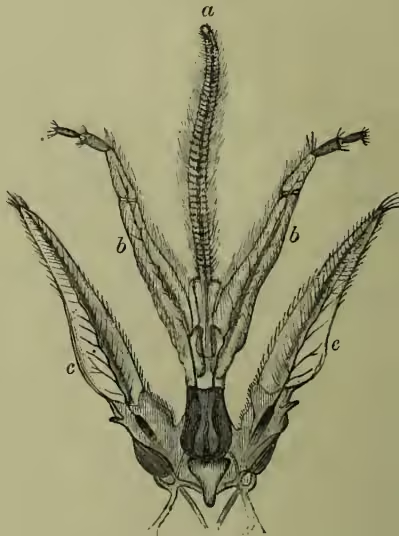
a, tongue; b, b, labial palps; c, c, first maxillæ.
This mentum bears internally the long structure known as the ligula or tongue. This is a much elongated slender hairy organ of varying fineness throughout its course. It occupies a number of very different positions according to the business of the bee at the moment, but a description of these would involve inconvenient detail. The four main positions are very lucidly depicted in Hermann Müller's Fertilisation of Flowers. When at rest, the internal portion of the tongue is somewhat curled up and retracted into the lower end of the mentum. It is capable of very rapid protrusion and of free motion in almost every direction. The external lateral portions or labial palps are comparatively small, and consist of two long and two short joints. Their tips remain as tactile organs, while their internal joints are elongated to form a sheath for the base of the tongue. Between the palps and the tongue there are also two very small structures known as paraglossæ. The whole proboscis thus consists of hairy tongue, of minute paraglossæ, of insheathing labial palps (all belonging to the second pair of maxillæ), and further, of external maxillary blades and reduced palps belonging to the first pair. The hairs which cover the tongue appear to serve for the upward passage of honey. The successive whorls have been seen to be erected from before backwards so as gradually, but rapidly, to sweep the nectar to the mouth. The expanded lobe at the tip of the tongue is thrust into the nectar, and a little appears to pass up a central capillary tube to the taste organs, by which the bee determines whether the food does or does not suit its taste. The tip may also be used to lick flat surfaces. The upward passage of the nectar among the hairs on the outside of the tongue and within the outer sheath is doubtless helped by the sucking action of the sides of the body, and of the first part of the food-canal. According to a recent investigator (Breithaupt), the honey may pass up either by the great suctorial tube of the proboscis, or when that ceases to be efficient, by the capillary tube of the tongue, but the exact action of this complex and beautiful organ is not yet thoroughly understood. The tongue of the workers is twice as long as that of the queens or the drones, who do not collect honey.
The somewhat oval thorax bears the two pairs of wings and three pairs of legs, and consists of the usual three segments, of which the most anterior (the prothorax) is greatly reduced. The wings, which are borne on the last two segments, are membranous and transparent. When at rest, they are folded together over the back; when in action, the two pairs are clasped together by means of small hooks on the fore margin of the hind pair. Perhaps it was this close union of the wings which suggested to Linnaeus the name Hymenoptera or 'wedded-wings,' though the term may simply refer to the fact that the wings are membranous. The arrangement secures a very steady and rapid flight. The many-jointed mobile legs do not differ from those of other insects, except in the high development of pollen-collecting hairs. In the workers the hind pair of legs exhibit on their central joint a spoon-shaped cavity fringed with bristles, so as to form an efficient pollen-basket. The pollen is kneaded by mouth and fore-feet, and shifted by the middle pair of legs to the safe hollow behind. The two terminal claws of the feet are used when the bees climb and hang, while the membranous lobe between the hooks probably aids in handling minute bodies and in clambering on smooth slippery surfaces.
The abdomen, or posterior portion of the body, is joined to the thorax by a comparatively narrow bridge. The margins of successive segments overlap, and the whole region is capable of free respiratory movements. Like other parts of the body, the abdomen has a dark-brown colour, with somewhat lighter cross bands. The females bear at the end of the body an ovipositor or sting, which consists of a median piece deeply grooved on its lower surface and of two adjacent sharply pointed structures, which being apposed to the median piece, make the groove into a canal. The internal end of the canal thus formed is in connection with the female generative aperture, so that the eggs can pass neatly down from the body of the bee into the cell prepared as a cradle.
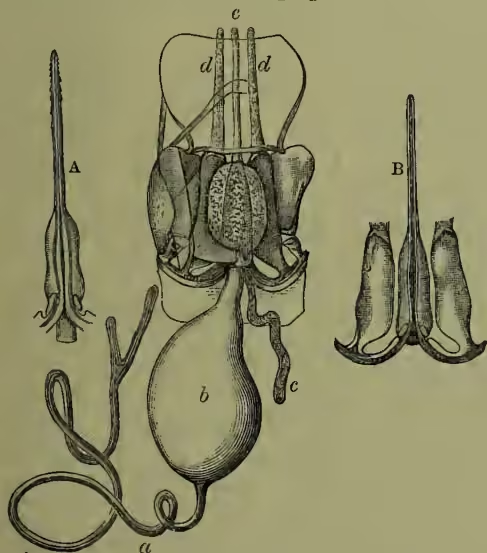
(After Kraepelin): a , poison gland; b , poison bag; c , accessory gland; d, d , outer supporting pieces; e , inner sheath inclosing sting proper. A , sting proper; B , sheath in which sting works, seen from below.
But the base is also connected with a poison-bag containing formic acid and other irritants, which are squeezed into the wound made by the sharp sting, and are the obvious causes of the familiar inflammation. In the queen-bees this specialisation of abdominal appendages forms a long, stout, curved organ, which is occasionally used as a weapon in duels with rivals, but much more frequently for its main business as an egg-laying organ; in the workers it is rarely used except as a sting; in the drones it is represented by the external male genital organs.
The Internal Anatomy—The Food-canal.—The nectar drawn up by the proboscis passes into a short pharynx, and thence into the gullet or honey-bag. This forms a long slender tube dilating into a transparent bag, filled with honey in the bees returning heavy laden to the hive. On the anterior region of the gullet, near the mouth, are several pairs of lobed salivary glands, the secretion of which is used in kneading the pollen into pellets, and in the labour of cell-building. In the honey-bag the nectar begins to undergo chemical change, and so much of it passes onwards into the digestive (chylific) stomach. At the end of the stomach are the usual excretory (Malpighian) tubes, opening into the beginning of the intestine. This dilates into a rectum before ending at the anus.
The Nervous System.—As in other insects, the nervous system consists of a ganglionic mass above the gullet—the brain, and of a ventral chain of ganglia, of which the anterior are connected with the dorsal mass by means of a nerve-ring round the gullet. The two posterior ganglia in the thorax are fused into one, and beyond this are five or six abdominal ganglia. The presence of these separate nerve-centres or ganglia in the body explains the apparent vitality of bees and other insects for some little while after the removal of the head. Reference has been already made to the compound eyes and to the ocelli. The location of the sense of smell is doubtful, though apparently in one or more of the mouth-appendages. The results of experiment as to the presence or absence of auditory organs are still for the most part negative.
The circulatory, respiratory, excretory, and reproductive systems do not differ markedly from those of other insects. The usual dorsal chambered heart is present. The main stems of the tracheæ or air-tubes, by means of which the air passes throughout the whole body, are very large and dilatable, especially in the abdominal region. The buzzing of bees is partly due to the rapid movement of the wings, and partly to the vibration of the stigmatic membranes which guard the entrance to the air-tubes. The excretory system is represented by the long fine Malpighian tubes already noted as occurring at the beginning of the intestine. The queen is the only female with fully developed reproductive organs; the workers are infertile females, though the skilful dissections of Miss Jurine demonstrated the presence of small ovaries, from which drone-eggs are very exceptionally produced. This occasional fertility has been plausibly explained by supposing that some of the 'royal bread,' which is necessary to rear the queens, falls by chance into cells for which it was not intended, and thus affords a slight additional food-stimulus sufficient to insure in an ordinary worker-grub some development of reproductive organs. The fertile worker is said not to appear unless the hive has long been queenless; it has therefore been suggested that the desire for brood may have stimulated their reproductive development. The female reproductive organs of a queen-bee consist principally of ovaries, oviducts, ovipositor, and a storing chamber for the male elements, known as the spermary or spermatheca.
Functions and Habits.—It has been already noted that the social life of bees has resulted in some division of labour. At the beginning of spring the hive contains a single queen and a much-reduced contingent of workers. Their first care is to restore the normal population. Towards this end the queen lays numerous eggs which develop into workers. After the stock has been thus replenished, eggs are laid which turn out males or drones. After they begin to appear, eggs are laid which develop into more workers, and also into a few queens. The rapid increase of population culminates in the emigration known as swarming, when the old queen leads off a large contingent of subjects. The date of swarming is markedly affected by the temperature and the food-supply. The symptoms of emigration are such as these—a clustering of bees in small dense crowds outside the hive, a commotion among the drones, a suspension of the labours of the workers, the excitement of the queen-mother, and, in the case of second or third swarms, the piping of the still imprisoned young queens. She is exasperated by the presence of possible rivals in her own household, and would ruthlessly kill her royal children, were they not guarded by the workers. In the case of swarms centred around an old queen, it seems customary to send out scouts to explore the land before the bees take any decisive steps towards emigration. When at length the pressure and excitement has reached a climax, the emigrants rush out with great rapidity. They form a spreading crowd, concentrating, however, round the egg-laden queen, who is rarely able to fly far. During swarming, the bees are singularly quiet, and may be safely handled. Should the queen be lost or removed, the bees soon return much depressed to their old home. The workers seem to take with them a heavy load of honey, and they at once set about building a comb, in the first cells of which the queen, losing no time, lays some eggs. The disruption of swarming obviously robs the old hive of its queen, but there are princesses ready to be liberated, and these may soon lead off fresh swarms.
A populous stock will often send off three in rapid succession. When the season and necessity for swarming is past, the young queens that remain imprisoned in the royal cells are liberated at once and allowed to fight for the sovereignty. The survivor takes her nuptial flight. By one, or perhaps several, of the males she is impregnated, though some authorities believe that the fertilisation is effected by drones from another hive. After impregnation has been accomplished, the young queen settles down to begin her egg-laying; she continues this throughout the rest of the summer. When swarming time is over, and the supply of honey decreases, the bees commence to rid the hives of the drones, henceforth mere useless consumers. They appear to drive them into a corner, and keep them without food until their powers of resistance are much weakened. They are then turned out of doors to perish, for the workers seem rarely to use their stings. Even the infant pupæ and the eggs are destroyed. The fact of this massacre suggests the difficult problem of the meaning of so many males. Their number, of course, insures the fertilisation of the queen. Romanes suggests that the numerous drones represent a survival of past times when the society was less complex, and when the females were probably more numerous, and the males less idle. If there is any chance of drones being needed, when for instance the queen is barren, and fresh ones have to be reared and fertilised, they are allowed to live beyond their usual term. On the other hand, when unfavourable weather prevents swarming, the workers in their despair sometimes massacre the drones.
The queen-bees are reared from special eggs, which begin to be laid after the drones appear on the scene. According to some, the queen herself deposits in the special royal cells the eggs which develop into future queens; according to others, the workers shift the eggs into these specially large cradles. They develop very rapidly in consequence of rich nutrition, attaining their maturity in about sixteen days. The queen is always treated with much respect and care, unless she turn old or become barren. An intruding stranger-queen is not always treated with respect, but may be pulled about by the workers for hours until she dies, and is thrown out of the hive. A queenless hive, without any prospect of a new sovereign, becomes completely demoralised and restless, but in this case a stranger is gladly adopted.
Just as the drones and queens maintain the numbers of the hive so far as reproduction is concerned, so the supplies of food are collected by the myriads of workers. Among these there is some slight division of labour. Members of the community varying in age and constitution, are told off to special tasks. Thus we can distinguish the external workers who collect nectar and pollen from those who attend to more internal domestic duties. Some of the internal workers, usually the young bees, act as nurses, effecting the mastication and semi-digestion of the food for the young larvæ, and caring for all the needs of the brood; while some wait upon the queen. Others again devote their energies, for a time at least, to the architecture of the cells, for which some of the heavy eaters secrete the wax. Others attend to the ventilation of the hive, which is apt to become hot enough not only to be disagreeable, but to soften the wax. These ventilators fan industriously with their wings, and produce air-currents through the hive strong enough to blow out a lighted match. 'When they are tired they are relieved by others.'
Feeding.—Bees feed principally on the nectar and pollen of flowers. In spring they frequent the early-flowering willow, hazel, plane, apple, pear, alder, gooseberry, currant, &c. Later on they turn to the crowfoot, clover, vetch, turnip, cabbage, dandelion, buckwheat, balsam, privet, elder, bramble, and other flowers, which yield abundant nectar and are accessible to their probosces. The borage, the mignonette, the thyme, the heathers, the teasel, are also valuable sources of food. Plants like the furze, which keep flowering for a long time, are obviously of great value to bees and bee-keepers. Some flowers abounding in nectar are avoided because of their strong smell, others like the red clover and the honeysuckle are inaccessible to bees with a proboscis not larger than that of the common hive-bee. Attempts have been made in Britain to rear varieties which would be able to utilise the abundant red clover, inaccessible to the common bee.
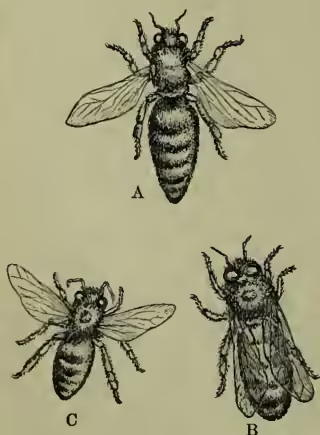
A, queen; B, drone; C, worker.
When the bee proceeds to rob a flower of its nectar, the tongue, folded up when at rest, is protruded beyond its ensheathing parts, and is pushed as a probe into the flower-tube. By the action of the hairs on the outside of the tongue, or by the powers of resistance are much weakened. They are then turned out of doors to perish, for the workers seem rarely to use their stings. Even the infant pupæ and the eggs are destroyed. The fact of this massacre general action of the suctorial proboscis, helped by muscular contractions of the body, or by an ascent up the fine capillary tube of the tongue, the nectar is conveyed to the mouth. Thence it passes down the gullet into the honey-bag, and is partly used for the sustenance of the worker itself, being digested in the stomach, and passing thence to the body generally. A large surplus, however, remains as a contribution to the honey-store of the hive, which is stored up for consumption during the flowerless season. Where there is no real winter, as in warmer countries (Australia and California), imported European bees tend to lose their storing instinct, and to become idle.
Besides the nectar, the pollen of flowers is essential to the normal life of bees; it is the ambrosia of the hive, and is largely used as food for the young. As the nectar is non-nitrogenous, the necessity for some other kind of food is obvious. Drones and queens, however, never eat raw pollen, and must therefore get their nitrogen indirectly. The special food supplied to the young is formed from pollen partly digested along with honey. The pollen is collected by the hairs of the body, from which it is cleaned off by the feet and jaws, damped with dew or other moisture, mixed with a little honey ejected from the mouth, kneaded into pellets, taken up by the brushes on the hind-legs, and deposited in the baskets in which it is carried home. The cargo thus brought to the hive may be immediately seized by the nursing bees, or may be stored up for future use. In the first case it is worked up by the nurses into a suitable state and given to the larvæ. In the other case the worker frees itself from its burden, pulling it off with its fore- legs over a cell in the comb, and starts off again for more, while another bee packs the pollen into the cell, with the addition of a little honey, and covers it over with a varnish. The industrious collectors restrict themselves on each journey to a particular kind of pollen. Bees may also consume the juices of plants, and do not hesitate to suck the bodies of the deceased or murdered grubs. In periods of scarcity, large quantities of the juices ('honey-dew') of aphides, and other small insects, may be stored.
It is difficult to understand on the principles of a selfish philosophy the extraordinary industry of the workers in their food-collecting. It cannot be called greed, since it is more for the good of the society than for their own. It is also well known that the rage for plunder often prompts bees to engage in warfare. Many individual bees try robbery on their own account, attempting to sneak into neighbour hives. In other cases four or five act in concert as highway robbers, waylaying some honey-laden victim, and outrageously despoiling it. It is even said that simple intimidation sometimes results in a submissive handing over of spoil. But in other cases a whole army of bees attacks a hive probably supposed to be at once rich and weak.
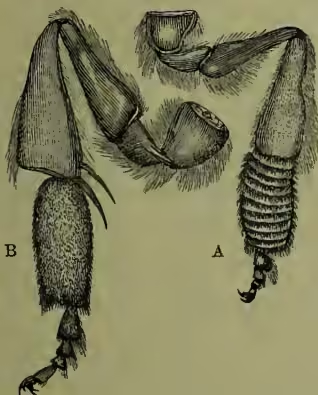
Hind-leg of Honey-bee, A; Humble-bee (Bombus lapidarius), B.
Their first care is to demoralise their enemies by killing the queen. This done, the rest is generally easy, and the panic-struck owners may even help the invaders to carry home their own honey.
Bees also collect a resinous, strongly adhesive, reddish-brown substance, known as propolis. This is obtained chiefly from the resinous exudations of such trees as fir, poplar, alder, birch, willow, horse-chestnut, &c., and is much used by the bees as a cement. With it they varnish the combs, stop up holes, and strengthen the outworks of their city. It may also be used for stranger and more occasional purposes, such as sealing up an intruding snail. The bees carry it home on their legs; other workers clean it off, and utilise it while still ductile, mixing it with various proportions of wax according to the use to which it is put. Bees also appreciate the honey-dew which appears on the leaves of many trees and herbs, usually in association with aphides.
Secretion.—The wax used in the construction of the comb is manufactured by the bees themselves. It has been shown that they are able to form it even when fed exclusively on honey. After a heavy meal, they often hang together in a small festoon, and secrete large quantities in this state of repose. The secretion is exuded from eight wax-pockets situated on the ventral surface of the abdomen. The wax projects in small flakes between the rings, is removed by the legs, shifted forward to the mouth, masticated by the jaws, and laid in heaps for the use of the comb-builders. In a young hive these wax scales may be found in thousands upon the floor.
Another secretion of a very different nature is the poison. This consists of a transparent fluid with much formic acid and other irritant components, and is secreted by workers and queens in a venom-bag situated near the end of the alimentary canal. There the waste products of honey literally form poison, which flows down between the two barbed piercing organs forming the main part of the sting. The scabbard or sheath of the sting has been already referred to as the ovipositor. The barbed form of the sting makes it very difficult for the bee to withdraw it after striking its foe, and thus death is generally the nemesis of passion, though, as we have seen, this is avoided in the massacre of the drones. The queens have longer and stouter stings than the workers, but are very slow to use them. They rarely have occasion to do so in fact, except in their duels with other rival queens. The best precaution against being stung is quietness. Of the numerous curative applications, ammonia solution (hartshorn) is one of the most serviceable. See POISONS.
In regard to secretion, it is only necessary to notice further that the bee-larvæ, like so many other young insects, secrete a certain amount of silk to form chrysalis-robos.
Hive-life.—During winter and early spring the bees remain at home, but the temperature of the hive (usually 45° F. at least) shows that they are not asleep. In March or April the work of the year begins—the hive is cleaned, the dead bodies are removed, and the queen begins to lay. How the first eggs produce drones, which issue forth in twenty-four days; and how in midsummer some eggs develop into young queens; how the birth of workers increases the population of the community, much reduced during the winter; and how in a short time a swarming occurs, are familiar facts which have been already noticed.
Cell-building.—The bee 'combs' consist of a series of waxen cells constructed by the workers for storing honey and as cradles for the young. They hang perpendicularly within the hive, firmly fixed to the walls. Each consists of a double row of cells disposed at right angles to the comb. Each cell of this two-sided comb is a hexagonal prism, with its internal apex lying in the depression between three adjacent cells on the opposite side. Of the three figures—the equal-sided triangle, the square, and the hexagon—which can be packed together without interstices, the hexagon is strongest and most convenient. To have the bottoms of the cells formed from three planes of adjacent cells on the opposite side economises labour and material. The amount of possible saving varies with the angle at which the three planes meet. Maclaurin showed by calculation that the angle of the bee-cell was mathematically the best. Though perfect regularity is disputable, there still remains a marvellous accuracy to be explained. On the one hand, some supposed, and one may almost say suppose, that the bees really know what they are about, and that they have by experiment solved the problem. On the other hand, others have tried to give either a mechanical or an historical explanation of the beautiful result. Thus Buffon sought to explain the hexagonal form as the result of the mutual pressure of crowded cylinders. He called attention to analogous results when soap-bubbles are crowded together, or when peas crammed into a bottle expand with boiling. While some, like Brougham, who have repeated this last experiment, denied that regular hexagons resulted, others have corroborated Buffon, and asserted that some of the figures formed are those of the bee-cells. Buffon's mechanical theory was, however, discredited, and indeed laughed at, by most authorities on bees, and the assumption which flattered the intelligence of these insects held ground till Darwin attacked the problem.
Darwin discussed the facts in the main from an historical point of view. He pointed out that at one end of a series the humble-bees either use their old cocoons for honey storehouses, or improve them slightly by the addition of short tubes, or build separate irregular rounded cells. At the other end of the series the hive-bees build their beautiful framework. But between these there are gradations, especially that exhibited by the Mexican Melipona domestica. This bee makes a comb of cylindrical cells for its young, and larger spherical cells for honey. These are placed so close that if the spheres were completed they would intersect. This is not, however, permitted, for the bees build flat plates between the cells which tend to intersect. Thus each cell presents an outer spherical portion and two or three or more flat surfaces. As one cell often rests against three others, a pyramid is formed by the union of three flat surfaces. Now if the Melipona made its spheres at a given distance from one another and of equal size, the result would be the hive-comb type. Darwin then resorted to experiment. He placed plates of wax in the hive, and on these the bees proceeded to excavate circular pits at equal distances, so that as they were completed the surfaces intersected. When this occurred, the bees built up flat walls along the lines of intersection. 'The work of construction,' he says, 'seems to be a sort of balance struck between many bees, all instinctively standing at the same relative distance from each other, all trying to sweep equal spheres, and then building up, or leaving ungnawed, the planes of intersection between these spheres.' Darwin thus called attention to the gradual evolution of the habit from less perfect expressions, and appealed, of course, to natural selection as tending to develop an instinct which was obviously economical of space, material, and labour. This account of the historical evolution of the habit does not, however, exclude the possibility of purely physical factors having much more to do with the actual solution of the problem than Darwin supposed. A recent investigator of this much-debated point, Dr Müllenhof, reverts very much to Buffon's position. After emphasising the perfect plasticity of the wax at the temperature of comb-building (– C.), he maintains that the beautiful result is not due to any artistic dexterity on the part of the bees, nor to any direct effect of their body-form, but 'to statical pressure according to the laws of equilibrium.' The cells are such as would naturally result from pressing the maximum number of cylindrical cells into the minimum of space. They really behave, he maintains, as softish cylinders would do in conditions of mutual pressure and continued plasticity. They form equilibrium figures with the smallest surface for given contact. But at any rate it is, on the one hand, certainly gratuitous to credit the bees with the mathematical insight of senior wranglers, and equally unnecessary, on the other, to ignore the neatness and precision of their manipulation.
Into some of the cells honey is placed for winter use. In going up and down over the full cells, bees have been seen to protrude their stings, and to deposit drops of poison on the honey. This has an antiseptic influence, due to the presence of formic acid, without which the honey would ferment. In other cells pollen is stored after being salivated and compressed by indoor workers. A pollen-cell is (frequently at least) sealed with honey, and over this a thin cream-like pellicle is formed, which can be pushed aside for the deposition of more honey, or walked over without causing overflow. But of equal importance are the brood-cells, the cradles of the future young bees. These vary slightly in size. Those for future workers are smaller and lower; those for the drones are broader and longer. In spring-time, after the drones have begun to appear, the royal cradles are formed for the young queens. These cells are usually made at the edges of the combs, have their mouths turned downwards, and are of a large size and more irregular form. In other cases they are merely modified worker-grub cells.
Life-history.—As in the majority of insects, the life-history is divisible into four chapters—the developing egg, the larva or grub, the pupa, and the perfect insect. (1) The eggs have a long oval shape, and a whitish colour. They are, barring an exception already noticed, all laid by the so-called queen. After normal fertilisation she becomes, in fact, little more than an egg-producing machine, turning them out sometimes at the rate of 100 per hour or 3000 per diem, and is often fed while at her work, so that the expenditure of living matter is to a certain extent recouped. If a young queen be not impregnated in the first three weeks of her life, she continues laying drone-eggs only, as above described. The discriminative process of fertilisation of the ova is highly noteworthy: in laying an egg in a worker-cell the queen's abdomen has to be contracted, and a drop of seminal fluid is thus brought into contact with the egg: in the case of the larger drone-cell there is no such abdominal contraction, and consequently no fertilisation of the ovum. The egg is fixed by its end to the base of the cell, and thus it remains for between three and four days, when the worm-like grub appears. (2) The grub grows like any other insect larva, and as it touches the sides of its cell, coils up in a crescent, and floats in the food which has been left in the cell. As it gains strength, however, it rears up to the mouth of the cell and eagerly devours the food supplied by the nursing workers. After the sixth day the worker-grubs only receive unmasticated food. The result is the stunting or atrophy of their reproductive system. With the queen-grubs it is very different. The grub is seen literally wallowing in the rich and carefully elaborated royal jelly; and this abundant and stimulating nutrition is naturally believed to be the condition of the perfect development of the reproductive system exhibited by the queen-bees. (3) In several days, varying slightly with the season, the grub passes into another stage of its life-history. It has grown greatly and accumulated some reserve material to serve it throughout a period of fasting. The cell is sealed up by the nurses, and the grub becomes a pupa. The queen is days a larva and days a pupa, the worker 6 and 11, the drone 6 and 15 days respectively. The nursing workers seal up the cell with a cap of wax, which is more convex in the drone-cells, and in all cases different from the paler, somewhat concave, cover of the honey-cells. The imprisoned grub does not at once fall into inactivity, but proceeds first to spin its chrysalis-robe. Alternately contracting and elongating its body, it at the same time allows filmy threads to exude from the orifices of spinning-glands situated on its lower lip. There are two such organs, and the resulting thread which the grub weaves round itself is therefore double. In a day and a half the worker-grub has spun a complete cocoon, and becomes a true resting pupa or bee-nymph. The male-grubs also spin complete cocoons, but those of the queen-grubs only inclose head, thorax, and the first ring of the abdomen. In this connection it is worth noticing, as an illustration of depraved teleology, that, according to Hüber, the final cause of these incomplete cocoons is that the pupæ may be more readily exposed to the sting of the jealous first-born queen, whose instinct prompts her to kill off all possible rivals.
Within the curtain of the cocoon important changes occur. The mummy-like pupa is gradually modified into the young bee. The skin, the segments, the appendages, and the internal organs undergo most marked changes, and on the twentieth or twenty-first day after egg-laying the young insect finally bursts its swaddling-clothes, and emerges as a winged perfect insect or imago. They break open their cocoons with their jaws, and are assisted by the kindly workers; they clean themselves of moisture and shreds, and proceed to eat after their long fast. In some cases, after a preliminary meal, they proceed at once to gather honey, but the first flight is usually postponed for about a week, the intervening time being spent in indoor employment. The empty cells may be repeatedly used over again as cradles, or may be filled with honey. The young queens are not allowed to escape when their metamorphoses are over. In the door of their cell a small hole is made, through which the royal prisoners are fed till the tone of their piping probably intimates their complete sexual maturity. If the queen should be lost, and there be no royal grubs, a new queen may be literally manufactured. A young worker-grub is simply fed up to the required pitch in an enlarged cell of the proper spaciousness.
The different members of a bee-community enjoy lives of very varied duration. The drones live from May till August, but were it not for the massacre, would doubtless live much longer. Contrary to the opinions of the ancients, who credited bees with an existence of as much as six or even ten years, the workers seem to have in summer an extremely short but hard-working life, which probably averages about six weeks. Those born in autumn live on till the next spring, though many perish in the hard times of winter. A queen, on the other hand, will live from three to five years.
Parasites of Bees.—Besides having cause to fear open enemies like the death's-head moth, bees are, like many other insects, subject to the attacks of parasites both on their bodies and within their nests. On the adult bee lice are common pests, while the larvæ of the ichneumon do great damage to the grubs. Honey-bees, however, are apparently exempted from the attacks of the latter, which appear to be unable to gain access to their dwellings. The adult honey-bee is greatly troubled by the Bee-louse (Braulta ceca) and by the Bee-fly (Phora incrassata). The larvæ are often devoured by a species of beetle (Trichodes). A hairworm of white appearance occurs abundantly inside the drones only—a somewhat remarkable fact, since it is not they, but the workers, which frequent the water-pools where the eggs of the worm are deposited. The wild bees are similarly infested by numerous parasites, such as the larvæ of ichneumons, the minute Anthophorabia, which may be obtained in hundreds on breaking open a few cells of the leaf-cutter and other species. From larval intruders found in the nest of the wall-bee Lampert reared no fewer than nine different parasites belonging to the Hymenoptera, Coleoptera, and Diptera. Parasitism also occurs between bee and bee. Thus, the 'cuckoo-bees,' Apathus and Nomada, live at the expense of hosts no larger than themselves, with which, however, they seem to preserve a curious sort of harmony. On the other hand, the larvæ of Stelis nasuta, found in the nest of the Wall-bee (Chalicodoma muraria), seems to devour not only the food, but the lawful tenants.
Senses.—The sight of bees is well developed; they are able to distinguish objects at some distance, and show a marked preference for certain colours, as might be almost inferred from the history of bee-fertilised flowers. Sir John Lubbock has shown by experiments with baits of honey on strips of paper of different colours that they can distinguish green, yellow, red, and blue, and prefer blue to all. Pink also appears to be a favourite colour. Like other insects, they are attracted to light. Much has been observed in regard to the power bees have of finding their way straight home. Lubbock's careful experiments have shown that the so-called 'sense of direction' is not in all cases a sufficient guide, but must be aided by definite registering of landmarks over the space traversed. This they are certainly able to do, and they can also remember their visual impressions for a considerable time. The sounds made by bees at their respiratory openings or stigmata are not restricted to a monotone, but vary considerably, as in the familiar case of the responses of the queen-bee to the piping of the princess pupæ. From the variable sounds, apparently expressive of emotion, it has been inferred that bees are also able to hear. Sir John Lubbock was, however, unable to get them to take any notice of any sound which he could devise, though he is disposed to believe that they can hear higher notes.
Some of the mouth parts, such as the inside of the tongue, evidently act as organs of taste, and are able to discriminate between different kinds of nectar. Bees have also an acute sense of smell, but how far this is physiologically separated from taste is uncertain. It is probably by a fine sense of smell that bees are able to recognise the members of their own hive, and to detect an unwary wanderer or thievish intruder of another house. Sprinkling them with some strong scent appears naturally to obliterate this power. In connection with the recognition of strange bees, it is worth while quoting Mr Langstroth's observation that a stranger laden with honey is received with open arms, while a hungry marauder is very summarily dealt with. 'There is,' he says, 'an air of roguery about a thieving bee which, to the expert, is as characteristic as are the motions of a pickpocket to a skilful policeman. Its sneaking look, and nervous, guilty agitation, once seen, can never be mistaken.'
Sir John Lubbock's experiments have shown that bees possess a certain power of communication, and other observers also, such as Fritz Müller, have recorded cases where the workers were able in particular ways to bring their friends to some treasure-trove, or in some way told one another the sad news of the loss of their queen, and the like. How they can communicate any definite impression to their fellows is a mystery, but observers have noted that they tap one another with their feelers, and that the notes emitted from their respiratory apertures differ somewhat in character. The antennæ are most essential organs of sensation; and an animal deprived of them exhibits a high degree of bewilderment and incapacity virtually amounting to insanity.
Intelligence.—Bees have thus keen sight, enabling them to distinguish objects and colours; acute smell, quick to detect, for instance, stranger bees or attractive food; and presumably a fine sense of hearing, fit to discriminate between the import of slightly varying tones in one another's voices. But they have more, inasmuch as they exhibit in their actions what can only be fairly described as intelligence. Without entering into any discussion, it may be useful here to recall the rough distinction between those instinctive reasonable actions which have become habitual, and those which exhibit a power of accommodation to new conditions or change of habit in the face of new problems. This whole subject, so far as at present understood, is well discussed in Romanes's Animal Intelligence and Mental Evolution, on the first of which the following summary is based. To begin at a comparatively low level, bees exhibit indubitable instances of memory. They are not only able accurately to register visual impressions of a locality so as to be able to find their way thither, even after considerable intervals, but they can associate their impressions so as to be able, for instance, to recognise a human friend, and have in some cases been tamed and trained. Sir John Lubbock also tells how a bee remembered what it had been shown—that the way out of a bell-jar held with its closed end against a window was not to endeavour to get through the pane, but out at the open end.
It is obvious further, from what has been already said of the habits of bees, that many features in their domestic and social economy suggest foresight and purposeful determination. Such a conclusion must, however, be made with great caution in regard to all actions or sets of actions which are distinctly habitual and shared by the whole race. That several surplus queens are reared to make up for losses; that worker-grubs can, if occasion demand it, be promoted by feeding into queens; that the young queens are not liberated till the old one leads off her colony, and then generally in gradual succession; that the workers allow the rival queens to settle their own affair by duel in which the fitter probably survives; that they massacre their drones when these are no longer of use; and that they do a dozen similar things, is doubtless marvellous, but the marvel must not at least be exaggerated by forgetting that they have been forced and drilled into these reasonable habits throughout the very long history of their social organisation. On the other hand, when an unusual juncture in the social relations occurs, and the bees act sagaciously in extraordinary conditions, then there is purposeful intelligence to admire. Thus Romanes quotes two observations of F. Hüber to the following effect:
Two sole surviving queens, prompted by their instinctive jealousy, were engaged in mortal combat, and were so situated that a simultaneous double sting would end the life of both—an obvious disaster to the hive. They released one another, and intelligence triumphed over instinct. And again, a hive was left queenless, with the not uncommon result that the remaining bees set about manufacturing some new queens from worker-grubs. Hüber restored the old sovereign, and the bees at once proceeded to remove the royal food from the worker-grubs, so as to counteract their previous, but no longer useful intention of rearing new queens. The submission of the bees of an invaded hive when they find that their queen has been killed, is also a curious instance of discretion, and the variations occasionally exhibited in connection with drone-killing, are no less suggestive of intelligence. Again, it is a fact, which any one can verify, that bees bite through the corollas of many tubular flowers near the nectaries, in some cases as a lazy trick to save time, in other cases as an ingenious device to reach nectar inaccessible by the normal process of stretching the proboscis down the corolla tube.
The careful ventilation of an over-heated hive is evidently an adaptation to an abnormal state of affairs which would not occur in the roomy natural hives, and ought not to occur in the artificial. 'It follows,' Büchner writes, 'that the fanning and ventilating can have absolutely nothing to do with an inborn tendency or instinct, but have been gradually evoked by necessity, thought, and experience.' In regard to cleanliness also, intelligent adaptations of much interest are exhibited. When possible, the excrement is voided outside; in winter the faeces may be retained till the first fine day; bees have even been known to make a kind of drain for the removal of the waste matter, which, when voided in the hive, often causes dysenteric and other fatal diseases. Small intruding animals, such as slugs, are known to be sealed up with propolis, while an intruding mouse, for instance, too large to be safely left in this way, was killed, and gnawed into bits, which were carried piecemeal outside. The bodies of deceased bees are also removed outside the hive. In regard to their treatment of intruders, besides the welcome of those bearing gifts, and the rough detection of those with evil intent, their clever device by which they fortify the hive against their formidable enemy the death's-head moth is extremely suggestive. Hüber was the first to notice that, as the result of repeated attacks, the bees were taught by sad experience to build at the entrance a barrier of wax and propolis, with a hole large enough to admit them and small enough effectually to exclude the invader. Whatever opinion may be held in regard to the intelligence displayed in the habitual architecture, there can be little doubt as to the inference to be drawn from cases in which the building habits are modified to suit peculiar conditions. Bees have been seen to make repeated trials of different plans in special cases, as when two combs meet at an angle, to pull down bad workmanship and rebuild it, to adopt ingenious devices when the sides of the hive were made of smooth glass, and so on. To Hüber 'the purest reason seemed to shine out' from the action of the bees in a hive where a piece of comb fell from its proper position. Wiser than many builders, they strengthened the attachments of all the other combs, 'clearly because,' as Romanes notes, 'they inferred that they too might be in danger of falling.' Many similar instances have been recorded.
Emotions.—The intellectual development associated with the complex social relations of bees seems much greater than the culture of their emotions.
Sir John Lubbock describes them as 'thoroughly callous and utterly indifferent to one another,' except, indeed, when attention to their comrades was for their own advantage, or part of the ordinary business of their life. He notes how they pay no regard whatever to the sudden death of a comrade beside them, nor even to the struggles of one in trouble. Other observers, both ancient and modern, give them credit for a little more sympathy, and have noticed cases, perhaps exceptional, where they did seem to exhibit active compassion for an unfortunate fellow-worker.
Relation to Flowers.—It is now well known that in the majority of flowering plants the female cell is fertilised by male elements or pollen grains carried by insects from another flower of the same species. Insects, more especially bees, and flowers have, in fact, grown up together in mutual dependence and with mutual influence. Bees are attracted to suitable flowers partly, no doubt, as the result of experience, but also by odours, and especially by colours.
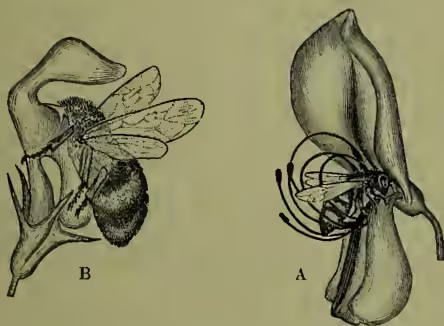
These colours exhibit a gradual evolution from yellow to blue. They 'follow a regular law of progressive modification, but have been fixed and stereotyped in each species by the selective action of the proper beetles, bees, moths, or butterflies.' Blue colour is characteristic of many highly-developed flowers, and bees are especially fond of this blue colour, probably because they have learned to associate it with flowers peculiarly suited to their access and taste, and the result of this preference is to insure the fertilisation and survival of the higher flowers. And again, numerous flowers, especially those visited by the higher bees, exhibit mechanical adaptations which insure that the bee in diving down for the nectar becomes thoroughly dusted with pollen. The wild sage (Salvia) and the orchis are two good examples of very different modifications securing fertilisation. There can be little doubt that at least the more mechanical of these pollen-dusting contrivances have resulted as direct adaptations in association with the continual visits of bees. See FERTILISATION OF FLOWERS.
Pedigree of Bees.—These adaptations are, however, mutual ones: just as flowers have been modified in relation to bees, so have bees in relation to flowers. Bees thus appear to be the last result of a long series of progressive changes, the steps of which are still to some extent discoverable. According to Hermann Müller, the primitive ancestor was a form like the common sand-wasp, carnivorous in its diet, and bringing its insect or spider prey to its larva. From these arose forms which adopted a floral diet, and thus filling up a more or less unoccupied corner in nature's household, got on amazingly well. They throve, were fruitful and multiplied, and were, in the course of time, likewise modified into the numerous types of modern bees. The chief modifications, as above noticed, are associated with the development of social life, the elaboration of honey-sucking mouth structures, and the equipment with pollen-collecting appliances. Müller's main stages are as follows:
(1) Starting from the sand-wasp, we find in Prosopis a bee but slightly advanced above the ancestral type. It is almost hairless, with mouth parts but slightly elongated, and feeds its young on honey and pollen, which are simply crammed into the brood-chamber. (2) Sphecodes, Halictus, and Andrena occupy a somewhat higher level. They are more efficient pollen-collectors, inasmuch as they have become hairy. In the first there appears the first trace of feathery-collecting hairs, and the primitive fashion in which they feed the young with the disgorged surplus of food is also interesting. Halictus has more hairy hind-legs, and special brushes on some of the terminal joints. The young are fed with pollen. In Andrena the whole hind-leg is hairy. (3) Dasyppoda and Panurgus exhibit yet another step in the direction of more efficient pollen-collecting. The hairs occur on the long tibia (second-last portion) and on the terminal part or tarsus. (4) The last step in this direction is exhibited by those forms in which the pollen is moistened with honey before it is stowed away. In Macropis, heaps of consolidated pollen are fixed without special contrivance to the hind-legs; in Bombus (humble-bee) the outer side of the hind-legs exhibits the familiar pollen-basket fenced in with long hairs—an obvious economy of both hairs and time; while Apis (honey-bee) shows a yet more evolved arrangement of collecting-brushes and receiving-basket. Besides those forms with collecting-hairs on the hind-legs, culminating in Apis, there is a separate division, in which the pollen is collected on the lower surface of the abdomen upon brushes or backward-directed bristles. The mason-bee (Osmia) and the leaf-cutter (Megalichile) are good examples. In the same way, Müller traces throughout a series of gradations the evolution of the honey-collecting organs. This progress is chiefly concerned with the lengthening of the tongue and the extension of the membranous and elastic parts between the bases of the two pairs of maxillæ (between mentum and carines). The tongue is in the lower bees decidedly shorter than the basal joint or mentum, but ends with becoming very much longer. The first pair of maxillæ also elongate into insheathing laminae for the tongue, and the same is true of the proximal joints of the labial palps (i.e. of the external lateral portions of the second pair of maxillæ). In power of extension and retraction, in equipment with honey-catching hairs, in the differentiation of a terminal lobe, &c., the tongue exhibits a progressive evolution.
Evolution of Social Life.—Just as among ants, so with bees we have to distinguish solitary and social genera, of which the former are greatly in the majority, and, in origin at any rate, the more primitive. Starting from completely solitary forms, we next find bees whose nests are individually separate, but at the same time closely adjoin those of their neighbours. From such a beginning the various grades of development up to the complex social life exhibited in the communities of humble and honey bees are still distinctly traceable. (a) Solitary Bees.—Colletes is a common and widely-distributed genus, the females of which closely resemble the common honey-bee. The males differ in several features, and are decidedly smaller. They form colonies of considerable size in loose soil or in the soft mortar of walls. Each cell is lined with a fine coating resembling gold-beater's skin. Prosopis is also a common bee of wide distribution. It closely resembles a sand-wasp, and is destitute of the usual means of carrying pollen, being on that account long regarded as a parasite. They make their cells in the pith of bramble-sticks, and line them, like Colletes, with a delicate membrane. The British species appear in June, and continue during the two succeeding months. When handled they give off a pleasant odour. The genus Sphex includes four British species, of world-wide distribution, but of infrequent occurrence. They also are often regarded as parasites on other bees (Halictus), but Mr F. Smith's observations go to show that both in burrowing and pollen-gathering they are entirely independent. The nests occur, indeed, side by side with those of Halictus, but each bee seems to keep to its own home. In spring females alone are met with, while in autumn both sexes occur together. The genus Andrena is the most numerous of all the Apidae, the British species alone numbering sixty-three. They have been fitly called the harbingers of spring, as they appear even in the cold of March. They are all burrowers, making holes which measure from 6 to 12 inches in depth, and give off lateral passages, each terminating in a cell. In this the female deposits its egg on the top of a mass of pollen about the size of a pea. After devouring this, the larva falls into a lethargy, which lasts till the following spring, when the rest of the metamorphosis is rapidly completed.
Halictus is a large genus, the members of which resemble Sphex in many characteristics, and in this among others, that they alone among solitary bees are impregnated in the autumn, and remain dormant during winter. The most beautiful bees found in Britain are the wasp-bees or Nomada. In their gray colours they resemble wasps. They are widely distributed in the northern hemisphere. Their life-history is still veiled in obscurity, little being known beyond the fact that they enter the hives of other bees (Andrenidae and Apidae). All the British species emit when captured very agreeable balmy odours. The mason-bee, or Osmia, includes a large number of species with most interesting diversity of instincts. They occur abundantly in temperate climates, and their nests are found in the most diverse localities, from the shells of snails to the branches of brambles. In regard to these wood-boring bees (such as Xylocopa), it has been a commonly received opinion, originating with Réaumur, that the young forms at the lowest portion of the excavated tunnel escaped first, and that the others followed suit in regular order from below upwards. Each young bee had thus simply to cut its way through the bottom partition of its cell, towards which its head was said to be pointed, and was thus not only saved trouble, but kept from disturbing the less mature inmates of the upper stories. This pretty observation is, however, denied by Mr Smith, with respect to the numerous British wood-boring bees. Megachile, the genus of leaf-cutters, is the most cosmopolitan of all genera of bees, and three hundred species are known to exist. They all excavate burrows in the ground or in wood, which they line with cuttings from the leaves or petals of flowers. Anthophora is a very numerous genus, of world-wide distribution, and includes one hundred and thirty species, of which four occur in Britain. Some of them are true carpenters, and others are burrowers. (b) Social Bees.—The genus Bombus includes one hundred species, of which twenty are British. Of all the wild bees, the species of Bombus (humble-bee) are the most familiar, being extremely conspicuous on account of their large size and noisy hum. In different parts of the country they receive different names, such as bumble-bees, hummel-bees, dumble-doors, foggie-bees, &c. Some species build their nests on the surface of the ground amongst moss and grass (e.g. B. muscorum, B. pratorum, and B. elegans), while others form subterranean homes (e.g. B. lapidarius, B. subterraneus, B. virginalis). At the first approach of spring, the females, which have been hibernating, come forth from their retreats, and at once set about establishing a homestead, choosing for instance the deserted abode of a shrew, or simply looking for a cosy nook on the surface. Having found a convenient site, the bee builds a nest of withered grass, moss, &c., in the centre of which a mass of pollen mixed with honey is then deposited. On this she lays several eggs, side by side, and covers them over with pollen. When the eggs hatch, the larvæ eat their way in different directions into the surrounding store until they reach their full growth, when they spin for themselves a strong oval cocoon. At the side of the mass are a set of shallow receptacles containing coarse liquid honey. These are probably designed either for the moistening of the pollen, or as a store for a rainy day. Within the cocoon the larvæ soon become perfect insects, but are not on emerging ready for active work, nor equipped with their full-coloured dress. The empty cocoons afterwards serve as store-chambers. The workers appear to issue first, and to take upon themselves the entire maintenance of the colony, while the queen now restricts herself more or less completely to maternal duties. Along with more workers small females appear, which are not unnaturally supposed to be only capable of producing drones. Later on the drones appear, while the last brood consists solely of large females, which, on being fertilised, liberate, and thus complete the life-history.
The industry of the humble-bees appears to surpass that of any other bees, which is saying a great deal. From the earliest morning till the last streak of evening light, they seem to continue most indefatigably at work. The temper and courage of the different species varies very considerably; the nests of the surface-bees are readily taken, while the underground homes can hardly be outraged with impunity. No species is more courageous than the red-backed B. lapidarius. In autumn, however, the courage seems to wane, and a general listlessness prevails; the males especially being often found on the heads of thistles and other composites in a dazed and helpless state, capable only of twisting their legs over their head and back in a beseeching fashion, this condition being more probably due to the stupor caused by cold, than to over-indulgence in nectar. Bombus has a curious semi-parasitic double-goer, called Apatherus, which is a very shadow of its host, and is thus able to enter the nest without molestation. The parent deposits her eggs in the pollen of a humble-bee nest, the larvæ are reared with those of the latter, and the adults enter and leave the nest as if perfectly at home. The association is by no means a friendly partnership, for the aristocratic idlers gather no pollen, and prey upon the innocent Bombi with which they live. They consist entirely of males and females, are veritable 'cuckoos,' and do no good to the flowers which they may visit.
Different Kinds of Honey-bees.—The genus Apis, to which the hive-bee (Apis mellifica) belongs, has a cosmopolitan distribution, and numerous local varieties have arisen in response to peculiarities of habitat and nutrition. The number of true species is a point of considerable debate. The fifteen enumerated in the General Catalogue of Apidae published by the British Museum, have been reduced by Mr F. Smith to nine—viz. A. dorsata (India, Borneo, &c.), A. zonata (Celebes), A. indica (India, Java, Sumatra, &c.), A. nigro-cincta (Celebes, Borneo, &c.), A. sincensis (China), A. florea (India, Ceylon, Borneo, &c.), A. adansonii (Africa), A. unicolor (Madagascar, Rodriguez), A. mellifica (cosmopolitan). Of the last there are several varieties.
Within the limits of this article it has not been possible to do more than touch on some of the most important facts in regard to bees. Enough, however, has been said to show that the perfected complexity of their social state, the marvels and mysteries of their family relations, the exquisite adaptations of their structure, the dexterity and intelligence of their work, and the part they have played in the history of flowers, justify us surely in sharing the enthusiasm of those who, from the time of Aristotle downwards, have gained in the study of these insects some insight into the wonder and beauty of nature. See ANTS, FERTILISATION OF FLOWERS, HONEY, HYMENOPTERA, INSECTS, WASPS, &c.
BEE-KEEPING as a source of profit has largely extended in recent years, owing to the improvement of modern appliances, and the more thorough knowledge of the habits of the honey-bee. The only species of bee cultivated in Europe for its honey-gathering powers is the Apis mellifica. Of this, the leading varieties are the Ligurian or Italian bee, the Carniolan or Hungarian bee, the Cyprian, and the common black bee of our own country. Bee-keepers differ as to which of those varieties is the most profitable; but, as a rule, the Ligurian is most sought after. The Ligurian queens are more prolific, and the swarms are therefore larger. Their progeny seem to work harder during the honey-season, going earlier abroad in the morning, and working till later in the evening. In Italy and Germany, as well as in Cyprus and Palestine, the rearing of queens for exportation is largely carried on; and the different foreign varieties have been introduced into our country to such an extent that our own black bee is now scarcely ever to be met with in its pure state.
Hives.—It is necessary to the well-being of a colony of bees that their hives should protect them from the changeable influences of the weather. While the hive should be light, so as to be easily moved about, its walls should be thick enough to protect the bees alike from the extreme cold of winter and the excessive heat of summer, and should be constructed of a material that will effectually protect them from rain or damp. The hive in use in Britain for ages past has been made of straw, sewed tightly together with narrow belts of cane or bramble. The straw-skep answered the purpose of its construction very well. It was light and comfortable and durable, and formed a picturesque object. The straw-hive is unknown in the United States, the frame-hive being the only form known. In Russia, round logs of wood, hollowed out in the centre, are used. The introduction of the movable comb method of management has made the skep give way to what is known as the bar-frame hive; and now in many parts of Scotland and England the straw-hive is looked on as a relic of the past. The principle of the movable comb hive is of very ancient origin, having been employed by the Greeks; but it has been reserved to our own times to develop it. To the Rev. L. L. Langstroth, an American bee-keeper, belongs the credit of conceiving a hive in which the combs are built in frames, hung side by side in a box. The Langstroth hive made its appearance in the United States in 1851; and since then profitable bee-keeping has advanced rapidly. The great advantage gained by the movable comb system of management is that the capacity of the hive may be regulated to accommodate any number of bees, however great or small. As winter comes on, and the bees decrease in number and cling more closely together, the hive is contracted by means of a division board, so that the internal heat is economised. As spring advances, comb by comb is added until the hive is filled. Other advantages of the method are that weak hives may be strengthened by combs taken from more prosperous colonies; that the drone-producing powers of the hive may be regulated, so as to allow breeding from the best stocks only; that on signs of anything having gone wrong in the economy of the hive, the bee-master is generally able to detect the cause, and to effect a remedy at once; and that the hive is so simple in construction as to be easily put together by any amateur joiner.
The frame, made of four bars of wood joined at the corners, is usually 14½ inches long by 8½ inches deep, and is made of wood about ¾ inch thick. If one examines a skep in which the bees have been allowed to work at will, it is found that the combs are about an inch in thickness, and hang at a distance of about half an inch from one another. Accordingly, the frames are made 1 inch broad, and are hung at a distance of 1½ inches from centre to centre. The number of frames depends on the size of the swarm to be accommodated, and on the honey-yielding capabilities of the district. Ten frames have generally been considered sufficient, although many bee-keepers use hives containing as many as fifteen or even eighteen frames. A hive, then, containing ten frames must be 15 inches long, 15 broad, and 8¾ deep. A passage of ¼ inch is thus allowed at the ends and under the bottom bar of the frames. If more than this be given, the bees will fill up the interval with comb, and if less, they will seal the frames to the walls and the bottom of the hive with propolis. The box thus constructed is the brood-chamber and storehouse of the bees, and is never despoiled of its sweets. It is necessary to provide accommodation for the storage of the surplus honey, of which the bees are to be deprived.
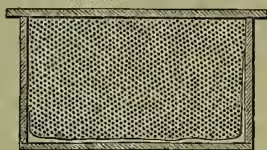
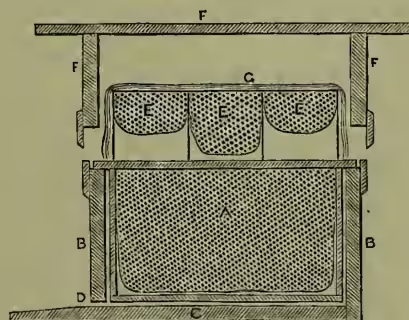
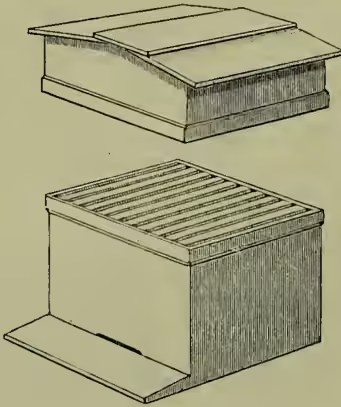
Bees, in their wild state, store the honey above the brood-combs; accordingly, a box of corresponding dimensions is fitted above the hive, while the whole is protected by a sloping roof. A doorway 6 inches in length, and inch in height, and a suitable floor-board, complete the bar-frame hive in its simplest form. Though the bars thus are hung at regular intervals, the bees would almost always work their combs irregularly on them, and the advantages of the frame-hive would be lost. To obviate this, guide-combs are fixed to the under side of the top bar. Thin pieces of old comb, or even strips of melted wax, were formerly used for this purpose. A septum of wax has recently been brought into use, however, that answers this purpose perfectly. This is known as 'comb-foundation,' and consists of thin sheets of wax impressed in a machine on both sides with the forms of the base of the cells. The bees take to this at once, and work combs of perfect regularity and flatness. The strips of foundation used may be of any breadth, from inch to a full comb. By using full sheets the bee-master is able to control the birth of drones in the live; for if worker-foundation—i.e. foundation bearing the impress of worker-cells—be used, the comb will necessarily be capable of containing only worker-brood. The bee-keeper is thus enabled to assist nature in preserving the fittest by breeding drones from his best queens only. Several thicknesses of carpet or felt are used as a quilt over the bars to confine the bees to their own chamber, as well as to prevent the escape of heat.
Quieting Bees.—Every one who has any knowledge of bees knows how rarely bees sting whilst they are swarming. This is owing to their being gorged with honey, when a bee will not sting unless hurt. If, then, the bees can be made to fill themselves with honey, they are in the bee-master's power. The general method of attaining this end is by blowing amongst them a little smoke. This may be done by a miniature bellows called the 'smoker,' in which a piece of cotton is kept smouldering; or a piece of brown paper rolled like a cigar may be used, from which the smoke is blown over the bees. A puff from a tobacco pipe serves the purpose equally well. The bees, frightened by the smoke, seem to fear that they are about to be driven from the hive, and they run to their store to gorge themselves, as they do preparatory to swarming, and in a few minutes they may be handled at will.
Swarming.—A pound weight of bees contains about 5000 individuals, and swarms are often found to weigh 8 lb., or even more. A populous hive will thus contain from 40,000 to 50,000 bees. In spring, however, the number is much smaller, amounting to only a few thousands. As the season advances and food becomes abundant, the queen deposits her eggs at the rate of from 2000 to 3000 a day, and the colony soon becomes too numerous for the limits of their dwelling. Swarming is a matter of necessity, not of choice, on the part of the bees, and may be almost wholly prevented by providing sufficient accommodation for the increasing numbers. In Scotland, swarming rarely commences before the close of May, while in the south of England it is a few weeks earlier. The chief indications that a swarm is about to issue are the clustering of the bees at the entrance of the hive, and a cessation of the usual activity amongst the community. Previous to swarming, the bees gorge themselves with honey that they may have some store of provision for their new home. A first swarm will rarely leave the parent hive in bad weather. The time usually chosen is the early part of the forenoon, though a swarm has been known to go off as early as seven in the morning, or as late in the afternoon as five o'clock. The bees pour from the hive door in a constant stream. The swarm is not led forth by the queen as is generally supposed, for she is sometimes seen to issue amongst the stragglers at the close. They fly round in circles until the whole have left the hive, filling the air with a busy hum. Gradually a knot of bees is seen to gather on some bush or tree close at hand, and this knot increases in size until the whole swarm have joined it. If left to themselves, they will remain at rest for an hour or more, when they will again take wing and go off in a 'bee-line' to some chimney top or decayed tree that has previously been decided upon. As soon, however, as the cluster is complete, the bee-keeper proceeds to skep the swarm. This he does by placing a straw-skep over it, and allowing the bees to crawl up of their own accord; or he may hold the skep under the cluster, and give the branch a sudden shake, when almost every bee will fall into the skep. He then shakes them into the bar-frame hive, which is either left till evening where the cluster has gathered, or is removed at once to its permanent station. Previous to swarming, the rearing of half a dozen, or more, of young queen bees had been commenced. Eight or ten days after the swarm issues, the most advanced of these queens comes to maturity, and issues forth from her cell. Her first impulse is to destroy the remaining royal grubs. If the hive be of sufficient strength to swarm a second time, the workers keep guard over the cells, when the newly-hatched queen takes flight with a second colony. Unless increase of stock is aimed at, second swarming should be avoided, and when they do occur, they should be returned again to the hive.
'Ringing' or 'tanging' the bees is an old custom not yet extinct. On the issue of a swarm, the owner proceeded to make hideous noises by beating on old pans and the like, thinking thus to prevent the bees from leaving his garden. The practice is so entirely ineffective, that some have thought it was originally meant merely to proclaim the ownership of the swarm.
Artificial Swarming.—As has been already noticed, a swarm left hanging in its original cluster will go off and establish a home for itself. The hives during the swarming season should therefore be carefully watched. To avoid the necessity of watching for swarms and the chance of eventually losing them, methods of artificial swarming are now practised by all advanced bee-keepers. This is a process easily accomplished, especially with the bar-frame hive. An empty hive is placed on the site of the hive to be swarmed, which is itself moved aside. The frames of bees are lifted out and examined one by one until the queen is discovered, when the comb on which she is found is placed in the empty hive. One or two brood- combs are also removed and placed along with it. The hive is filled up with empty bars and covered up as before. Empty bars take the place of those removed from the old hive, which is taken to a new situation in the garden, when the work is complete. All the bees on wing during the operation, as well as the old bees in the swarmed hive, will make their way to the new hive on the old site. In the case of swarming from a straw-skep the principle is the same, but the method of procedure is somewhat different. As the combs cannot be removed in the search for the queen, the bees must be driven from them. In order to do this, a warm day is chosen when the bees are busily engaged at work. The hive must first be quieted as already described, when it is inverted, and an empty skep of about the same size is placed over it at an angle of 45°, touching it at a point where the combs converge. The skeps are held together at this point by a skewer pushed through their edges, while the empty one is supported by another skewer in front. Then a gentle and regular rapping with the palms of the hands is commenced on the sides of the hive, when the bees begin to run, slowly at first until a buzz arises, and they rush in a long stream into the empty hive. A sharp watch should now be kept for the queen, who will be seen running up with the other bees, and after a little experience, she will rarely pass without being noticed. The new hive with the swarm containing the old queen is then placed on the old stool, and the parent hive is removed to a new site.
Feeding.—A hive should have at least 20 lb. of honey stored for winter use. After the season is over it may be found that the supply is deficient, and as bees should never be fed during the winter months, the quantity should be made up before cold weather sets in. If fed in autumn, a strong colony will easily store away a quart of sirup in 24 hours, and the whole winter supply may be thus given in a few days. A good feeding sirup may be made by dissolving 4 lb. of cane-sugar in 2 pints (40 oz.) of water over a gentle fire. A tablespoonful of vinegar should be added to prevent the sirup from recrystallising in the combs. One-fourth of a pint of this given daily will be found to be sufficient. Gentle feeding in early spring is also frequently advisable. The simplest method of feeding is to fill a jar or squat bottle of sufficient size to hold one day's supply. Over this a piece of linen should be tied, when the bottle may be inverted over a hole cut in the quilt.
Getting the Honey.—In olden times, the invariable method pursued in this country of taking the honey was by allowing the bees to work at will in small straw-skeps until the close of the season, when they were destroyed by sulphur fumes. This has almost everywhere now given place to a more humane method of management. The method usually adopted by advanced bee-keepers is what is known as 'extracting.' This method is only possible in the movable comb hive. A box of equal dimensions to the body of the hive, and filled like it with bars, is placed above the bars. The quilt is removed, and its place is taken by a sheet of 'excluder zinc'—i.e. zinc with slits cut of sufficient width to let the worker bees pass freely, but effectually to bar the progress of the queen. The upper story is thus kept free from brood, and the honey got is pure. When this box is filled, it is removed, and an empty one is put in its place. The capping of the cells is then cut off, and the bars are put into a machine known as the 'extractor.' This is a large cylinder containing wirework cages, that may be set in rapid rotatory motion. The centrifugal force throws out the honey, and the empty combs are replaced on the hive, to be again filled by the bees. By this method of working, the bees are saved the labour of comb-building, and large harvests of honey may be secured. As much as 400 lb. of surplus honey has been taken from a single hive in this way. It should be noted that heather-honey, being of a thicker consistency than flower-honey, cannot be extracted in this way. Another method is to fill the upper story of the hive with boxes of thin wood known as 'sections,' placed side by side. The sections are usually made to contain 1 or 2 lb. of honey, and are fitted, like the bars, with guides of comb-foundation. The advantage gained here over the old method of producing large supers, is that the surplus-chamber, like the hive, may be enlarged or contracted at will, while the sections may be removed as they are filled, and their place supplied by empty ones. The honey, too, is put into the market in a form much more convenient for use. The quantity of honey that may be taken from a hive differs with the locality as well as with the season. In a good season, a populous hive will yield from 50 to 100 lb. of comb-honey, besides laying up a sufficient store to keep them through the winter, while, if the extracting system be followed, double this amount is easily got.
The honey of various regions is flavoured by the flowers predominant in the districts where it is gathered—heather, rosemary, lavender, orange-flowers, white clover, bass-wood, lime-tree; that gathered from the flowers of some kinds of African Euphorbia and other plants is poisonous. In Scotland, it is not unusual to transport the hives in the flowering season to the neighbourhood of heathery tracts. The honey most famous in the ancient world was that of Mount Hybla in Sicily, and Mount Hymettus in Attica. Supplies are imported into Britain from various quarters; but it is to the United States and Canada that we must turn for bee-farming on the largest scale, and California, especially Southern California, is the paradise of bee-keepers. In 1880 there were said to be 700,000 hives in the United States, kept by 35,000 persons, of whom 5000 were professional bee-keepers. Some bee-keepers have from 2000 to 3000 hives; and as much as 700 lb. of honey has been obtained from one hive. The most improved hives, honey-extractors, artificial combs, and comb-foundations are in general use. In California the bees swarm in March or April, and the taking of the honey begins about the 20th May. See ADULTERATION, HONEY, WAX.
For further information, consult E. Bevan, The Honey-bee (1827); C. Claus, Der Bienenstaat (1873); Curtis, British Entomology; Darwin, Origin of Species; Girdwoyn, Anatomie et Physiologie de l'Abeille (1875); F. Hüber, Nouvelles Observations sur les Abeilles (2d ed. 1814); Kirby and Spence, Introduction to Entomology; Kirby, Monograph of British Bees; L. Langstroth, Hive and Honey-bee; Latreille, Histoire Naturelle des Insectes; Sir John Lubbock, Ants, Bees, and Wasps (International Science Series, 1882); A. S. Packard, Guide to the Study of Insects (1876); G. J. Romanes, Animal Intelligence (International Science Series, 1886), and Mental Evolution (1886); Schmiedeknecht, Monograph of European Bees (1837); F. Smith, Catalogue of British Bees (British Museum, 1876); Smith, Bees of Great Britain; St Fargeau, Hyménoptères; Müller, Fertilisation of Flowers (1833); T. W. Cowan, The Honey Bee (1890). And on bee-keeping, see Pettigrew, Handy Book of Bees (4th ed. 1880); Robinson, British Bee-farming (1880); Cook, Manual of the Apiary (Chicago, 1878); Hunter, Manual of Bee-keeping (3d ed. 1879); Cheshire, Bees and Bee-keeping (2 vols. 1886-88); and works by Quinby (New York), Root (New York, 1891), Samson (1892), and Simmins.