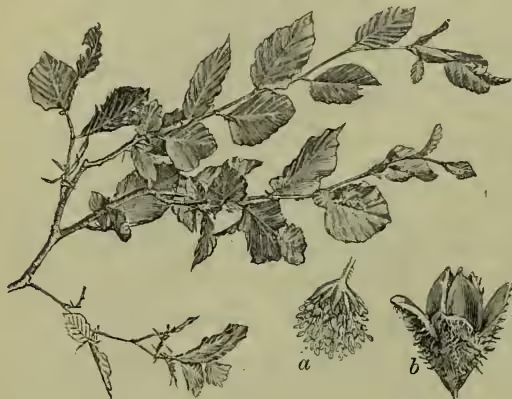
a, flower; b, fruit.
Beech (Fagus), a genus of Cupuliferae (q.v.). There are about fifteen species, all forest-trees of great beauty. The COMMON BEECH (F. sylvatica) forms whole forests in many parts of Europe. It is one of the stateliest of our forest-trees, and rivals the oak in its dimensions and outline. Its bark is smooth, of a gray colour; and it is remarkable for the frequency with which hard wooden knobs—abortive buds—occur in it. Grass does not grow readily under the shade of the beech, but some rare plants are almost peculiar to such situations. The beech thrives best in light soils; and does not send its roots deep into the ground. The wood is very hard and solid, but brittle; and when exposed to the open air, very liable to rot and to be worm-eaten. It is therefore not adapted to the purposes of the house-carpenter; but when kept always under water, it is very durable, and is accordingly employed in the erection of mills, and for weirs, sluices, &c. It is extensively used by cabinet-makers in the making of chairs, tables, bedsteads, &c., and by turners in making wooden bowls, ladles, butchers' trays, and many other articles of everyday use. It is used also in the manufacture of carpenters' planes and other tools. Berkhamstead, Hertfordshire, is noted for its trade in beech turnery-ware. The wood is also employed by wheelwrights, cartwrights, and coachbuilders. It is much used in France for making sabots, being preferred for that purpose to any other, except walnut-wood, on account of its not readily absorbing water. It is regarded as being superior to that of most other trees as fuel, and the green wood is generally preferred to the dry, as it burns more slowly. It also makes an excellent charcoal. The ashes yield a large amount of potash of superior quality. The leaves are sometimes used for making mattresses, and the male catkins in packing. The raspings of the wood are used in the preparation of vinegar; the bark is sometimes employed for tanning where oak-bark is scarce, and also for making pyroligneous acid. The beech bears lopping well, and is often planted for hedges. Beechmast, when fresh, has a sweet taste, like that of a walnut. A volatile, narcotic, poisonous principle called Fagin is found in it, but more in the rind than in the kernel. This poisonous principle is, however, easily dissipated by drying; after which the kernels are in some countries ground into flour. Pigs, poultry, and cattle have been long known to thrive and fatten on it, but it is injurious to horses. It yields to pressure a great quantity of oil which is said to be equal in flavour to olive oil, and keeps longer sweet; it is used for many domestic purposes and in the arts. The marc left after the oil is expressed is given as food to swine, cattle, and poultry, but swine are apt to be attacked by a distemper called gargct when they are fed exclusively upon it. Cocoa is sometimes adulterated with beech-mast.
Beeches from 90 to 100 feet high, with stems from 12 to 22 feet in girth, are not rare in Britain. The finest one in the kingdom is at Newbattle Abbey, Midlothian. It is 95 feet high, and girths 37½ feet at 1 foot, 21½ at 5 feet, from the ground, while the spread of its branches is 350 feet in circumference. The beech is not, in general, found in Europe north of 59° lat., although it occurs two degrees farther north in Scandinavia. It is found in the temperate parts of Asia and in North America; the WHITE BEECH of the latter country being generally regarded as the same species. In gardens and pleasure-grounds a variety is very frequently to be seen of which the leaves have a red colour or purplish-brown, and is named the PURPLE or COPPER BEECH. The same colour appears also in some degree in the narrower and longer leaves of the RED BEECH of North America (F. ferruginea), which forms extensive forests; and its wood, which is of a reddish colour, is more valued than that of the White Beech.—Two species of beech are found on the mountains of Java; four are natives of the more elevated parts of the south of New Zealand; several belong to the south of South America. The genus is, in fact, more characteristic of the colder latitudes of the southern than of the northern hemisphere. F. betuloides is the 'myrtle-tree' of the mountains of Tasmania—a large tree with small, evergreen, leathery, serrate leaves. The same species is the evergreen beech of Terra del Fuego, where it forms forests of which the dark green foliage contrasts strikingly in winter with the dazzling snow. The wood makes tolerable planks, and is carried to the treeless Falkland Islands for roofing houses. F. antarctica ascends higher on the mountains about the Strait of Magellan. It has deciduous leaves, and much resembles the common beech. F. procera grows in the Andes of Chili, and attains a majestic size. It is a valuable timber-tree.