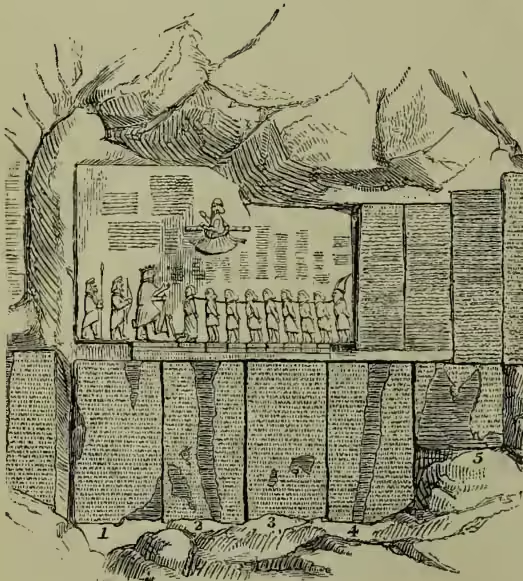
Behistun, or BISUTUN (ancient Baghistan), the site of an ancient Persian city, 22 miles E. of the city of Kirmanshahan. It is noted for its famous precipitous rock, anciently known as Mount Bagistanus, which on one side rises perpendicularly to the height of 1700 feet. Diodorus relates that Semiramis encamped near the rock, and caused the lower part to be smoothed away and an inscription engraved on it in her honour. This, like many other traditions attached to the mythic queen, is now proved false. The rock bears inscriptions of Darius Hystaspes about 518 B.C. The inscriptions—which are in the three forms of cuneiform writing, Persian, Babylonian, and Median—set forth the hereditary right of Darius to the throne of Persia, tracing his genealogy, through eight generations, up to Achæmenes; they then enumerate the provinces of his empire, and recount his triumphs over the various rebels who rose against him during the first four years of his reign. The monarch himself is represented on the tablet with a bow in hand, and his foot upon the prostrate figure of a man, while nine rebels, chained together by the neck, stand humbly before him; behind him are two of his own warriors, and above him, another figure (see cut). The Persian inscriptions which Sir H. Rawlinson has translated are contained in the five main columns numbered in cut 1, 2, 3, 4, 5. The first column contains 19 paragraphs and 96 lines. Each paragraph after the first, which commences, 'I am Darius the Great King,' begins with, 'Says Darius the King.' The second column has the same number of lines in 16 paragraphs; the third, 92 lines and 14 paragraphs; the fourth has also 92 lines and 18 paragraphs; and the fifth, which appears to be a supplementary column, 35 lines. The second, fourth, and fifth columns are much injured. Sir H. Rawlinson fixes the date of the sculpture at 516-515 B.C. See Rawlinson in Journal of Royal Asiatic Society, vol. x.; Oppert, Le Peuple et la Langue des Medes (Paris, 1879); and Spiegel, Die Alt-persischen Keilschriften (Leip. 1881).