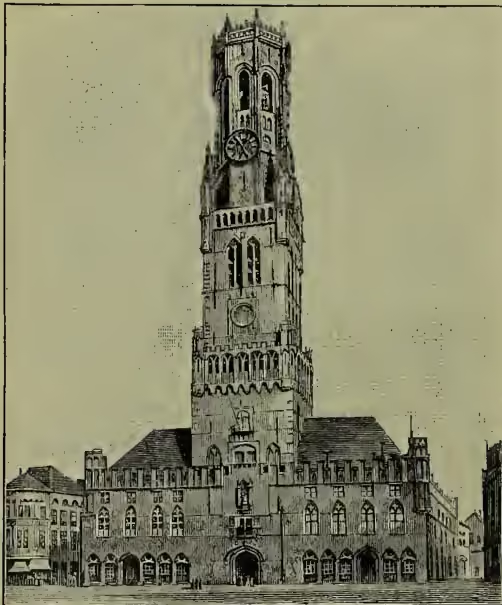
Belfry (old Fr. berfrei; modern, beffroi, of Teutonic origin; lit. 'a place of safety'). Originally a kind of movable tower used for defence in sieges, it came to mean a tower to protect watchmen, a watch-tower, beacon-tower, or alarm bell-tower, then any tower where a bell is hung—a bell-tower or turret. The belfry usually forms part of a church, but is sometimes detached from it—as at Evesham, Berkeley, and Beccles, in England, and still more frequently in Italy (see CAMPANILE). Where a church was built in a deep glen, the belfry was occasionally perched on a neighbouring height, as at St Feve and elsewhere in Cornwall, and at Ardclach and Auldbar in Scotland. At this last place, the bell was hung upon a tree, as was common enough in Scotland at the close of the 17th century. Where the belfry consists of a mere turret, it is often called a bell-gable or bell-cote, and is placed on the west end of the church; a smaller one being usually placed at the east end for the sanctus bell, for which reason it is placed over the altar. Municipal belfries are more common on the Continent than in this country. When the boroughs began to rise into importance after the 12th century, they asserted their right to have bells to call the burghers together for council or for action. Thus detached belfries arose in the heart of towns, and were regarded as important symbols of their freedom. At a later date, they often became part of the maison de ville, or town-house, as at Glasgow and Aberdeen, in this country; at St Quentin and Douai, in France; and at Brussels, in Belgium. The belfry attached to the building known as Les Halles (not the town-hall) in Bruges, was commenced in 1291. It is 353 feet high, and possesses a carillon of 48 bells, regarded as the finest in Europe. It is well known through Longfellow's poem.