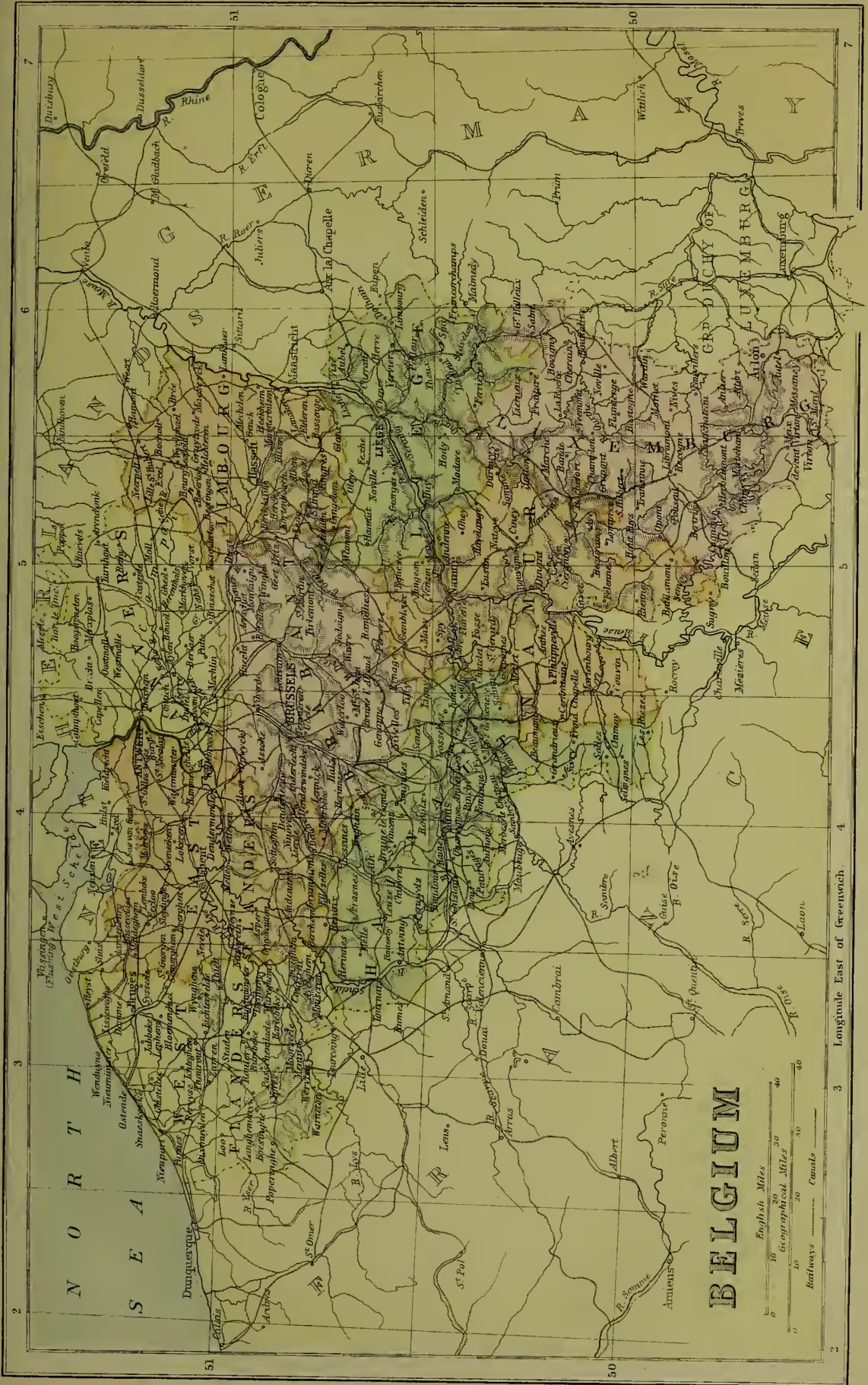
Belgium (Fr. Belgique), one of the smaller European states, consists of the southern portion of the former kingdom of the Netherlands (as created by the Congress of Vienna), lying between France and Holland (i.e. the present kingdom of the Netherlands), the North Sea and Rhineland Prussia. Its greatest length from north-west to south-east is 173 miles; and its greatest breadth from north to south, 105 miles.
Area and Population.—The whole area of Belgium is 11,373 sq. m., or slightly over a third of that of Ireland. The population at the census of 1880 was 5,520,009, and at that of 1890, 6,147,041. Beneath are given the provinces, their areas, their population at December 31, 1892, and their chief towns:
| Provinces. | Sq. Miles. | Pop. | Chief Cities. |
|---|---|---|---|
| Antwerp..... | 1,093 | 726,233 | Antwerp. |
| West Flanders..... | 1,249 | 749,291 | Bruges. |
| East Flanders..... | 1,158 | 961,007 | Ghent. |
| Hainault..... | 1,437 | 1,065,881 | Mons. |
| Liège..... | 1,117 | 778,724 | Liège. |
| Brabant..... | 1,268 | 1,136,827 | Brussels. |
| Limburg..... | 931 | 225,000 | Hasselt. |
| Luxemburg..... | 1,706 | 212,171 | Arlon. |
| Namur..... | 1,414 | 339,321 | Namur. |
| Total..... | 11,373 | 6,195,355 |
At the same date the kingdom contained seventeen towns with over 20,000 inhabitants. Of these the largest were Brussels, the capital, 488,188
BELGIUM
Longitude East of Greenwich

W & R CHAMBERS, LIMITED LONDON & EDINBURGH. (including suburbs); Antwerp, 240,343; Liège, 155,898; and Ghent, 151,811.
The population of Belgium is of mixed German and Celtic origin. The Flemings (of Teutonic stock) and Walloons (Celtic in origin), distinguished by their peculiar dialects (see HOLLAND, Vol. V. p. 745; WALLOONS), are still conspicuous among the pure Germans, Dutch, and French. East and West Flanders, Antwerp, and Limburg are almost wholly Flemish; and Brabant mainly so. The line between the Flemish and Walloon districts is sharply defined, the Flemish part being the richest and most cultivated. The French language has gained the ascendancy in educated society and in the offices of government; but the Flemish dialect prevails numerically in the proportion of nine to eight.
Belgium is the most densely peopled country in Europe, the population being 548 to the sq. m., as compared with 497 in England and Wales (in 1891 England without Wales having 540, Lancashire 2080). In Brabant the density was 896 per sq. m. The increase of the Belgian population is due largely to the steady excess of births over deaths, which in the years 1881-85 averaged 57,800 annually. This may be compared with the returns from France during the same period, where, with an area seventeen times greater, and a population more than six times as large, the total average excess was only 93,300. Of the total population in 1890, 45 per cent. spoke Flemish, 41 per cent. French, and 11 per cent. both tongues. In 1880 2,479,750 spoke Flemish only, 2,237,870 French only (including Walloon), 41,000 German only, 420,300 Flemish and French, 35,350 French and German, 2800 Flemish and German, and 13,400 spoke all three languages. There were, besides, 6500 foreigners.
Physical Aspect.—Belgium is, on the whole, a level, and even low-lying country; diversified, however, by hilly districts. In the south-east, a western branch of the Ardennes highlands makes its appearance, separating the basin of the Maas from that of the Moselle, but attains only the moderate elevation of 2000 feet. In the northern portions of Antwerp and Limburg, a naturally infertile district named the Campine, composed of marshes and barren heaths, extends along the Dutch frontier. In Flanders the land becomes so low that, in parts where the natural protection afforded by the dunes is deficient, dikes have been raised to check the encroachments of the sea; and the once impassable morasses of the Morini and the Menapii, which stayed the progress of Cæsar's legions, are now drained and converted into fertile fields surrounded by dense plantations. Colonies having been settled on whatever patches of the sandy, marshy Campine district it was deemed possible to reclaim, it has been largely cleared and drained, and became the centre of a thriving agricultural industry. At the same time, the coast is said to be undergoing a change by which the land southward is gradually gaining on the sea, while the northern coast is losing.
Hydrography, Climate, Agriculture, &c.—The abundant water-system of Belgium is chiefly supplied by the great navigable rivers Scheldt and Maas, both of which rise in France, and have their embouchures in Holland. The Scheldt, like the Maas, is navigable all through Belgium. Its tributaries are the Lys, Dender, Durme, and Ruppel. The Maas, or Meuse, receives in its course the waters of the Sambre, the Ourthe, and the Roer. These natural hydrographical advantages are increased by a system of canals (44 in number, with an entire length of 563 miles). The climate is, in the plains near the sea, cool, humid, and somewhat unhealthy; but in the higher south-east districts, hot summers alternate with very cold winters. The mean annual temperature at Brussels is 50° F. The rainfall ranges from 27.5 inches in the west, to 40 inches in the district east of the Maas. The Ardennes districts yield a large supply of wood, and their forests abound in game and other wild animals; while the level provinces raise all kinds of grain—wheat, rye, oats, and barley, leguminous plants, hemp, flax, colza, tobacco, hops, dyer-plants, and chicory. The beet is cultivated in increasing quantities, both for sugar and for fodder. Belgium contains nearly 7,278,000 acres, of which almost two-thirds are in ordinary cultivation, more than one-eighth is meadow and pasture, one-sixth is under wood, and less than 600,000 acres are waste or water. Some hundreds of acres are devoted to vineyards, but the wine produced is of an inferior quality. Good pasturage is found on the slopes and in the valleys of the hilly districts, and in the rich meadows of the low provinces. Gardening occupies not less than 130,000 acres; indeed, it has been said that the agriculture of Belgium is gardening on a large scale, so carefully and laboriously is every inch of soil cultivated by the farmers, the vast majority of whom are small holders owning less than one hectare (about 2½ acres) of land. The spade is still the principal instrument used. The interests of this class are promoted and superintended by provincial committees of practical men, who are directed by a central council, and improvements are encouraged and rewarded at quinquennial exhibitions at Brussels. The state supports four agricultural schools and nine experimental stations, including a school of forestry, to which pupils are admitted for a fixed period as boarders; and at 29 middle-class state schools courses of agricultural lectures are delivered to the farmers of the district. Belgium is famous for its horses, and to improve the breeds a government stud of stallions is maintained at Tervueren. In the Campine, the care of bees and the cultivation of the silkworm are encouraged, and its butter is considered the best in Belgium. There are valuable fisheries on the coast, but foreign fish being admitted free of duty, the fishermen of Holland, England, and France have proved keen competitors in the Belgian markets. This led in 1887 to repeated disputes and much bad feeling, culminating in a series of riots at Ostend.
Geology.—The geological formations of Belgium are closely associated with those of France and Britain. The greater portion of the country is covered with Tertiary deposits. A line drawn across the course of the Scheldt, by Mechlin, along the Demer and Maas, will have on its northern and north-western aspect a tract of Tertiary deposits, bounded northwards by the sea. In these Tertiary strata the different geological periods are fully represented; but only the second, containing the Pliocene deposits, is rich in fossils. The Secondary deposits occupy an extensive tract in the centre of Belgium, between the Scheldt and the Demer. The most important district, economically, is the south-western, consisting of Palæozoic rocks—Silurian, Devonian, and Carboniferous.
Mineral Products.—Belgium is rich in minerals, which, next to its abundant agriculture, constitute the chief source of its national prosperity. The four provinces in which they are found are Hainaut, Namur, Liège, and Luxemburg. These yield lead, copper, zinc, calamine, alum, peat, marble, limestone, granite, slate, iron, and coal. Lead and zinc are wrought to some extent in Liège; copper in Hainaut and Liège; manganese in Liège and Namur; black marble at Dinant; slates at Herbeumont; and calamine principally at Liège.
But these products are insignificant compared to the superabundance of coal—from anthracite to the richest gas coal—and iron, in which Belgium ranks next to England. The mines are superintended, under the minister of the interior, by a corps of mining engineers, one of whom is appointed over each of the six mining districts.
There are in Belgium some 250 coal-mines, employing 120,000 persons, and producing about 20,000,000 tons, of a total value of £5,000,000 or £6,000,000. The metallic mines produce about 200,000 tons of iron ore, 2500 of pyrites, 18,000 of calamine (zinc), 2000 of blende (also a zinc ore), 3000 of sulphuret of lead, and 450 of manganese. These mines give employment to over 1500 workmen; but this industry has fallen off, the corresponding number of miners in 1865 having been 11,800. There are upwards of 500 ironworks, producing manufactured iron and steel to the value of £6,000,000 or £7,000,000, and the produce of the quarries is valued at near £2,000,000.
Manufactures.—The chief manufactures are linen, woollens, cotton, silk, lace, leather, and metals. Flax is one of the most valuable products of Belgium. The great seats of the linen manufacture, the oldest in Belgium, are in Flanders; it employs some 350,000 persons. The lace industry has fallen off in importance, but still employs 150,000 workers and a capital of two millions sterling. Centres of the woollen manufacture are Ypres, Ghent, Tournay, and especially Verviers, which alone employs 20,000 workmen in this branch of industry. Brussels and Louvain have large carpet manufactures, and Hainault supplies a considerable amount of hosiery. The principal seat of the cotton trade is Ghent, where the industry was first established in 1798. It employs over 30,000 persons. Belgian leather has a good reputation, and the manufacture of gloves has made great progress in recent years. Metallurgy also has rapidly increased in productiveness since 1816, when Cockerill (see SERAING) introduced into Belgium the English method of smelting iron with coke. The principal seats of the metal manufacture are Liège, Ghent, Charleroi, Mons, and their neighbourhoods. There are large ordnance foundries at Liège and Antwerp, and celebrated makers of firearms and machinery in Liège; nail-making at Charleroi; manufactures of copper at Malines, and of tinware at Liège; wire and brass factories at Namur, Liège, and Brussels; zinc manufactures at Liège; and lead and shot factories at Ghent. Gold and silver goods are manufactured at Brussels, Liège, and Antwerp. Besides these, we may mention the straw-bonnet manufacture in the neighbourhood of Liège; the calico-printing at Ghent and Brussels; the paper fabrics of Brussels and Liège; the glass-works of Charleroi, Liège, and Namur, whose annual output reaches a value not far below £2,000,000; the porcelain of Tournay; and the sugar-refineries, of which there are 130. There are in Belgium upwards of 2500 breweries, mostly small, and 250 distilleries.
Commerce.—In the middle of the 13th century, Flanders, with Bruges as its chief seat of manufactures, had surpassed all its neighbours in industry. After the discovery of America, Antwerp took the place of Bruges. But the unhappy period of Spanish oppression and the war in the Netherlands deeply depressed Flemish commerce. Separation from Holland has also been indirectly favourable to the development of Belgian resources; and its admirable network of railways (2850 miles open in 1894) has greatly promoted commerce. There are 1000 miles of navigable rivers and canals.
The unit of the Belgian monetary system is the franc, and in 1865 Belgium, along with France, Italy,
Switzerland, and Greece, entered on a monetary league, in which these states agreed to adopt the French decimal system of coins, weights, and measures, and established a reciprocity of currency, whereby their respective unit coins would have the same value throughout their territories.
Among the principal articles of export are coal, flax, linen, woollen and cotton goods, glass, firearms, and nails. About a fourth of the whole is consigned to France, and most of the remainder to Germany, England, and Holland. The carrying trade is almost entirely in the hands of the British, the native shipping being only some 60 vessels, of under 100,000 tons burden, besides 350 fishing-vessels. In 1882-92 the exports had an annual value of from £47,000,000 to £61,000,000; the imports from £53,000,000 to £72,000,000. The commercial intercourse with Great Britain is represented by exports thither to the amount of from £15,000,000 to £17,000,000 a year (woollen yarn, silks, flax, sugar, iron manufactures, eggs, poultry and game, &c.), and by imports from Britain worth from £6,300,000 to £7,600,000 (cottons, cotton-yarns, woollens, machinery, iron, &c.). Imports and exports in 1831 were £3,750,000 and £4,025,000 respectively.
Religion.—The Roman Catholic is the dominant religion. Although full liberty of worship is guaranteed to all, and the ministers of each denomination are paid by the state, almost the entire population are Roman Catholics, the number of Protestants being set down at 15,000, of Jews at 3000. The supreme Catholic dignitaries of Belgium are the Archbishop of Mechlin, and the five diocesan bishops of Bruges, Ghent, Tournay, Namur, and Liège. There are over 1200 conventual houses, inhabited by 4000 monks and 21,000 nuns.
Culture.—Diversity of dialects has retarded the growth of the national intellect and the formation of an independent national literature to act as the bond of national unity. The Flemish element—the most important—has done much of late to foster the Flemish tongue, and if possible secure its predominance. Flemish theatres are supported in the great towns; a Royal Academy to encourage the study of its language and literature was opened at Ghent in 1886; and in 1887 the king was constrained to make speeches in Flemish. Scientific and literary societies, museums, and public libraries, are of course numerous. Great efforts are being made to improve the musical standard of the people; there are as many as 60 musical schools throughout the country, with about 1000 pupils, and the conservatoires of Brussels, Ghent, and Liège count 3000 or 4000 pupils. Painting and architecture formerly flourished in the wealthy old towns of Flanders; and although, after the brilliant epoch of Rubens and his pupils, a long period of dullness followed, in modern times a revival of art has taken place, and important academies have been founded at Antwerp and Brussels. For the achievements of the old Flemish school, see PAINTING, and the articles on RUBENS, TENIERS, VAN DYCK.
The Belgian school-system has undergone many changes during the present century. In 1879 education in the public schools was completely secularised; but on the succession of a Catholic ministry in 1884, the government support was withdrawn from these schools, and each parish had to decide whether its primary school should be continued at the parish's cost, or the children be sent to the church school. As a result, numerous church schools have been recognised as public schools, the others having been abolished. There are universities at Ghent and Liège, a Catholic university at Louvain, a free university at Brussels, 10 Athénées, over 150 middle-class and many private schools, and four Jesuit gymnasia. Yet in 1890, 27 per cent. of the inhabitants over fifteen years of age could neither read nor write.
Literature.—The older literature of the country falls to be discussed under HOLLAND (Language and Literature). Of modern authors in Flemish, Conscience (q.v.) the novelist and Willems the philologist are noteworthy; the work Onze Dichters, published in 1880, is an anthology of the poets who, since 1830, have contributed to the revival of Flemish literature. Of late, however, the main current of Belgian literary activity runs mainly in the channels of politics and modern national history, and in the French tongue. Historians are Pouillet, Moke, Namèche, and Juste; Laveye was a well-known publicist. Quetelet, the statistician and astronomer, was a Belgian. The Bibliotheca Belgica is a work on a large scale containing many of the chief documents of national history. The Bibliographie Nationale (1880) is a dictionary of Belgian writers and their works from 1830 to 1880; there is also a Bibliographie de l'Histoire de la Belgique.
Army.—The organisation of the Belgian army is established by a law of 1873, under which the peace-strength is fixed at 47,000 men, to be raised in time of war to 103,000. It is intended solely for defence, and to preserve the neutrality of the territory; it is formed by conscription, to which every healthy man who has passed his nineteenth year is liable. Substitution is allowed. The legal period of service is eight years, but five of these are, as a rule, passed on furlough or in the reserve. Besides the standing army, there is a Garde Civique, numbering in all some 45,000 men, with a reserve of 90,000. The importance of Belgium in a military point of view, and the length of its frontier towards Holland, Germany, and France, affords a reason for the maintenance of fortifications at Antwerp, Dendermonde, Namur, Diest, Liège, Mons, Tournai, and Ypres. The chief arsenal is at Antwerp.
Finances.—In the period 1885-1891 the revenue rose from £13,300,000 to over £16,000,000, but there was an annual deficit (amounting in 1890 to £1,600,000, in 1896 to only £35,000). The debt, with a gross total of close on £90,000,000, has been incurred mainly for works of public utility, especially state railways; and its interest is more than covered by the revenue from the railways. The debt includes a proportion of the debt of the kingdom of the Netherlands.
Government.—The government of Belgium is a limited constitutional and hereditary monarchy, and was established in its present form by the revolution of 1830. The administration of justice is governed by the Code Napoléon. The legislative body consists of two chambers—the Senate, and the Chamber of Representatives. The members of the Chamber are paid £160 a year, and have a railway pass to and from their homes. By the constitution as amended in 1893 all citizens (not disqualified) of twenty-five years of age and upwards have a vote; and citizens over thirty-five, married or widower, with legitimate issue, and paying 5 francs a year in house-tax, have a supplementary vote—as has also every one of the younger class possessed of a certain amount of property. Deputies are elected for five years. The senators are elected for eight years, partly directly, by a similar constituency, and partly indirectly. The directly elected members are half as many as those in the Chamber of Representatives. The others are chosen by the provincial councils, from 2 to 4 for the province according to population. A senator must be 40 years old, and pay 1200 francs of direct taxes.
History.—The history of Belgium dates from 1831, when the Southern Netherlands parted from Holland and became an independent kingdom. The narrative prior to 1831 of the provinces forming the present Belgium will be found in the article HOLLAND. But it may be well to introduce our account of Belgian history with a brief sketch of its previous development. On the downfall of the Roman empire, the Gallia Belgica of the Romans passed under the dominion of the Franks. As the feudal system arose, the country was distributed under a number of dukes and counts with a considerable measure of local independence. These provinces were absorbed by the great House of Burgundy from 1385 onwards, and they continued under that rule till the downfall of Charles the Bold in 1477. With his daughter Mary they then passed to the House of Hapsburg, and remained with the Spanish branch of that line till the peace of Utrecht in 1713, being known as the Spanish Netherlands to distinguish them from the northern provinces, which, in the reign of Philip II., had revolted from Spain, and formed a Protestant Republic, while the southern provinces continued subject to the Roman Catholic Church. In 1713, by the peace of Utrecht, the Spanish provinces were transferred from Spain to Austria, as the Austrian Netherlands. The country was conquered by Pichegru in the campaign of 1794, and subsequently united to France by the treaties of Campo-Formio and Lunéville. It now shared the fortunes of France during the Consulate and the Empire, received the Code Napoléon, and in all political relations was organised as a part of France. After the fall of Napoleon it was united with Holland under Prince William-Frederick of Nassau, and its boundaries were defined by the Congress of Vienna (May 31, 1815). In the campaign of 1815 Belgium was once again, as it had often been, the 'battle-field of Europe;' and Belgian troops were present at Waterloo.
The union of what had been the Spanish or Austrian Netherlands to Holland in 1815 was from the first an arbitrary one, as the people of the northern and southern parts of the united kingdom differed essentially in religion, language, interests, and historic feeling. Nor was the policy of the Dutch fair or conciliatory. The Dutch almost exclusively occupied the higher posts in the army and administration. The use of French in the southern provinces was discouraged, and the privileges of the Catholic clergy were curtailed. Old feelings of patriotism and the interests of self-government were equally disregarded. Thus, Liberals and Catholics were alike ready to revolt against Dutch supremacy, and the concessions tardily made to satisfy the growing discontent did no good. The outbreak of the French Revolution in 1830 set the example to the discontent across the frontier. On the king's birthday (August 24, 1830), several riots occurred in various towns of Belgium. At this period, however, the idea of separation from Holland does not seem to have presented itself consciously to the Belgian mind; the deputies who were sent to the Hague to state the causes of the general dissatisfaction merely insisted on Belgium's possessing a separate administration, with the redress of particular grievances. But the dilatory and obstructive conduct of the Dutch deputies in the States-general assembled at the Hague on the 13th September, together with the ill-advised occupation of Brussels by an army of 14,000 men, exasperated the Belgian nation beyond measure. A new and more resolute insurrection instantly took place. In seven days the people had deposed the old authorities and appointed a provisional government. Prince Frederick, the son of the Dutch king, who commanded the troops, was compelled to retreat from Brussels to Antwerp, having suffered considerable loss. On the 4th of October Belgium was declared independent by the provisional government. The useless bombard- ment of Antwerp by the Dutch general Chassé (October 27) increased the bitterness of feeling, and rendered reconciliation wholly impossible. At the national congress of November 10, out of 200 votes only 13 were in favour of republican government. Meanwhile, the London Congress had assembled, and after mature deliberation, the representatives of Austria, Prussia, Russia, and England recognised the severance of the two kingdoms as a fait accompli (December 20). When the Belgian Congress met, it appointed Baron Surlet de Chokier provisional regent, but on June 4, 1831, it elected Prince Leopold of Saxe-Coburg king of the Belgians. Leopold entered Brussels on the 21st July, and subscribed the constitution. His marriage to a daughter of Louis-Philippe secured French support. Holland refused to acknowledge the validity of the decision of the London Congress, and declared war, which was speedily terminated by France and England—Holland securing that Belgium should annually pay 8,400,000 florins as interest for its share in the national debt of the Netherlands. And it was agreed by the powers that Belgium should remain an independent and perfectly neutral state. Holland, however, was still dissatisfied, and ventured to employ force. England and France were compelled to interfere. The French besieged and took Antwerp, still held by the Dutch troops; and the blockade of the coast of Holland having brought the Dutch to terms, the dispute was closed by a treaty signed in London, May 21, 1833.
In 1838 it seemed as if Holland and Belgium were likely to engage in war once more. According to the 'twenty-four articles' of the 'Definitive Treaty,' Belgium was under obligation to give up Limburg and a part of Luxemburg during the above-mentioned year. This it now refused to do, and put its army on a war-footing; but its obstinacy finally gave way to the unanimous decision of the five great powers, and on the 19th April 1839 a treaty of peace was signed at London, Belgium's annual share of the Netherlands' debt being at the same time reduced to 5,000,000 florins; and both Limburg and Luxemburg being partitioned between Holland and Belgium.
After 1840 the opposition of the Catholic to the Liberal party became more and more decided, the educational laws not being satisfactory to the clergy, until, in July 1845, the liberal Van de Weyer endeavoured to confirm the so-called 'union' of the two parties. In 1846 a purely Catholic ministry took office; but in 1847 a liberal ministry was formed by Rogier. The revolutionary tempest of 1848 menaced the tranquillity of the country; but the king disarmed hostility by promptly declaring himself ready to retain or to surrender the crown of Belgium, according to the decision of the people.
In July 1848 the elections greatly strengthened the liberal-constitutional party, and in 1850 the educational question was supposed to be settled on soundly liberal principles; but since then there has been a keen and continued struggle between Progressists and Ultramontanes, the balance of power shifting from time to time. Thus liberal ministries have been in power from 1857 to 1864, and in 1878 (under Frère-Orban); clerical ministries in 1870, 1876, 1880, and 1884, the education question being the chief bone of contention. On the death of Leopold I. in 1865, his son had succeeded as Leopold II. In 1861 Belgium took part in the London conference for settling the Luxemburg question, which threatened to plunge Europe in war, but did not sign the guarantee for the neutrality of Luxemburg. On the outbreak of the Franco-German war in 1870, the Belgians, fearing risks both from Prussia and from France, mobilised their army; but in a special treaty arranged by England, both belligerents recognised anew the neutrality of Belgium, guaranteed in 1831 and 1839. In 1885 the Congo Free State (q.v.), under the presidency of Leopold II., was acknowledged by the powers. Although the country has on the whole steadily grown in prosperity, and constitutional principles have been generally strengthened, yet 1886-87 witnessed industrial riots and Socialist disturbances of a serious aspect, attended at Liège, Mons, Charleroi, and other places, with great violence. The king at the opening of the chambers in November promised that measures of reform should be introduced, and this had the effect of quelling the disturbances. In 1880 the jubilee of the state was celebrated with much enthusiasm.
Compare FLANDERS and the articles on the several provinces; see also Genoneaux, La Belgique (1879); Hymans, La Belgique Contemporaine (1880); Wanters, La Belgique, Ancienne et Moderne (1882 ff.); the Annuaire Statistique; and the histories by Juste (4th ed. 1868), Moke (7th ed. 1881), and Hymans (5 vols. 1880).