Bell. Though there has been some variation from time to time in the substance of which bells are formed, yet in all ages the best-approved has been a mixture of copper and tin called bronze. The proportions of the metals are by no means the same in all cases. The small bells found by Mr Layard in the palace of Nimroud contain 10 parts of copper to 1 of tin; but such an excess of the former metal is rare, and 2 to 1 was for ages in Europe a more approximate ratio. For instance, in the reign of Henry III., 1050 lb. of copper and 500 lb. of tin were allowed, together with old bell-metal, for casting three bells for Dover Castle. The tendency of after-ages has been to increase the proportion of copper, which is stated on good authority to be in the ratio of 13 to 4 to the tin. Of late, steel bells have been cast in Sheffield by Riepe's patent, but these have a less sustained vibration, which is also the result of attempting to extract from a specified amount of bronze a deeper note than it is fairly capable of affording. The fragility of glass bells will prove a serious obstacle to their use, whatever beauty there may be in their sound. As to hand-bells, crotals, and the like, they have been made of almost endless variety of material. Silver, however, is always injurious to the tone of any bell, great or small, and it is only the eye which feels pleasure from these little instruments. An elegant specimen of a silver-gilt hand-bell, which belonged to Mary, Queen of Scots, was exhibited in the year 1887 at Peterborough among a number of other objects connected with that unhappy queen. The pitch of a bell is regulated by the thickness of the striking-place in proportion to the diameter, the ratio being about 1 to 12 in a bell of 10 cwt. Some medieval bells of good tone are remarkable for the thinness of the sound-box.
From a remote antiquity cymbals and hand-bells were used in religious ceremonies. In Egypt we find that the festivals of Isis were celebrated with the sound of sistra, apparently small crotals. Aaron and other Jewish high-priests wore golden bells attached to their vestments; and the priests of Cybele used cymbals in their rites. The Greeks employed bells of some kind (kōdōnes) in camps and garrison; and the Romans announced the hour of bathing by the as thermarum. Great uncertainty prevails as to the introduction of bells into Christian churches. Suetonius relates that Augustus Caesar placed tinnabula round the top of the temple of Jupiter Tonans; and it is possible that when basilicas and other buildings came into the possession of the church in the reign of Constantine the Great, the bells belonging to them were readily adapted to the purpose of calling together congregations. The ascription of the first use of bells for church purposes to Paulinus, Bishop of Nola in Campania, appears to rest mainly on the names Nola and Campana, which are commonly given to bells. Nola, however, is a word in use long before the time of Paulinus, and hardly likely to be taken from the name of a city without modification. The derivations of both words are probably not local. Bells appear to have been introduced into France about 550; and Benedict, abbot of Wearmouth, is related to have brought one from Italy for his church about 680. Bells came into use in the Greek Church in the 9th century, and in Switzerland and Germany in the 11th. Most of the bells first used in Western Christendom seem to have been hand-bells. Several specimens, some of them, it is believed, as old as the 6th century, are still preserved in Ireland, Scotland, and Wales. They are made of thin plates of hammered iron, bent into a four-sided form, fastened with rivets, and brazed or bronzed. Perhaps the most remarkable is that which is said to have belonged to St Patrick, called the Clog-an-eadhachta Phatraic, or 'The bell of Patrick's Will.' It is 6 inches high, 5 inches broad, and 4 inches deep, and is kept in a case or shrine of brass, enriched with gems and with gold and silver filigree, and was made (as an inscription in Irish shows) between the years 1091 and 1105. The bell itself is believed to be mentioned in the Annals of Ulster as early as the year 552. Engravings as well of the bell as of its shrine, with a history of both, by the Rev. Dr Reeves of Lusk, were published at Belfast (where the relic is preserved) in 1850.
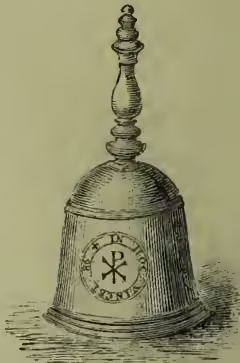
The accompanying cut shows an ancient specimen of this type from Brittany. Some of the Scottish bells, of the same primitive type, are figured and described in Dr Joseph Anderson's Scotland in Early Christian Times (Rhind Lectures, Edin. 1881). The four-sided bell of St Gall, an Irish missionary who died about 646, is still shown in the monastery of the city which bears his name in Switzerland.
Ancient Bell from Brittany.
Church-bells were suspended either in the steeples or church-towers, or in special bell-towers. They were long of comparatively small size: the bell which a king presented to the church of Orleans in the 11th century, and which was remarkable in its age, weighed only 2600 lb. In the 13th century much larger bells began to be cast, but it was not until the 14th century that they reached really considerable dimensions. The bell 'Jacqueline' of Paris, cast in 1400, weighed 15,000 lb.; another Paris bell, cast in 1472, weighed 25,000 lb.; the famous bell of Rouen, cast in 1501, weighed 10 tons; 'Great Tom' at Christ Church, Oxford, a faulty bell, cast in 1680, 7 tons; 'Great Tom' at Lincoln, cast in 1834, 5 tons; the Great Bell at St Paul's, cast in 1881, 17 tons; the church of the Sacred Heart at Montmartre, close on 19 tons. Many of these weights have been imperfectly verified, and must be received with reserve. See Gatty's The Bell (1848), Stainer's Great Paul (1882), North's English Bells and Bell-lore (1891), and the present writer's Church Bells of Suffolk (1891); with a bibliography of English Campanology.
Associated in various ways with the ancient ritual of the church—insomuch that Mohammedanism (q.v., p. 249) rejects the use of bells and substitutes the muezzin's cry—bells acquired a kind of sacred character. They were consecrated by a complete baptismal service; received names, had sponsors, were sprinkled with water, anointed, and finally covered with the white garment or chrism, like infants. This usage is as old as the time of Alcuin, and is still practised in Roman Catholic countries. Bells had mostly pious inscriptions, sometimes indicative of the widespread belief in the mysterious virtue of their sound. They were believed to disperse storms and pestilence, drive away enemies, extinguish fire, &c. The medieval inscription, 'Voce mea viva depello euneta nociva,' is still frequently found on bells in the west of England. Among the superstitious usages recorded to have taken place in old St Paul's Church in London, was the 'ringing the hallowed belle in great tempestes or lightnings.' The strange notion that bells are efficacious in dispelling storms is by no means extinct.
Church-bells were at one time tolled for those passing out of the world, in order that the people might put up their prayers for the dying person, as we learn from the Rationale of Durandus. The tolling of the passing-bell was retained at the Reformation; nor do the Puritans seem to have objected to the practice, as, for instance, when Dr John Rainolds was dying, 'he expressed by signes that he would have the passing bell tole for him.' But by the beginning of the 18th century, the passing-bell, in the proper sense of the term, had almost ceased to be heard; the tolling took place after the death, instead of before. The practice of slowly and solemnly tolling church-bells after deaths, and before funerals, is still an established usage throughout England. The Pardon, Gabriel, or Ave bell, prior to the Reformation, was rung at morning, noon, or evening, or before or after service, inviting to the recitation of the salutation of the angel Gabriel, Ave Maria, gratia plena, Dominus tecum, for purposes of intercessory prayer, or the forgiveness of personal sins. The Ave bell was generally one of the ring dedicated to the angel Gabriel, and bearing on it the words of the Annunciation; but any bell might serve the purpose. The Sanetus or Sacring bell, rung at the Sanctus in the mass and at the elevation of the host, was often hung in a place by itself, usually on the gable at the east end of the nave; but a small hand-bell is now usual. Vesper-bell, properly the bell that summons to Vespers (q.v.), is usually a popular phrase for a bell rung at evening. Bishop Burnet has recorded the order of Bishop Shaxton of Sarum in 1538, concerning the discontinuance of the custom.
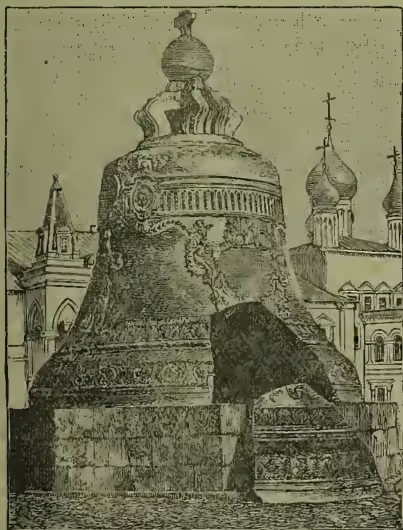
The ringing of the eurfew-bell, supposed to have been introduced into England by William the Conqueror, was a custom of a civil or political nature, and only strictly observed till the end of the reign of William Rufus, the statute being abolished by Henry I. in 1100. Its object was to warn the public to extinguish their fires and lights at eight o'clock in the evening. The eight o'clock ringing is still continued in many parts of England and Scotland. 36,364 lb. The largest bell in the world is the Great Bell, Monarch or Czar Bell (Tsar Kolokol), of Moscow. It is 19 feet high, 60 feet round the rim, and weighs 198 tons. Cast in 1653, it came cracked out of the foundry, and never was hung. In 1837 it was raised on a granite basement, and makes a kind of chapel, the broken side forming the doorway. Another Moscow bell, the largest in use, weighs 128 tons. The Great Bell at Pekin weighs 53 tons; the 'Kaiserglocke' of Cologne Cathedral (1887), 14 feet high, 11 in diameter, is made of 22 French cannon, and weighs 26 tons 13 cwt.; those of Olmütz, Rouen, and Vienna, nearly 18 tons; that first cast for the New Palace at Westminster (but cracked), 14 tons; that of the Roman Catholic cathedral at Montreal (cast 1847), 13 tons; 'Great Peter,' placed in York Minster 1845,
On all that belongs to the playing of bells in belfries, the inventive genius of the Netherlands long since arrived at proficiency. In some of the church-towers of that country, the striking, chiming, and playing of bells is incessant; the tinkling called chimes usually accompanies the striking of the hours, half-hours, and quarters; while the playing of tunes comes in as a special divertisement. In some instances, these tune-playing bells are sounded by means of a cylinder, on the principle of a barrel-organ; but in others, they are played with keys by a musician. The term carillons is used either to the tunes played on bells, or of the suites of bells which yield this kind of music. The tower of Les Halles, at Bruges, is allowed to have the finest carillons in Europe (see BELFRY, CAMPANILE).
Many of the church-towers throughout England, in villages as well as in towns, are provided with peals of bells, the ringing of which is a well-known practice. The number of changes or permutations of order that can be rung on a peal, is the factorial of the number of bells—i.e. the continued product of all the natural numbers from unity to the number of bells. Thus: 3 bells allow 6 changes; 4 bells, 24; 8 bells, 40,320; 12 bells give as many as 479,001,600 changes. The ringing of peals differs entirely from chiming or tolling.
There is no method of sounding bells equal to the English ringing, when the bell at each pull revolves round a complete circle, and is under the full command of the ringer. This power over the bells makes the sequence of sounds to be regulated at the will of the band of performers, each of whom has his bell, while the leader 'calls' the peal. It is of course necessary that strict order should be observed in arranging the changes, for no unassisted memory would carry a ringer far into the peal. Also, from the nature of bell-machinery, a certain time must elapse between two strokes of the same bell, to allow for its swinging round. The first known writer on the subject is Fabian Stedman, a Cambridge printer, whose Tintinnologia was published in 1668. He is said to have printed his changes on slips of paper in his leisure hours, and taught them to his company in the tower of St Benedict, Cambridge. According to his account, there was no idea of change-ringing till the beginning of the 17th century, though there certainly seem traces of it in Udall's Ralph Roister Doister, which was written in 1553. Once started, the art made rapid progress, and rings of bells increased from five or six to ten and twelve, the latter being the greatest number ever rung in peal. The simplest peals are those called Grandsire on an odd number of bells, and Bob on an even number. Thus, changes on seven bells, with the tenor, or great bell, sounded last in each change, are called Grandsire Triples; on nine, Grandsire Cuters; and on eleven, Grandsire Cinques; while on six, eight, ten, or twelve, the more usual methods are respectively Bob Minor, Bob Major, Bob Royal, and Bob Maximus. There are, however, a variety of other methods of producing the changes, known as Oxford Treble Bob, Norwich Court Bob, &c. The muffled peal, which is an invention of later days, is rung with a leather cap over half of the chapper, thus rendering the chimes alternately clear and dull. The effect is very fine.
The general method of making bells has not varied much for centuries, though constant modifications in detail have come into vogue. A core of brickwork covered with soft clay is moulded to the intended form of the inner surface of the bell by means of a curved compass called a crook; and in a similar way the form of the outer surface is moulded on the inside of the outer mould, or cope. The cope is fitted over the eore, with a hole left at the top for the escape of the air, and the metal in a state of fusion is admitted to fill the space intervening between the cope and the core (see CASTING).
The art of casting bells in sequence of sound appears to have been practised after the Conquest, partly by ecclesiastics, and partly by handicraftsmen, who produced bronze lavers, mortars, and after a time cannons, as well as bells. Walter of Odington, a monk of Evesham, in the time of Henry III., has given careful directions for producing a tunable ring, and Sandre (or Alexander) founder of Gloucester, shortly afterwards, was an ecclesiastic. By the end of the 14th century the work appears to have fallen entirely into the hands of laymen; and excellent bells of the period from that time to the Reformation from the foundries in Norwich, Bury St Edmunds, York, Leicester, and other centres, remain in abundance all over England. Nor has the general form of the bell undergone much change since that time. The late 'Tom of Lincoln,' weighing a ton less than the present bell, was cast in the Minster Yard in 1610 by the joint efforts of Henry Oldfield of Nottingham and William Newcombe of Leicester. The bells made by Miles Graye of Colchester, who died in 1649, are deservedly much esteemed by ringers. At the present day the principal foundries in England are those of Messrs Mears & Stainbank, Whitechapel; Messrs Warner & Sons, Cripplegate; and Messrs Taylor & Co., at Loughborough. The foundry at Louvain, lately famous under M. Severin van Aerschoot, has produced many excellent bells, great and small, since the days of the Van den Gheyns, more than three centuries ago. A few medieval bells from Venlo are still found in England. The twelve bells of Christ Church, Oxford, are renowned for their tone; the largest peal in England is that of St Paul's (12 bells, the tenor weighing 64 cwt.).
Rings of bells other than carillons are apparently unknown on the Continent, but in every considerable town fine-toned large bells are to be found, sometimes in sequence though in different churches. Very few old bells remain in France, some districts having been entirely cleared of them in the time of the first Napoleon.
The cost of bells varies according to the current price of tin and copper. It may be taken at from £6 to £7 per hundredweight, so that a ring of twelve bells of the best quality can be obtained for about £1200. The recent invention of tubular bells of steel, patented by Harrington of Coventry, may revolutionise all our notions of ringing, but it is as yet hardly on its trial. The tubes, varying in length from 4 or 5 to 12 or 14 feet, are suspended in a frame in the belfry by means of cords passed through holes in the upper part of each tube, and are struck by a hammer above the point of suspension. The volume of sound is remarkable both for mellowness and fullness; and a ring of eight bells costs from £75 to £130, according to size.
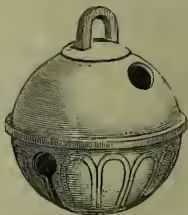
The custom of hanging bells on the necks of horses, cows, and other animals, was in use by the Romans, and still survives in Switzerland and elsewhere. The bells are useful in the dark, or when the animals that wear them are out of sight. The attaching of small spherical bells or crotals to riding and sleigh-horses is common in some parts of Europe and America. These crotals used for this purpose are often exactly like those found in British graves, which were suspended on the spear of the warrior.
The hanging of bells in dwelling-houses, and ringing them by means of wires from the different apartments, is quite a modern invention; for it was not known in England in the reign of Queen Anne.
More recently, electric bells have been introduced. A galvanic battery requiring attention only at long intervals is used. From this an insulated wire goes to a 'press-button' in a room or lobby, thence to the bell, and back to the battery to complete the circuit. The press-button makes contact when one requires to ring; at other times the current is broken. Beside the bell there is an electromagnet, with an arrangement by which a spring is attracted and released in rapid succession as long as the automatically interrupted current of electricity is passing. This spring carries a knob which strikes the bell as it oscillates to and fro. An index is used when the bell is rung by press-buttons from several rooms.
The best-known earlier campanologists are Hieronymus Magius (Girolamo Magi, an Italian jurist), Pacichelli, and Stockflet. Among later English writers, Lord Grimthorpe (Mr Beckett Denison, Q.C.) approached the subject from the side of acoustics, while Messrs Ellacombe, North, Stahl-schmidt, and others have investigated the archaeology of the bells of several districts in England. Schiller's famous Song of the Bell, and Poe's Bells, may be mentioned as notable amongst poems on the subject.
'Bells,' on shipboard, is a term having a peculiar meaning, not exactly equivalent to, but serving as a substitute for 'time' or 'o'clock' in ordinary land-life. The division of the day into watches, usually of four hours' duration each, is explained at WATCH. Each half-hour is marked by striking on a bell, in either single or double strokes. The number of strokes depends not on the hour, according to ordinary reckoning, but on the number of half-hours which have elapsed in that particular watch. Thus, 'three bells' is a phrase denoting that three half-hours have elapsed, but it does not in itself show to which particular watch it refers, and may indicate either half-past one, half-past five, or half-past nine in the ordinary watches, or half-past seven in the dog-watch, which is half the period of the ordinary watch. In foggy weather, both steamers and sailing-vessels when at anchor sound their bells (see FOG-SIGNALS).