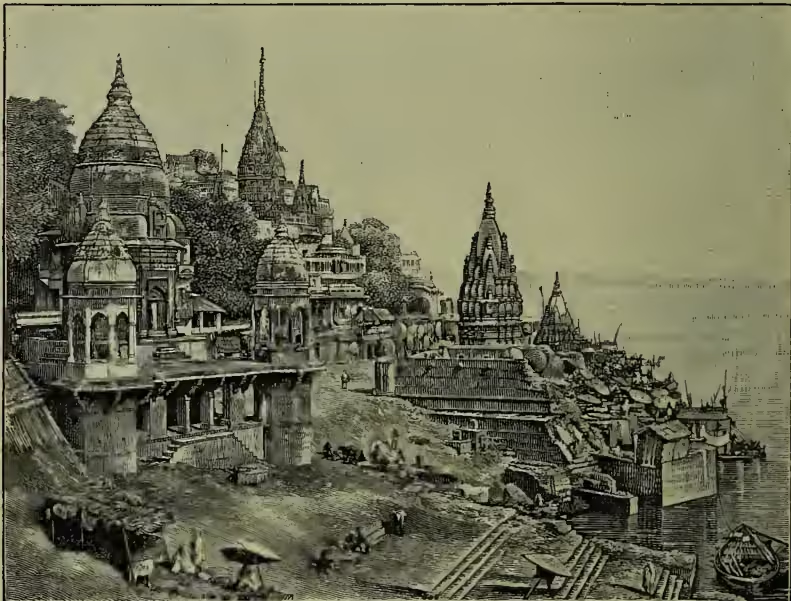
Benares (Banāras), the most sacred city of the Hindus, and one of the principal towns of North India, situated on the left or northern bank of the Ganges, 420 miles by rail from Calcutta, and 74 from Allahabad. It is the largest city in the North-west Provinces (excluding Oudh). It skirts the Ganges for 3 miles, and the high bank is lined continuously with broad flights of stairs or ghāts, leading to the innumerable temples and large substantial houses, which present towards the river an imposing array of towers and pinnacles and richly carved façades. The river takes a great crescent-like sweep at this point, and the view of the city is one of the most striking in the world. Benares, however, is disappointing internally, the streets being mere narrow lanes between the lines of tall, dismal houses. But the crowds of priests and pilgrims on the ghats and at the temples, the sacred bulls wandering at large, and even the wares exposed for sale, all point to the religious character of the place. Among the chief buildings are the Nepalese Temple, Auringzebe's mosque, with its two minarets 147 feet high; Raja Jai Singh's observatory; the Gopal Mandir, wealthiest of all the temples; the Bisheswar or Golden Temple of Siva, the holiest of all; and the famous Monkey Temple, in the suburbs. Other points of special interest are the well of Mani Karniki, formed of Vishnu's sweat; the Juana-vapi, or 'pool of knowledge,' and the Lat Bhairo, a portion, it is believed, of one of Asoka's pillars. To bathe in the Mani Karniki is to be cleansed from all sins for time and eternity. At the Burning Ghat the bodies of Hindus are reduced to ashes. The city counts 1450 Hindu temples or shrines, most of them small, and 272 Mohammedan mosques. In the European part of the city there is the Government College, a large freestone structure, with 700 students; the Prince of Wales's Hospital; and a town-hall. By far the most important European work is the new Dufferin Bridge, opened on the 18th of December 1887, on the East Indian and Oudh and Rohilkhand railways. It crosses the Ganges in sixteen spans, having a total length, not including approaches, of 3518 feet. Formerly there was only a bridge of boats, which had to be withdrawn during the floods. Benares draws immense revenues from the thousands of pilgrims who visit it from all parts of India. It has a considerable trade, not only in country produce, but in English goods, jewelry, and precious stones. Its brass-ware, kinob or gold-cloth, and lacquered toys are famous. Pop. (1881) 191,025, of whom 147,230 were Hindus, 45,529 Mohammedans, and 266 Christians; (1891) 222,420, of whom 160,000 are Hindus.—A city of great antiquity, Benares (Sansk. Vārāṇasī) was for 800 years the headquarters of Buddhism. In the 4th century B.C. it reverted to the ancient faith, of which it has ever since been the metropolis. It has been in the hands of many temporal rulers—the Rajput princes, the Mogul emperors, the Oudh nawabs—being ceded by the latter to the English in 1775. There was a rising here during the Mutiny in 1857, but it was promptly dealt with, and the constant passage of troops from Calcutta to the north kept the city free from disturbance. The western suburb of Sikrol (Secrole) contains the military cantonments and European quarter; the suburb of Sighra is the seat of most of the missionary institutions.—The district has an area of 998 sq. m. The climate is the hottest and dampest in the North-west Provinces, the mean temperature being 77°, and the annual rainfall about 40 inches. The soil is very fertile. The population is over 900 to the square mile.