Bend, in Heraldry, one of the figures known as Ordinaries, consists of the space contained between two parallel lines crossing the shield diagonally from dexter chief to sinister base (fig. 1). It is said to occupy a fifth part of the shield unless charged, when it occupies a third part. Its diminutives are the Bendlet, which is half its width (fig. 2), the Cotise (q.v.), one-fourth (generally borne in pairs flanking the bend), and the Ribbon, one-eighth of its width. In early Heraldry the bend was used as a difference or mark of cadency as well as an original bearing.
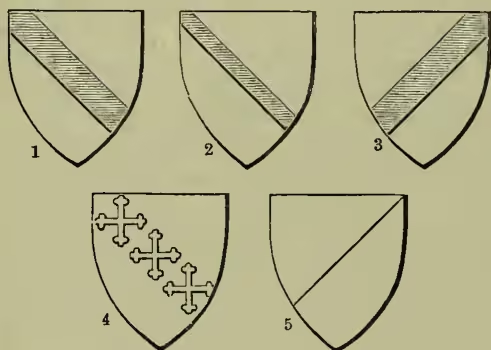
The Bend-sinister is an occasionally occurring variety of the bend, drawn from sinister chief to dexter base (fig. 3). The Searpe is its diminutive; and that well-known mark of illegitimacy, the Baton-sinister (q.v.), is also so accounted.

Charges placed in the direction of a bend are said to be bendwise, and when a bend is charged with other figures, the charges on it are understood to be placed bendwise. The term in bend, when applied to several charges, differs from bendwise, in so far as it has reference to the relative position of the charges, not the direction in which each charge lies, as will be understood from the figure, where the three charges botonné are placed palewise in bend (fig. 4).
A field divided by a diagonal line in the direction of a bend is said to be parted per bend (fig. 5).
Bendy is a term applied in Heraldry to a field divided into four or a larger even number of parts by lines drawn diagonally, or in the direction of a bend as in the figure, Bendy of six argent and azure.