Bessemer, SIR HENRY, F.R.S., inventor, born 19th January 1813, at Charlton, Herts, was the son of a French artist, and was to a great extent self-taught. He was a prolific inventor, as the volumes issued by the Patent Office show; indeed, it was said he paid in patent stamp duties alone as much as £10,000. The working out of many of his inventions, however, resulted in a loss to himself and to others. His first pecuniary success was obtained by his invention of machinery for the manufacture of Bessemer gold and bronze powders, which was not patented, but whose nature was long kept secret. His process for the manufacture of steel, noticed below, raised the annual production of steel in England from 50,000 tons by the older processes to as many as 1,600,000 tons in some years. Bessemer steel is also largely made abroad. This steel soon averaged £10 per ton, while the price of (much finer) steel before the introduction of his process averaged not less than £50 per ton. Bessemer was knighted in 1879, and received many gold medals from scientific institutions. In addition he had, to use his own words, received in the form of royalties 1,057,748 of the beautiful little gold medals issued by Her Majesty's Mint. He died 15th March 1898.
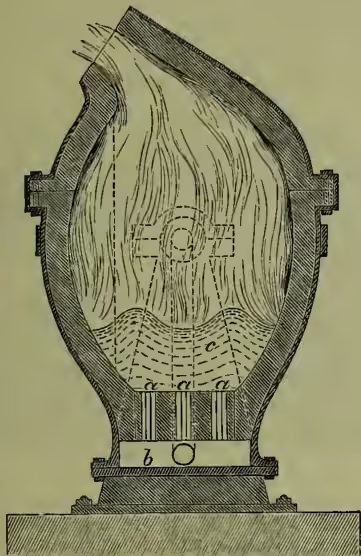
a, a, a, tuyères; b, air-space; c, melted metal.
BESSEMER STEEL.—Sir Henry Bessemer's process for making steel, which is now so largely practised in England, on the continent of Europe, and in America, was patented in 1856. It was first applied to the making of malleable iron, but this has never been successfully made by the Bessemer method. For the manufacture of a cheap but highly serviceable steel, however, its success has been so splendid that no other metallurgical process has given its inventor so great a renown. Although the apparatus actually used is somewhat costly and elaborate, yet the principle of the operation is very simple. A large converting vessel (see annexed figure), with openings called tuyères in its bottom, is partially filled up with from 5 to 10 tons of molten pig-iron, and a blast of air, at a pressure of from 18 to 20 lb. per square inch, is forced through this metal by a blowing engine. Pig-iron contains from 3 to 5 per cent. of carbon, and, if it has been smelted with charcoal from a pure ore, as is the case with Swedish iron, the blast is continued till only from 25 to 1 per cent. of the carbon is left in the metal, that is to say, steel is produced. Sometimes, however, the minimum quantity of carbon is even less than 25 per cent. In England, where a less pure but still expensive cast-iron—viz. hæmatite pig—is used for the production of steel in the ordinary Bessemer converter, the process differs slightly. In this case the whole of the carbon is oxidised by the blast of air, and the requisite quantity of this element is afterwards restored to the metal by pouring into the converter a small quantity of a peculiar kind of cast-iron, called spiegeleisen, which contains a known quantity of carbon. But small quantities of manganese and silicon are also present in Bessemer steel. The 'blow' lasts from 20 to 30 minutes. Steel made from whatever kind of pig-iron, either by this or by the 'basic' process, presently to be described, is not sufficiently dense, at least for most purposes, and it is accordingly manipulated under the steam-hammer and rolled into a variety of forms. Bessemer steel is employed for heavy objects, as rails, tires, rollers, boiler plates, ship plates, and for many other purposes for which malleable iron was formerly used.
Basic Steel.—This kind of steel is now largely made from inferior pig-iron, such as the Cleveland, by the Thomas-Gilchrist process patented in 1878. It is, however, only a modification of the Bessemer process to the extent of substituting for the siliceous or 'acid' lining generally used, a lime or 'basic' lining for the converter. Limestone, preferably a magnesian limestone in some form, is commonly employed for the lining. By the use of a basic lining, phosphorus is eliminated towards the end of the 'blow.' Phosphorus is a very deleterious substance in steel, and is present, sometimes to the extent of 2 per cent., in pig-iron smelted from impure ore.