Bethlehem ('house of bread;' modern Beit-lahm), the birthplace of Jesus Christ and of King David, and the Ephrath of the history of Jacob, is now a small unwalled village of white stone houses, in the midst of a most interesting country, 6 miles S. of Jerusalem. The population, about 3000 souls, is wholly Christian—Latin, Greek, and Armenian. The Convent of the Nativity, a large square building, resembling a fortress, was built by the Empress Helena, 327 A.D., but destroyed by the Moslems in 1236, and, it is supposed, restored by the Crusaders. Within it is the Church of the Nativity, which is subdivided among the Latins, Greeks, and Armenians, for devotional purposes. The church is built in the form of a cross; the nave, which is by far the finest part of the building, belongs to the Armenians, and is supported by 48 beautiful Corinthian columns of solid granite, each between 2 and 3 feet in thickness, and about 17 in height. The other portions of the church, forming the arms of the cross, are walled up. At the farther end of that section, which forms the head of the cross, and on the threshold, is a sculptured marble star, which the Bethlehemites say covers the central point of the earth. Here a long intricate passage descends to the crypt below, where the blessed Virgin is said to have been delivered. The walls of the chamber are hung with draperies of the gayest colours; and a silver star, with the words, 'Hic de virgine Maria Jesus Christus natus est,' marks the spot of the nativity. The manger stands in a low recess cut in the rock. The site appears to have been venerated since the 2d century A.D., and St Jerome, a monk of this convent towards the end of the 4th century, found the grotto in possession of pagans, who celebrated here the birth of Adonis. To the north-west stands than a hostile invasion, and on arriving under the walls of Presburg, was greeted with acclamations by the citizens. He was subsequently crowned king of Hungary by the assembled diet, August 25, 1621. After various alternations of fortune, in which he was ultimately successful, a peace was in 1621 concluded with Ferdinand II. of Austria, by which Gabor gave up his claims to Hungary and the title of king, but obtained large accessions of territory, and the dignity of prince of the empire. This treaty, however, was soon broken by the emperor; but the prince raised an army of 60,000 men, invaded Moravia, and obtained the solemn renewal of the former treaty. He died in 1629. His reign was a glorious epoch in the history of the principality; for not only did his military successes give a prestige to its arms, but his protection of science and letters did much to aid the progress of learning.
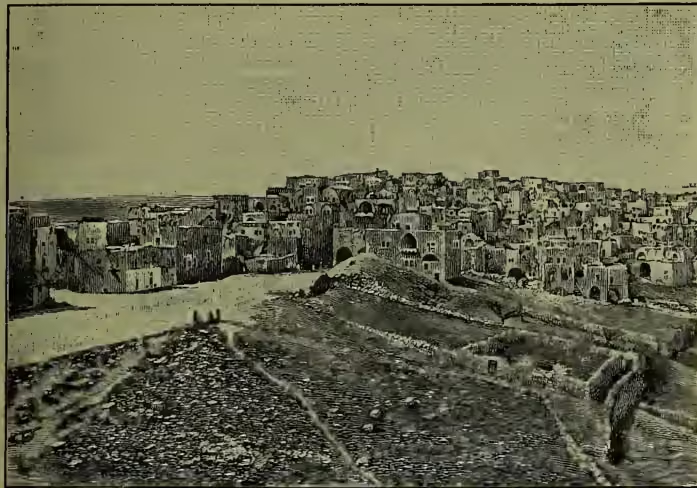
a square domed building, marking the reputed site of Rachel's tomb. The Bethlehemites chiefly gain their subsistence by the manufacture and sale of crucifixes, beads, boxes, shells, &c. of mother-of-pearl and olive wood.