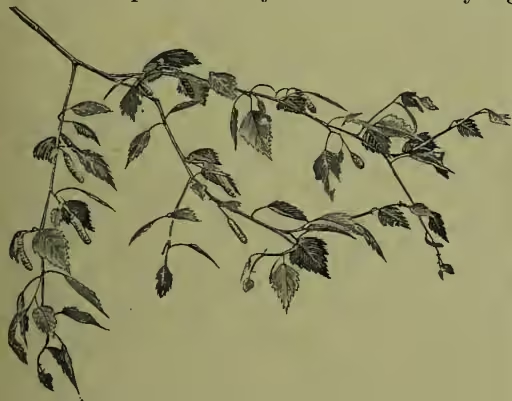
Birch, THOMAS, D.D., an industrious historical writer, born at Clerkenwell in 1705, was the son of yellow. The bark is sometimes used for tanning, and for steeping nets, sails, and cordage (see BARK FOR TANNING). It is in some countries made into shoes, hats, drinking-cups, &c., and is even twisted into a coarse kind of ropes, and is the material of which the North American Indians made their light canoes. It is remarkable for its durability, which even exceeds that of the wood itself. In many parts of the north of Europe it is used instead of slates or shingles by the peasantry; and in Russia—the outer or white layers being subjected to distillation—there is obtained a reddish empyreumatic oil called Birch Oil, of which a somewhat tarry form, the so-called degutt or degget, is employed in the preparation of Russia leather. Dried, ground, and mixed with meal, birch bark is used in Norway for feeding swine; and in times of scarcity has even served for human food. The wood is white, firm, and tough, and is employed by turners, wheelwrights, and coopers, who use it in the manufacture of barrels for fish. Much of it is made into charcoal for forges. The twigs are in general use for besoms, and for the 'birch' used in flogging naughty boys. On account of its fragrant smoke, birch brushwood is much em- a Quaker, but in 1730 took Anglican orders, and received half a dozen preferments in the course of the next thirty years. He was killed by a fall from his horse in the Hampstead Road, 9th January 1766. He was author or compiler of Lives of Boyle, Tillotson, Queen Elizabeth, Prince Henry, &c.