Bittern (Botaurus), a genus of birds nearly related to the herons (Ardea). Bitterns are chiefly distinguished from herons by the long, loose plumage on the front and sides of the shorter neck, and by the greater length of their toes, the middle one being as long as the shank. The feathers can be erected so as greatly to increase the apparent size of the bird. The back of the neck is downy or almost bare.
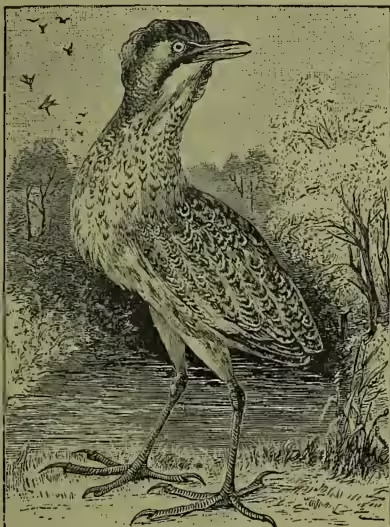
They are almost all solitary birds, inhabiting reedy and marshy places, where they lie hid during the day, and will almost allow themselves to be trodden upon before they take wing. They feed during the night, and then often rise to a great height in the air, making the night noisy with loud resounding cries. Their food consists chiefly of frogs, and partly, also, of fish, lizards, water-insects, &c., and even of small birds and quadrupeds. The claw of the middle toe is serrated on the inner edge, probably to aid in securing slippery prey. The Common Bittern (B. stellaris) is distributed very widely over the Old World, being found in almost all, at least of the temperate, parts of Europe, Asia, and Africa, which are sufficiently marshy for its manner of life. It is now rare in Britain, owing to drainage; but was formerly more common, and in the days of falconry, was carefully protected on account of the sport which it afforded. Its flesh also was in high esteem, not being rank and fishy, like that of the herons generally. In size it is rather less than the common heron; the sharp bill is about 4 inches long, the feathers on the crown of the head are greenish black, and the plumage in general of a dull yellow colour, beautifully and irregularly marked and mottled with black and reddish brown.
The bittern makes a rude nest of sticks, reeds, &c. in its marshy haunts, and lays four or five greenish-brown eggs. It has a peculiar bellowing or booming cry, especially insistent at the breeding-season. This has earned for it such English provincial names as Mire-drum, Bull of the Bog, &c., and many of its appellations in other languages, perhaps even its name Bittern (Bitour, Botur, Botaurus). Some naturalists used to assert that the booming cry of the bittern was produced by the bird inserting its bill into a reed; that notion, however, has long since been exploded. The animal is sluggish, and its flight is neither swift nor long sustained. When assailed, it fights desperately with bill and claws; and it is dangerous to approach it incautiously when wounded, as it strikes with its long sharp bill, if possible, at the eye.—The Little Bittern (B. minutus) is common in some parts of Europe, but rare in Britain. Its whole length is only about 13 inches. The American Bittern (B. lentiginosus), a species almost equal in size to the common bittern, and very similar to it in habits and voice, has occasionally been shot as a straggler in Britain. It is common in many parts of North
America, migrating northward and southward, according to the season. The crown of the head is reddish brown, and the colours and markings of the plumage differ considerably from those of the common bittern. The Least Bittern (B. exilis) is another North American species, of very small size, which is also migratory, and somewhat social in its habits. The Australian Bittern (B. australis) is generally diffused throughout Australia, wherever marshes or sedgy rivers occur. In habits it closely resembles the bittern of Europe. The head and upper parts generally are purplish brown, except the wings, which are buff, conspicuously freckled with brown; the throat, breast, and belly mottled brown and buff.