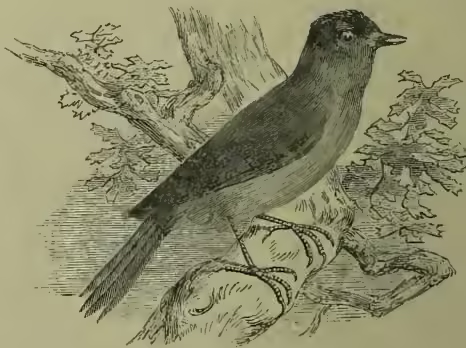
Blackcap, BLACKCAP WARBLER, or BLACKCAP FAUVETTE (Sylvia atricapilla), a bird of the great family of the Sylviae, or Warblers. It is regarded as the sweetest song-bird in Britain, or indeed in Europe, except the nightingale, to which it is said to be even superior in 'its shake or trilling note.' Very often, however, the strain is desultory, and of short continuance; but it is loud, rich in tone, and has a 'great variety of sweet and gentle modulations.' The song is especially joyous during and after rain. White says, in his Natural History of Selborne, that while the Blackcap warbles, its throat is wonderfully distended. It is a rather smaller bird than the nightingale; the female is larger than the male. The general colour is gray, with an olive tinge above, and becoming white below. The upper part of the head in the male is jet-black; in the female, of a rusty-brown colour. The feathers of the head, both in the male and female, are somewhat erected, giving the bird a hooded appearance, on account of which it is called, in Germany, 'the monk.' In Britain, the Blackcap is only a bird of passage, arriving early in spring, and retiring in September. It is most frequent in the southern counties of England, but is found even in Scotland; on the Continent, it extends its migrations as far north as Lapland. In the south of Europe, it is found both in summer and winter, and especially frequents bushy places. Its beautiful song, sometimes spoilt by successful mimicking, and its lively affectionate habits, make it a favourite captive. See WARBLER.