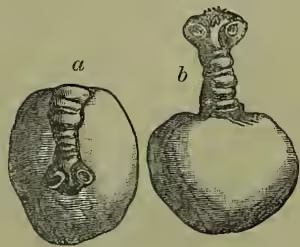
Bladder-worm, the asexual stage of a tapeworm or cestode. It is found encysted in a host which is likely to be eaten by the final host of the tapeworm. The stage owes its name to the bladder-like form resulting from the encysted embryo. Within the bladder a 'head' is developed (a in fig.), which is eventually turned outwards, and retains the bladder as a sort of appendage (b in fig.). In exceptional cases (see HYDATIDS) the bladder buds off internally, not one head but many. On passing to the final host the bladder-worm loses its bladder, and the head or scolex, becoming attached to the gut, buds off the familiar chain of 'joints,' which gradually become sexually mature. Before the life-history of cestoid parasites was understood, the bladder-worms were described as separate organisms, but they are now known to be simply the asexual stages of an 'alternation of generations.' Thus the Cysticercus cellulosa or bladder-worm of the pig becomes the Tænia solium or tapeworm of man; the C. medio-canellata of ox, the T. saginata of man; the C. fasciolaris of the mouse, the T. crassicollis of the cat; the Cænurus cerebralis of the sheep, the T. canurus of dog; the Echinococcus of man, the T. echinococcus of dog, and so on. The bladder-worm is more passive, vegetative, and entirely asexual; the tapeworm joint is more active, its nutrition probably more stimulating and variable, its reproduction sexual. See CESTOID WORMS, TAPEWORM.