Blasting is the method of loosening or shattering masses of solid fracturable matter by means of explosive compounds. It is an operation of fundamental importance in Engineering and Mining, for, without the agency of powerful explosives, many of the greatest undertakings of modern times would have been practically impossible. Previous to the invention of gunpowder the only means of quarrying stone and of extracting minerals from the earth was by the hammer, chisel, and wedge, or by the expansive power of heat. For obtaining large regular blocks of stone the wedge is still used, and blasting has to do not so much with quarrying as with disintegrating rock in the sinking of shafts, the cutting of tunnels, the formation of roads and railways, the removal of obstructions to navigation, and generally the shattering of solid masses, irrespective of the shape of the debris produced.
The explosives commonly used in blasting consist of gunpowder and preparations of nitro-glycerine, nitro-cotton or gun-cotton, and of several nitrates and chlorates. Blasting-powder contains less nitre than ordinary gunpowder, and is made in pellets of varying size, according to the extent of the blast. Nitro-glycerine is now used in the free condition only under exceptional circumstances, owing to the great risk of accidental explosion. As Dynamite (q.v.) it is absorbed and retained by porous ingredients with comparative safety and little diminished blasting efficiency. Gun-cotton (q.v.) is employed in the form of Lithofracteur, and in combination with nitrate of barium, under the name of Tonite. Blasting-jelly or gelatine, which is now largely used in the form of dynamite, consists of a solution of gun-cotton in nitro-glycerine, making a thick jelly-like mass of great explosive power. Numerous other explosives have been proposed and introduced, but many of them, from their instability, or from the great risks of their manufacture and handling, are prohibited under the provisions of the Explosives Act (see EXPLOSIVES). Among the drawbacks connected with the use of these substances must be reckoned the poisonous gases evolved by their explosion, and the danger of gas and dust explosions in fiery mines from sparks spread by blast-shots. For use in coal-pits, blasting-cartridges of highly compressed air, and of quicklime, have been proposed without success; but much more hopeful results are obtained from the use of the new water-cartridge, in which gelatine dynamite is surrounded with water.
The use of modern explosives renders three kinds of blasting practicable—(1) the small-shot system, (2) the mine system, and (3) surface blasts. The small-shot system consists of boring holes, 1 inch to 1½ inch diameter, sometimes more, and from 18 inches to 6 or 7 feet into the solid rock. The boring is done either by hand or machine power (see
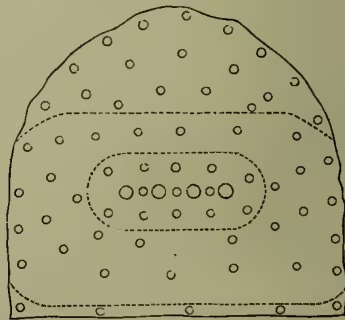
BORING). The hole is cleaned out, and the charge, generally in the form of a cartridge of sufficient diameter for the bore, is placed in its extreme end, and the remainder of the hole is tamped or closed with sand or clay. With the cartridge is connected a length of Bickford's time-fuse, which burns at a rate sufficient to enable the workmen to reach a shelter-place before the explosion takes place. In tunnelling and shaft-sinking a series of shot-holes, which embrace the superficial area to be excavated are driven and exploded in a connected manner, a core or central set being first fired off, after which a ring of shots around the core are simultaneously fired, and so on till the whole area is embraced. The accompanying sectional diagram of Mont Cenis Tunnel shows the position of the shot-holes in the face of the workings. For this simultaneous firing, lengths of fuse corresponding to the number of shots are connected in a metal case, called an igniter, whence they pass each to a separate shot-hole. But single or combined shots are fired with great advantage by electricity, for which purpose special cartridges, provided with two insulated wires instead of time-fuse, are used. These wires are connected up to any number of shot-holes, and the explosion is produced by a current of electricity passing from a special apparatus.
Large blasts or mines are resorted to when great masses of rock have to be removed at once, or when a great supply of irregularly broken stone is required. These blasts are of two kinds—shafts sunk from the top of the rock, and headings or galleries driven in from the face. In a shaft mine the charge of powder is placed in a chamber cut at one side of the shaft, so that the tamping may not be in the direct up line of fire. It is exploded by electricity, the wires from the battery being protected from injury from the rough tamping by being embedded in battens placed up one side of the shaft. Headings are driven, if possible, along a natural joint in the rock. The explosive may be divided and placed in two or more separate chambers, and it is better to distribute large charges than to fire them at one centre. The charges in these mines vary from 600 lb. to 13,000 lb. of powder, and even more, and they should dislodge from 3 to 6 tons of stone per lb. of powder exploded. The Round-down Cliff, on the South-Eastern Railway at Dover, was in 1843 overthrown by a blast of 18,500 lb. of powder in three separate charges. At Crarae Quarry, Argyllshire, in September 1886, a blast of 14,000 lb. of powder dislodged 60,000 tons of granite. Immediately after the explosion a crowd of onlookers rushed into the quarry, and by the liberation of poisonous gases in the confined state, nearly sixty persons were overcome, of whom seven died without recovering consciousness.
The removal of Hell Gate or Flood Island, in 79 parts chlorate of potash and 21 parts dinitrobenzole; and, second, a cartridge of dynamite, the two together filling the entire bore. In all, there were used 240,399 lb. of rackarock and 42,331 lb. of dynamite. Water was admitted to the mine, and it was exploded on the 10th October 1885. In the operations 80,166 cubic yards of rock were tunnelled out, and 270,717 cubic yards were blasted. The resistance offered to the explosives equalled 500,000 tons of rock and 200,000 tons of water.
Surface blasts are explosions produced by firing the explosive simply in contact with, or placed near the substance to be shattered. Such blasts have become possible only since the introduction of detonating explosives. Gunpowder fired in an unconfined space would spend its force through the air, and produce little local effect; but the explosion of nitroglycerine, gun-cotton, and other nitro compounds is so sudden that it acts with enormous violence in every direction, though within a limited area. Thus blasts of detonating compounds laid on the surface of any rock, &c., and fired by a detonator, operate downward and produce great shattering effects. Surface blasts have been largely used in removing reefs and other obstructions to navigation in the Long Island Channel, New York, which altogether has been the arena of the greatest of all blasting operations. Surface blasting is illustrated by the effects of the few successful explosions which have been perpetrated by dynamitards in London and elsewhere.