Blenny (Blennius), a genus of bony fishes, belonging to a large family (Blenniidae), in the division with spinous rays (Acanthopterygii). The family is characterised by Günther as follows: Body long, low, more or less cylindrical; naked, or with small scales; usually slimy. Dorsal fins extend along most of the back, often with prominent spinous rays. The hind fins are on the throat, with few rays, and may be rudimentary or absent. The family includes 32 genera, with more than 200 species, widely distributed on the coasts of temperate and tropical seas, though some are found in brackish or even fresh water. The Sea-wolf or Cat-fish (Anarrhichas), with its formidable teeth; the slimy Butter-fish (Centronotus); the Viviparous Blenny (Zoarces viviparus), which brings forth its numerous young alive, and is popularly credited with being the parent of eels (Ger. aalmutter); the brightly coloured Salarias; and many other interesting forms, belong to this family. They are carnivorous, and somewhat indiscriminate in their diet. There are but few British representatives.
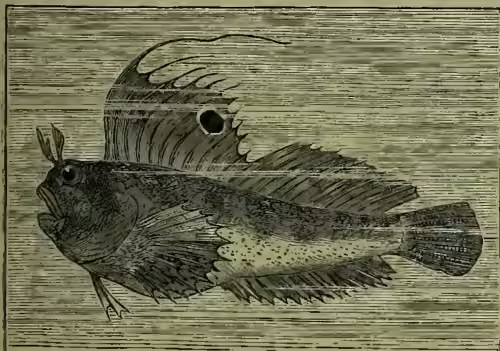
The blennies themselves have moderately elongated, short-tailed, naked bodies. There is usually a tentacle over each eye. There are about 40 species, which are usually marine, though several live temporarily or constantly in more or less fresh water. They swim in small shoals, and can live on the wet shore for a much longer time than the absence of a tide. They are said to use their ventral fins in clambering among the seaweed. They are all greedy flesh-eaters. B. gattorugine is rare on British coasts, but abundant farther south. The Butterfly Blenny (B. ocellaris) is a quaintly pretty little fish about 3 inches long, with flowing spines, and with an eye-like spot on its dorsal fin. It is most frequent towards the Mediterranean. The Smooth Blenny or Shanny (B. pholis), with similar distribution, has the spinous portion of the dorsal fin separate from the soft portion, and is of an olive-green colour irregularly marked with black spots. Like some of the others, it has in both jaws a long curved tooth, which it is said to use in detaching molluscs. There is no eye-tentacle. This organ is best developed in B. tentacularis, a Mediterranean form. B. vulgaris is found in fresh water in Italy, and also in the Rhone. The blennies are but rarely used as food, but their activity and hardiness make them favourite inmates of aquaria. See Günther's Introduction to the Study of Fishes.