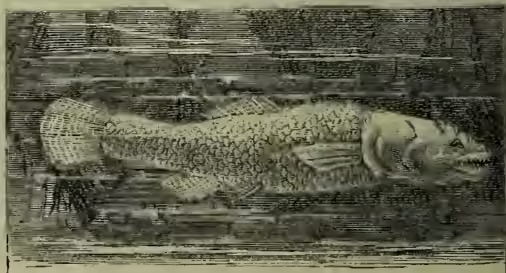
Blind Fish. In situations where light is absent, blind animals are commonly found. The absence of the normal stimulus has necessitated cessation of function and various degrees of degeneration in structure. In most cases rudimentary traces of eyes prove the fact of degeneration; and that the latter is largely the direct effect of the absence of the stimulus preserving the health of the eye is allowed by most (see DEGENERATION). The blind fish of the Kentucky caves (Amblyopsis, q.v.) has degenerate hidden remnants of eyes; Lucifuga dentata, a very different form, found in the subterranean caves of Cuba (though member of a marine family), is also blind; the Hagfish (Myxine glutinosa), though perhaps hardly a fish in the technical sense, has also virtually lost its eyes in association with its habit of spending much of its life buried in the mud, or parasitically within eels and haddocks; the primitive vertebrate, the Lance- let (Amphioxus, q.v.), is in the same state. In the sea the eyes of fish are large in proportion to the depth inhabited, down to 200 fathoms; big eyes are needed to make the most of the scanty light. Below the light-limit large-eyed forms occur, probably utilising the gleams of phosphorescence, or small-eyed forms with greatly developed tactile organs. In the greatest depths, however, as the result of the Challenger Expedition demonstrated (see Günther's Challenger Report on Fishes), fishes with rudimentary eyes occur, as one would indeed expect. See CAVE ANIMALS, ENVIRONMENT, FISHES.