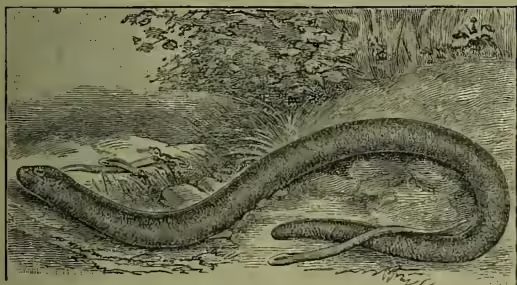
Blind-worm, or SLOW-WORM (Anquis fragilis), a limbless lizard, in the Skink family. The form is worm-like, tapering slightly in the tail; only internal traces of limbs are present; the two girdles are very rudimentary; the tail occupies about half the total length; the nostril is situated in a shield; the eyelids are scaly and movable; the ear-hole very small and hidden; the teeth borne on the jaws are long, pointed, and directed backwards; the tongue is scaly in front, with slender warts behind; the scales are smooth, and those of the head very distinctive. The colour varies considerably with age; the young are whitish above with a median black stripe, but black on the sides and below; the adults are brownish above and black below, often relieved by longitudinal lines. The full size is about a foot, about half of which goes to the tail, but large specimens may measure a foot and a half or more. The blind-worms are shy animals, living among bushes, and coming out at night in search of earth-worms and white slugs. They give a feeble bite, but are perfectly harmless. So timid are they that they become rigid when caught, and in this state an attempt to bend the greatly contracted muscles results in a breakage. The body divides in two, as the specific title fragilis implies. The young are born alive in midsummer to the number of 8 to 26. In winter they hibernate in holes in the ground, not alone, however, but in companies of two dozen or so. The blind-worms are found all over Europe, except in Sardinia and the northern regions, and are also known in North Africa and Western Asia. They appear to be hardy animals, and have been found more than 3000 feet up the Alps. They occur, though not abundantly, in Britain. White of Selborne gives an interesting account of their habits. It need hardly be said that they have no special connection with serpents, though similarity of habit has come to be associated with a superficial external resemblance. As true lizards they must also be distinguished from the much rarer amphibian Cæcilia (q.v.), to which the name blind-worm is also sometimes applied.