Block, in the rigging of a ship, is an important part of the apparatus necessary for raising sails and yards, tightening ropes, &c. The block comprises both the frame or shell, and the pulley or pulleys—usually termed 'sheaves'—contained within it. In nautical and mechanical language a tackle includes the rope as well as the block through which it works. Ships' blocks vary greatly in size, shape, power, designation, and use, but nearly every block comprises a shell or wooden exterior, a sheave or wheel on which the rope runs, a pin or axle on which the sheave turns, and a strap (of rope or iron) to fasten the block to any particular station.
For very many years, the uniform practice was to bind the shells by straps of rope—hempen or wire—but in more recent times, only the smaller class of blocks are thus bound, and those of a heavy calibre are environed by a band of iron—sometimes inside the shell, and said to be 'inside ironbound,' and sometimes outside, when they are termed 'outside ironbound.' Ironbound blocks have been in use in merchant-ships for a much longer period than in government vessels, on board which modern improvements are often slow of being adopted. A single block contains only one sheave, a double block, two; a treble block, three; and so on; while the term 'purchase-block' is generally applied to all blocks having more than two sheaves. All the blocks on board ship have distinctive names—e.g. cat-block, check-block, claw-garnet-block, claw-line-block, boat-block, snatch-block, &c., according to the kind of service they have to perform, or to their place of fixing, while not a few names are examples of the odd and sometimes unaccountable nomenclature adopted by seamen.
Ships' blocks are usually made of elm, and the sheaves of lignum-vitæ, the hardest kind of wood procurable in any considerable quantity. The pins are of iron or steel, and the bushes or bearing parts of the sheave are usually of brass. Patent roller bushes, which allow the sheave to turn with minimum of friction, have for several years been largely adopted. The figures show examples of the blocks most commonly in use.
Blocks made wholly of iron (see PULLEY) are used to some extent about the decks of ships, but are ill adapted for use in ships' rigging, on account of the chafing and fraying of ropes and sails thereby entailed.
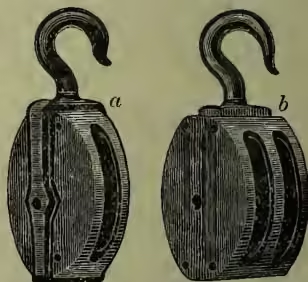
b, double 'inside ironbound' block
(with swivel hooks).
Until near the end of the 18th century blocks were all made by hand, and the trade was of considerable importance. For one of the old seventy-fours of the navy alone, more than 1400 blocks were required, and for vessels of larger or smaller size a proportionate number. The introduction of steam in place of the 'unbought wind' as a propulsive power, has materially reduced the number of blocks required on board ship, and the adoption of specialised labour-saving machinery has rendered their manufacture at the present time a matter of great ease and simplicity. Two men, comparatively unskilled, with the aid of the machines now in use, can produce as many complete blocks in one day as would have taxed the efforts of the skilled artificers of other days during the best part of a week. In 1781 a Mr Taylor began to make the sheaves and shells of blocks by a process which he had invented. He made all the blocks for the royal navy until the expiration of his patent rights. The Admiralty then commenced the manufacture on their own account. In 1801 Mr (afterwards Sir) Mark Isambard Brunel submitted to the Admiralty plans of a system of machinery for block-making, which was accepted, and the inventor engaged to set up the apparatus at Portsmouth. In 1808 the system was put into effective operation, it being found even then so perfect, that very few additions or improvements have since been needed. The machinery made blocks more accurately than they had ever been made by hand, and with the aid of ordinary workmen only. It could effect £50,000 worth of work in a year, or 140,000 blocks, by the assistance of ten men in attendance. Duplicate machinery was made for Chatham. Brunel received £20,000 for his invention and for his personal superintendence until the machinery was brought into working order; this sum was money well laid out, for the system saved to the country more than £20,000 a year, in the busy warlike period from 1808 to 1815.