Blood-stains, DETECTION OF, an important subject in connection with forensic medicine. On criminal trials the guilt of prisoners has frequently been established by the discovery of these stains. The following scheme shows the various methods employed in the investigation:
Visual—aided by a, ordinary lens; b, microscope; c, spectroscope; d, artificial light.
Chemical—a, heat—positive: (1, change of colour; 2, coagulation); b, ammonia—negative; c, hæmatin test; d, guaiacum test.
Blood when liquid stains all articles with which it comes in contact. It sinks into woven textures and such material as soft wood, but on metallic surfaces and on hard woods it forms a film of greater or less thickness, and quickly dries. At first it is of a reddish-brown colour, but in the course of a few weeks this deepens and becomes almost black.
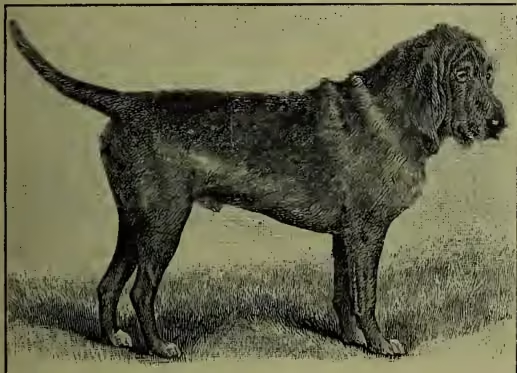
Looked at with a lens of low power—say 10 or 20 diameters—the blood, if in any quantity, and coagulated, and if it has not sunk into the texture of the cloth, is observed to present an irregular surface, and entangled in it have frequently been detected foreign materials which have afforded a clue to the culprit, and to the manner in which the crime has been committed. Thus hairs, fragments of cotton, epithelial scales from the throat, and minute fragments of birds' feathers have often been noted. This preliminary investigation concluded, the attempt is now made to discover the peculiar corpuscles of the blood (see BLOOD). This is a matter of great difficulty when the blood has stained such articles as linen or cotton stuffs and become dry, but when spilt on hard surfaces, or when it is in such quantity as to form a distinct coagulum, the corpuscles are generally easily determined by the following process. The object is, by breaking up the coagulum, to dissolve out the corpuscles in some medium as nearly as possible of the same density as the liquor sanguinis of the circulation. Numerous media have from time to time been proposed, such as solutions of sugar, phosphate of soda, iodide of potassium, &c., but the one generally employed is a solution of glycerine in but is now rare, though Lord Wolverton, who died in 1887, at one time hunted a pack of bloodhounds in Dorsetshire. Bloodhounds were also much used to track escaped prisoners, and are mentioned in the poetical histories of Bruce and Wallace as being used by their enemies to discover them; and in later days they were resorted to by slave-owners in America in the pursuit of fugitive slaves. The bloodhound is a large tan-coloured dog, with an exceedingly handsome and noble head expressing dignity and strength. The head should be long and narrow, with a dome-shaped skull, the occipital bone forming a peculiar peak on the back of the skull; the eyes distinctly showing the third eyelid or 'haw,' which gives the eye a bloodshot and rather fierce look; the ears long enough to meet in front of the nose, but falling down close on either side of the face; colour, a rich tan with a dark saddle, showing no white if possible. The bloodhound is rather unmanageable when thoroughly roused, on account of his courage and strength, but when properly treated is generally docile, and makes a capital watch-dog. Many interesting anecdotes are recorded of the perseverance and success of bloodhounds in following a track upon which they have been set, even when it has led them through much frequented roads. As recently as 1876 an unsuccessful attempt was made at Blackburn to track a murderer by means of a bloodhound.—The CUBAN BLOODHOUND, notorious as having been employed water of specific gravity 1.028. If this solution be applied, for example, to the stained blade of a knife, or if a minute portion of dried blood-clot be gently dissolved in it, a reddish fluid is obtained which under a high power of the microscope (300 diameters) rarely fails to exhibit numerous corpuscles which by their peculiar appearance (see BLOOD) are at once recognised to be mammalian blood-discs. In the case of stained linen, &c., there is greater difficulty. The stained portion must be thoroughly moistened with the solution, and then squeezed over a glass rod. When the reddish fluid reaches the surface, it must be removed with the blade of a knife, placed on glass, and submitted to the microscope. By this simple process, unless the stain be of great age, its character is determined. Human blood in these circumstances, however, cannot be distinguished from the blood of the other members of the great class of the mammalia, with the solitary exception of the camel tribe, which present an oval blood-corpuscle (see CAMEL).
Of late years, the interesting fact has been discovered that blood possesses a distinct spectrum, so that it is possible to determine that a reddish fluid is really blood, although the corpuscles may not have been discovered owing to their accidental destruction. The stained portion of cloth or a portion of blood-clot is digested in distilled water, and as the result a liquid of a reddish colour is obtained. This should be placed in a deep narrow cell and examined by a spectroscopic eye-piece with a low power of the microscope. Two dark bands make their appearance, one in the middle of the green rays, and the other at their junction with the yellow. These are highly characteristic of the presence of the blood of some red-blooded animal. See SPECTRUM, and SPECTROSCOPE.
Lastly, under this head of the visual detection of blood, the presence of blood-stains may unexpectedly be discovered with artificial light, by examining the furniture and especially the walls of an apartment on which blood has fallen. During the day the spots of blood remain undetected, but at night, and with artificial light, they are clearly visible. It is especially on papers with dark-blue figuring that this interesting fact has been observed.
The chemical relations of blood are very definite. All stains due to blood are soluble, and this fact enables us at once to distinguish them from insoluble stains which closely resemble them, and which have frequently been mistaken for them, such as paint and ironmould. The stain to be examined is cut out and suspended by means of thread in a glass tube filled with distilled water. Should the stain be at all recent, it immediately dissolves, and long filmy streaks of colouring matter are discharged and descend in wavy lines to the bottom of the tube, where ultimately a stratum of reddish fluid of greater or less intensity is collected. The clear supernatant fluid is poured off, and the coloured portion is divided into two parts. One part is boiled, and if the fluid contain blood, the following peculiar changes take place. The colour is discharged, the redness disappears and gives way to a grayish green, and in addition a distinct coagulum is formed. Both these changes are highly characteristic of blood. Should some liquor potassæ be now added, the coagulum is redissolved, and shows a green colour by reflected light. This may be described as a positive test of the presence of blood. The action of ammonia supplies us with a valuable negative one. If this volatile alkali be added to a solution of blood, no change of colour is produced. All other soluble stains are more or less altered in colour, such as those from the juices of fruits, &c., which have frequently been mistaken for blood, and thus have given rise to grave suspicions. Experiments were made in France to form a fluid which in its chemical reactions, it was expected, could not be distinguished from blood. Mixtures of madder and other colouring matters with white of egg were proposed, but while they coagulated with heat, there was no alteration in the colour of the liquid. If a particle of dried blood can be removed from a weapon or any surface, an attempt may be made to prove that it is blood by the formation of blood or hæmatin crystals. The procedure is as follows: the particle is placed on a microscopic glass slide and moistened with glacial acetic acid. The glass is now gently heated over a spirit-lamp, when ebullition occurs, the blood particle dissolves, and ultimately a reddish-brown stain is left. If this stain is examined by the microscope, peculiar prismatic crystals are visible among the dried debris.
Lastly, in several interesting medico-legal cases where it was suspected that articles of clothing had been washed in order to obliterate the traces of blood, its presence has been determined by its reaction with the resin of guaiacum. On the suspected site of the blood-stain are placed a few drops of a spirituous solution of guaiacum freshly prepared. The resin is at once observed to separate on the surface of the cloth; if to this is now added a small quantity of peroxide of hydrogen, a beautiful sapphirine-blue colour is struck.
Such are the chief means employed to detect blood. It is important to remember that they do not enable us to distinguish human from other mammalian blood—with the exception already mentioned—nor arterial from venous, nor male from female, nor adult from that of the young; but the blood-discs of birds and cold-blooded animals generally, from their size and other peculiarities, cannot be mistaken for those of man.
The standard works on medical jurisprudence are those of Taylor, Principles and Practice of Medical Jurisprudence (3d ed. 1883); Guy and Ferrier (5th ed. 1888); Woodman and Tidy; Orfila, Médecine légale; Briand; Caspar; Hoffman.