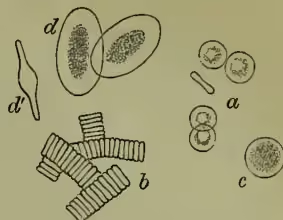
Blood, the nutritive fluid of the tissues and the great carrying tissue of the body, is the well-known red fluid which fills during life the arteries and veins of the body. It consists of an almost colourless fluid, the liquor sanguinis or blood-plasma, in which float a large number of small corpuscular bodies, the blood-corpuscles or blood-globules. The proportion of these to each other by weight is about one-third corpuscles to two-thirds plasma. The quantity of blood in the body by weight is about one-thirteenth part that of the whole body. When a drop of blood is examined under the microscope, the corpuscles floating about are seen to be of two kinds, distinguishable chiefly by their colour—the white and the red. The white are very much fewer in number than the red, the proportion in healthy blood being about 1 to 355. Even in health, however, this proportion is subject to considerable variations, and still more so in disease; in some forms of disease (e.g. Leuco-cythaemia) the white corpuscles almost equaling in number the red.
The white corpuscle is a pale granular-looking body, containing in its centre a small round nucleus. In common with all simple cellular bodies, it possesses the power of altering its shape from time to time, by alternately shooting out and withdrawing small processes from its substance, a movement to which the term ameboid is given from its resemblance to what is seen in the simple organism the Amæba (q.v.).
The red corpuscles, on being withdrawn from the body, tend to run together into heaps resembling piles of coins or rouleaux. Their peculiar colour is due to the presence of a special colouring matter (hæmoglobin). It is only when in bulk that they appear red and give the blood its characteristic red colour; the individual corpuscle itself is not red, but has more of a pale straw or fawn tint.
Throughout the animal kingdom two forms of red corpuscles are to be found. In man and in all other mammalians, with the single exception of the camel in which the shape is elliptical, the red corpuscles are minute circular discs, flattened on each surface, and entirely devoid of any central kernel or nucleus. Each surface presents a slight hollowing out or depression, which gives rise to the shaded appearance seen in the centre of the corpuscle when viewed from its flat surface. In all other vertebrate animals, including birds, reptiles, amphibians, and fishes, the red corpuscles are oval in shape, and contain a large central oval nucleus, the presence of which gives rise to a bulging in the centre of the corpuscle when viewed from its edge.
The red corpuscles of the blood vary much in size in different animals. In each species of animal they are always of uniform size. The corpuscles of mammals generally are much smaller than those of birds, those of reptiles and amphibians being still larger. In man the average size of the red corpuscle is about inch. The largest corpuscle of all—about inch in diameter—is to be found in Proteus (q.v.).
The number of corpuscles present in even a drop of blood is to be estimated by millions. In certain conditions of disease (e.g. Anæmia) the number may be reduced by one-half, one-third, or even more. They are formed in the spleen and red bone-marrow, probably also in the lymph glands, their exact mode of origin, however, being as yet obscure.
Composition of the Blood.—The red corpuscles are almost entirely made up of the colouring matter of the blood—hæmoglobin; but contain in addition a very small proportion of albuminous bodies, with lecithin and cholesterol. Of the salts contained in them, the most abundant are those of potassium.
The composition of the plasma is much more complex than that of the corpuscles. In addition to water, of which it mainly is made up, it contains albumens, fats, traces of sugar, and a large number of extractive bodies and salts. As regards the salts contained in it, the most important feature is the preponderance of the sodium salts over those of potassium.
The composition of the blood-plasma varies considerably at different times and under different conditions, according to the waste matters thrown into it from the tissues, or derived by absorption from the alimentary canal.
Coagulation of the Blood.—One of the most remarkable properties of the blood, and one which at all times has excited great interest and attention, is the property it possesses of 'clotting' or 'coagulating' on being withdrawn from the body. In the vessels of the body the blood is in a fluid condition; but shortly after being withdrawn, instead of remaining fluid, it becomes viscid and gelatinous, and finally 'sets' into a firm jelly-like mass, so that the vessel containing it can be inverted without any of it escaping. If it be now set aside for a few hours, a clear somewhat straw-coloured fluid gradually separates from this mass, and collects between the clot and the sides of the vessel in which it is contained. This gradually increases in quantity till finally the blood is divided into two portions, a firm red clot, which retains the shape of the vessel, floating free in a clear, transparent, straw-coloured fluid—the blood-serum. Coagulation is not a simple cooling of the blood, as was formerly supposed. On the contrary, it is delayed by cold; and by surrounding the blood with ice it can be prevented altogether. The rapidity with which it takes place varies considerably in different cases. It can be entirely prevented by the addition to the blood of various salts, especially those of sodium and magnesium. The blood remains fluid within the blood-vessels in virtue of some property possessed by their walls. Even after death the blood may remain an indefinite time without coagulating; but on being withdrawn from the blood-vessel it at once coagulates.
The clot which forms as the result of coagulation retains the shape of the vessel into which the blood has been poured, and presents usually a cup-shaped depression on its upper surface. It consists almost entirely of the red corpuscles of the blood entangled in a meshwork of fine fibrils or threads, which are composed of a substance termed fibrin. This substance does not exist as such in the living blood, but is formed at the moment of coagulation by the action of a body also formed at the moment of coagulation—the fibrin-ferment—on one of the chief constituents of the plasma—fibrinogen; the original blood-plasma thus separates into a solid and a fluid portion, the former (fibrin) entangling in its meshes almost all the corpuscles, the latter (the serum) escaping free. By 'whipping' the blood—i.e. beating it up with a stick, coagulation is hastened, and at the same time the fibrin is removed from the blood in the form of a tough stringy mass; the remaining blood is then made up solely of the red corpuscles floating in the serum.
In former times, when blood-letting was so much practised for the relief or cure of disease, much importance was attached to the appearances presented by the blood after being withdrawn, and more especially to the appearance of the clot which formed. When the blood coagulates slowly, time is given for the red corpuscles, which are the heavier, to fall to the bottom, the white corpuscles then forming a paler layer at the upper part of the clot. The appearance of this paler layer—the so-called 'buffy coat'—was thought to be of great significance, as indicating the existence of inflammations, and the patients were repeatedly bled, with a view to its removal. Little or no importance is now attached to such appearances. The colour and consistency of the clot, whether redder or paler, firm or more gelatinous, are entirely dependent upon the previous condition of the blood—its richness in blood corpuscles, or the poverty of its plasma in solid constituents.
Functions of the Blood.—The blood is the great carrying tissue of the body. As such its functions are of a three-fold nature: (1) it conveys the food-material to all the tissues of the body; (2) removes thence the waste-products; and (3) its red corpuscles are the great carriers of oxygen, without which the act of respiration could not be carried on. The blood going to the tissues (arterial blood) is of a bright red colour, due to the presence of a large excess of oxygen obtained in the lungs; whereas the blood returning from the tissues back to the heart and lungs (venous blood) is of a dark purple colour, its oxygen having been removed from it in the tissues, and a large quantity of carbonic acid having been added to it.
The red corpuscles possess great powers of absorbing oxygen, solely from the presence of the colouring matter in them—the hæmoglobin. This substance, one of the most complex found in the body, attaches oxygen to itself in a loose form in the lungs, and then delivers it up to the tissues. This is the change which occurs in the blood during breathing, the dark venous blood returning from the tissues, poor in oxygen and rich in carbonic acid, giving off its carbonic acid in the lungs, and again taking up fresh oxygen from the air, to return once more to the tissues as bright arterial blood. The highly important function of the white corpuscles, the leucocytes, in attacking and absorbing harmful and other microbes, is dealt with at Phagocytes (q.v.). See RESPIRATION, ARTERIES, CIRCULATION, VEINS; also ANTISEPTIC SURGERY,
BACTERIA, BLEEDING, BLOOD-STAINS, GERM (for the germ theory of disease), INOCULATION, MALARIA, PYÆMIA, TRANSFUSION, WOUNDS.
In the early ages of society it was looked upon as the duty of the next of kin to avenge the death of a murdered relative; but among some primitive peoples, as the modern Bedouins, as among the ancient Anglo-Saxons, the right is annulled by compensation. The Mosaic law placed it under regulations, prohibiting the commutation of the penalty of death for money, and appointing cities of refuge for the involuntary manslayer. The wilful murderer was, in all cases whatever, to be put to death without permission of compensation (see CITY OF REFUGE). For the blood-fend, see VENDETTA. The eating of blood was prohibited by the Old Testament. Christians have generally regarded the prohibition as having ceased with the reason for it, and consider the exhortation of the apostolic council of Jerusalem to the Gentile converts, to abstain 'from things strangled and from blood,' to have been merely an application of the great law of Christian charity to the circumstances of a transition period, with reference to the prejudices of Jewish converts. Jews still always kill their own butcher-meat.