Boa, a term popularly applied to the large snakes of the Python and Boa Constrictor families. The former are Old-World, the latter New-World giants, and closely resemble one another both in structure and habit. Both are very large, not poisonous, with great powers of crushing, with an expansible gape, with prehensile tails, with rudimentary traces of the hind-legs beside the anus, and so on. Apart from general difference of habitat, the two families may be distinguished by the facts that in the pythons the premaxillæ (most anterior upper jaw-bones) bear teeth, but not in the boas; that the inferior shields of the tail are in two rows in the former, in one in the latter. Leaving the python family meanwhile, we may resume the characters of Boidæ in the strict sense.
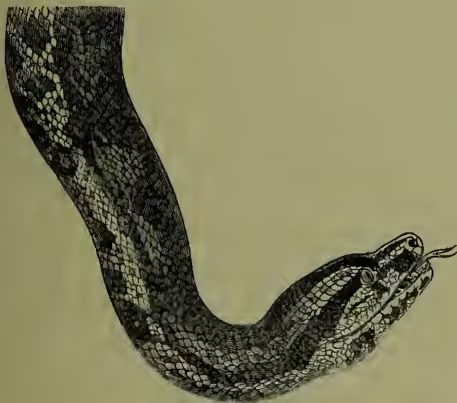
The body of these large non-venomous crushing snakes is slightly compressed sideways, and is covered with smooth or keeled scales. The gape, tail, and hind-legs are referred to above. The genus Boa itself has smooth scales, a scaly head, lateral nostrils, and characteristic arrangement of shields. The common species (Boa constrictor), found in the north and east of South America, is usually about 12, but, according to report, may be over 20 feet in length. The colour of the back is reddish gray, with zigzag, broad, dark longitudinal stripes, including oval grayish-yellow spots; the head exhibits three dark stripes. It frequents dry bushy regions, is shy of man, and little feared. To a large extent arboreal in its habits, it is aided in climbing by the rudimentary claw-like hind-limbs. From its concealment the boa swoops down on even comparatively large mammals, crushes them in its coils, and swallows them slowly. The bones are broken by the external crushing, a copious flow of saliva within the mouth makes the laborious swallowing of the large mass somewhat easier, but it is at the best a tedious and exhausting process. After a meal comes a period of digestion and quiescence, and in this state of torpid lethargy they may be readily killed. On wakening up they are very hungry, and the demands of appetite at this time prompted a boa in the Zoo to swallow its rug, which, after a week or two of unsuccessful digestion, it put up again. The boa bears its young alive. The skin of the Boa constrictor is used for making boots, saddle-covers, &c. The great water-snake Anaconda (Eunectes murinus), the Xiphosoma of the Amazon district, which occasionally visits houses; the Enygrus of Java, Amboyna, and New Guinea, with keeled scales, are closely allied genera of Boidæ. See ANACONDA, PYTHON, SNAKES.