Boar, WILD (Sus scrofa), a non-ruminant, even-toed hoofed mammal, with conical teeth (Ungulata, Artiodactyla, Bunodontia). The family (Suina) to which the boar belongs, and which also includes the river-hog, the babiroussa, the wart-hog, the peccari, &c., is characterised by the pointed head with familiar pig-snout, large ears and small eyes; by the thin legs, often curled tail, bristly hide; by the four toes on fore and hind feet, of which only the two inner reach the ground; by the prominent canines, especially in the males. They are also notorious for their voracious omnivorous diet, love for damp places, and rapid multiplication.
The wild boar is a large powerful beast, measuring 4 feet or more in length, with very strong and formidable canine teeth in the male. The head is more elongated than that of the domesticated form. The strong bristles are blackish-brown, mingled with yellow, and these, along with the brownish-gray under-hair, give the animal a dark grayish-brown colour, often approaching black.
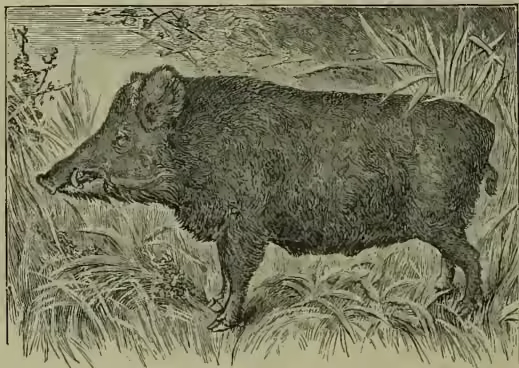
The young ones are yellowish for six months, and have white and brown stripes or spots. The adult males usually live alone, but the female is accompanied by her family, and sometimes by other sows and families. Four to six young are born in a litter. The boars come from their places of concealment at night; they devour all sorts of things, but especially vegetable produce. The sense of smell is acute, and they do not miss much of what they rout up. By their voracity and ruthless grubbing they do great damage to crops and to young trees. On account of this, as well as for the sake of their flesh and bristles (q.v.), they are much hunted in the regions where they occur, and the fury of the enraged male, and the zeal of the sow in protecting its young, add a spice of danger to the chase. In some parts of India 'pig-sticking' is the chief sport. Many species of Sus have been distinguished, but four or five alone are certain: S. vittatus, 'from Sardinia to New Guinea, from Japan to Damara-land (South-west Africa); S. verrucosus, from Java and Celebes; S. barbatus, from Borneo; and S. scrofa, formerly common throughout temperate Europe and Asia. At Chartley, in Staffordshire, the wild boar was not extinct so late as 1683; and at Sydnope, in Derbyshire, Alpine boars and sows, introduced from the Continent, bred between 1823 and 1837, when the last was shot (Harting's Extinct British Animals, 1880). The wild boar is still common in woody damp regions in some parts of the Continent.— Fossil species occur in the Miocene and Pliocene strata. Hyotherium is abundant in the upper Eocene and Miocene ages. The oldest representatives are Eohyus and Achaenodon (Parahyus?) from the lower and middle Eocene, the former 'with at least four functional toes, and with certain peculiar carnivore modifications of the skull.' Heilprin calls attention in this connection to the remarkable Pachysimia, found in the phosphorite deposits of Quercy, France, which are held by Fillhol 'to possess striking structural features allying them with the Primates.' It would be indeed curious if the monkeys should find their ancestors among such beasts.
A boar's head, served up as the most important dish on the baronial table, was the subject of many a carol and poetical allusion connected with Christmas festivities in England. The boar's head (see HERALDRY) is a well-known cognisance. For the wild boar's tooth, see also BABIROUSSA; for swine in domestication, see PIG.
In hunting the boar, any and every large and powerful kind of dog has been used, those with rough coats being preferred, as being less liable to severe injury from the boar's tusks. But the name BOARHOUND is generally given in England to the breed also known as Great Dane, Ulmer Dog, Deutscher Dogge or German Mastiff. It is a strong, handsome dog, which may reach thirty-three inches in height at the shoulder, carrying the head and neck high, with prick ears. It unites the strength of the mastiff with the elegance of the greyhound. It hunts chiefly by sight, but is usually a kindly, companionable dog, and is in Britain rarely employed in the chase. The hair is short, hard, and dense, the colour various shades of gray ('blue'), red, black, or white, with patches of the other colours.