Boat-lowering and Disengaging Gear, an inclusive term for the system of ropes, blocks, and davits or cranes, by which ships' small boats (see BOAT) are lowered to the sea, and sent clear of the fastenings. For a long time in the early history of shipping, no proper means were employed for launching boats, but afterwards, and especially as the passenger-carrying trade developed, vessels were built having davits with blocks and falls, or tackle. At first the davits were fixed wooden uprights at the side of the ship; then wooden uprights, moving upon hinges or pivots called 'topping davits;' then of curved iron, fixed in sockets, but capable of turning round. The last-named method is still the one most universally adopted, although a plan of working a curved iron davit upon a hinge or pivot, in a similar manner to the old wooden topping davit, has been sometimes fitted within recent years. Until within comparatively recent times, the almost universal mode of attaching boats to the falls and blocks was by a fixed hook on the bottom of the lower block, which hooked into an eye or ring fixed near the bow and stern of the boat. The many calamities befalling boats thus fitted when being launched in the hurry and excitement of shipwreck or other emergency at sea, led to the invention of more efficient and reliable means for safely disengaging them from the lowering tackle, and for regulating the process of lowering as well. The first recorded invention of an improvement in lowering and disengaging boats is that of Lieutenant Cook, R.N., in 1830. The next invention was by Shore in 1836; and in 1852 Stirling, Lacon, and Dewey each invented a system of disengaging boats. From that time till now, the records of the Patent Office show a continuous and plentiful list of devices, many of them, however, simply being modified forms of methods formerly patented. A goodly proportion have related only to the mode of housing and lowering boats; but in the case of Clifford's apparatus, which, more than any other, at one time met with wide acceptance, the work of disengaging was also embraced. The aim in this apparatus, which began to be introduced in 1856, was the rapid and equable lowering of boats, by unreeving pennants placed round drums and rollers, and the simultaneous disengaging of both hooks; the whole operation being under the control of one man seated in the boat. When first brought out, and when fitted and worked properly, this plan was a most successful one, and without doubt its adoption led to the saving of many lives. As time went on, however, it was found that the pennants were allowed to get out of order, and being often made of inferior material, were unreliable, while in frosty weather they became almost useless. The necessity also of using the old blocks and falls to hoist the boat was too often the cause of the apparatus not being immediately and properly adjusted for lowering, and in consequence found worthless at the moment of necessity. Its adoption therefore did not extend, and at the present time, although other and better apparatus have been designed to accomplish the safe lowering of boats, the almost universal practice, as before stated, is to employ the old and primitive plan of simple blocks and falls.
With regard to disengaging boats (perhaps the most critical part of the whole operation of launching), the number of patented gears is very large. Captain Kynaston, R.N., in 1857 invented and patented a slip-hook which for several years received the approval of the Admiralty, and was fitted in the boats of many naval ships. An improved form of the same hook was designed by Mark Robinson. In 1870 Hill & Clark patented a novel hook—improved subsequently—which has been extensively adopted both in the naval and mercantile marine; and in 1872 a disengaging apparatus, similar in principle to previous gears, was patented by Douglass, and received for several years extensive adoption in merchant-ships. This consisted of a round ball attached to the end of the falls, and a cup or socket fitted in the seats at each end of the boat, the balls fitting into the sockets, and being held there by means of levers, the tops of which pressed partly over the balls, and gripped them. These levers were kept in position by means of a tightened chain held by a trigger in the centre; when this trigger was released, the chain slackened, and allowed the levers to open, and the balls to clear. This plan, like some of the other methods, had the disadvantage (a most serious one in cases of dire emergency or panic) of permitting the boat to be detached when suspended at any height; the disengaging thus being entirely dependent upon the judgment of whoever had charge of the trigger. Recent and more approved methods insure that a boat suspended from the falls cannot be unhooked or released until entirely water-borne, and all strains taken off the falls.
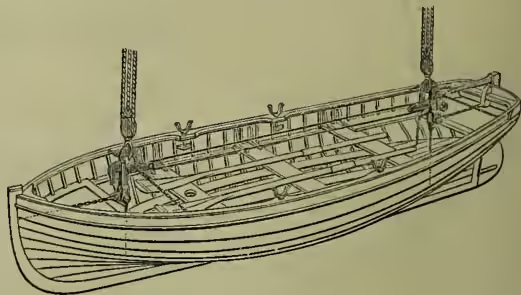
It would occupy too much space even to simply enumerate recently patented gears; it must suffice to illustrate and describe one of the simplest. Figs. 1, 2, and 3 illustrate a disengaging apparatus designed and patented by W. F. Rees, R.N., curator of the Naval Museum, Greenwich. Fig. 1 shows the disengaging hooks in position, with the boat under suspension. Fig. 2 shows an enlarged view of the hook as it appears with the boat suspended. It will be seen that it consists of a straight shank with, at its upper end, the hook proper, pivoted through its crown, and at its lower end the slot and pin-hole, wherewith to fix it to the standard or sling reaching down to the keel of the boat. Half-way up the shank, and pivoted to it, is a slotted tumbler which receives and holds the bill or point of the hook when the boat is suspended. When, however, the fore and aft line, reaching from tumbler to tumbler and holding them up, is allowed to slack, the tumblers drop and allow the hooks to swing back on their pivot (see fig. 3), thus freeing the block and tackle. The fore and aft line is thus the key to the whole operation of disengaging. It is attached to the after-tumbler; the end, after passing through the
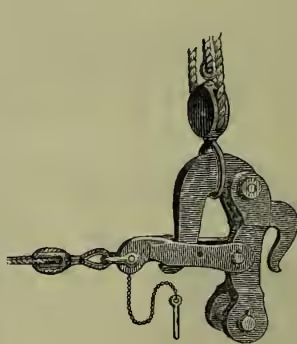
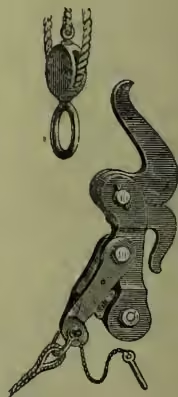
forward-tumbler, is belayed round the cleat or afterthwart, and is under control of the coxswain. By keeping the line hand-taut while the boat is being lowered, there is no possibility of the boat disengaging itself should one end of it touch the water before the other. Indeed, even when the boat is completely water-borne, the hooks of themselves cannot become disengaged, unless as the result of an intentional slackening of the line. The small safety-pin with chain shown on fig. 2 is used to keep the hook in position when there is no strain on the fall—i.e. the boat not under suspension—and the fore and aft line is not taut; for example, when attaching the falls, previous to hoisting up the boat. In rough weather or in the dark, the boat can be hoisted up by simply slipping the eye of the lower block over the second small fixed hook, shown at the back of the shank, the disengaging hooks being afterwards adjusted ready for lowering again.