Boat is the general name for a small open vessel. Boats differ, however, greatly from one another. They may be slight or strong, sharp or flat bottomed, swift for despatch or roomy for cargo, ornamental for pleasure or plain for hard service, deep or light of draught for deep or shallow water. The royal navy formerly set the pattern for the large merchant-ships; but the introduction of steam-launches of all sizes has practically brought about the extinction of the largest kind of boats propelled by oars for the use of ships of war. The length of the steam-launches is usually 38 to 42 feet, and they weigh (without boiler) from 90 to 113 cwt. A steam-pinnace, 30 to 37 feet, weighs (without boiler) 52 to 83 cwt.; and a steam-cutter, 21 to 28 feet, weighs (also without boiler) from 13 to 33 cwt. A steam-launch will carry 70 men; a pinnace, 50; a cutter, 20. The boats kept for rowing are: Barge, a long, narrow, light boat, employed in carrying the principal officers to and from the ship. An 'admiral's barge' is 34 feet long, and weighs 23 cwt. (For other kinds of boats or vessels under this name, see BARGE.) A Pinnace, a boat for the accommodation of the inferior officers, ranging from 25 feet to 35 feet in length, has usually eight oars, whereas the barge has ten or more; a Cutter, broader and deeper than the barge or pinnace, ranging from 20 feet to 32 feet, and weighing from 10 to 20 cwt., is rowed with six oars, sometimes hoists a sail, and is chiefly employed in carrying light stores, provisions, and crew; a Jolly-boat is a smaller cutter, rowed with four oars instead of six; whilst a Yawl is small in size, and used for nearly the same purposes as cutters and jolly-boats. A Gig is a narrow boat, ranging from 22 to 32 feet, and weighing from 6 to 9 cwt.; it is rowed with six or eight oars, and employed by the chief officer on expeditions requiring speed. Some of the above-named boats are diagonal-built for strength; the others are clencher-built, to be as light as possible. Besides the foregoing, life-boats, ranging in length from 23 to 28 feet, and in weight from 8 to 11 cwt., are carried; also a dinghy of 12 or 14 feet, and weighing about 3 cwt. The latter are capable of being rowed by one or two men. A merchantman ordinarily carries a pinnace of from 25 to 30 feet; a life-boat, 20 to 30 feet; and a jolly-boat, 14 to 24 feet. Passenger-ships are, however, required by law to carry a sufficient number of boats to hold the whole number on board; but often this is not done.
In reference to the legal regulation of boats in the merchant-service, the following are the chief provisions: When a boat belongs to any ship or other vessel, the name of the vessel and of the place to which she belongs must be painted on the outside of the stern of the boat, and the master's name within-side the transom—the letters to be white or yellow on a black ground. Boats not belonging to ships or other vessels must be inscribed with the name of the owners and the port to which they belong. All boats having double sides or bottoms, or any secret places adapted for the concealment of goods, are liable to forfeiture.
The boats intended for the rescue of shipwrecked persons, or crews and passengers exposed to that danger, are described under LIFEBOAT.
Yachts' boats vary in size according to the dimensions of the yacht. A cutter for an 80-ton yacht would be about 17 feet long, and be rowed by four oars; whilst a yacht of 300 tons would have one 34 feet long, and capable of being propelled by six or eight oars. A yacht's cutter is of good depth and breadth, and employed by the crew in watering or other services, or by the owner in rough weather; the length is generally four times the breadth, and the depth one-tenth the length. A yacht's gig varies in length from 18 to 32 feet, and is rowed by four, six, or eight oars. The length is about 4.8 times the breadth, and the depth one-twelfth the length. A yacht's dinghy ranges from 8 feet to 14 feet in length, the breadth being one-third the length, and the depth one-seventh.

Boats differ very considerably at various parts of the coast, and are generally adapted to the nature of the beach and general condition of water they are employed in. Thus on the Thames, the waterman's skiff or wherry (fig. 1) is usually of very light build, whilst on the coast they are comparatively heavy, to bear the straining they are subject to in rough water and constantly beaching. On the south coast the square-sterned skiff is mostly in use, and is generally about 14 feet long, with three thwarts (or transverse seats), and the seat in the stern, with two side-seats. These boats are met with about the watering-places from the Thames to Weymouth, and are usually in charge of one man. At Portsmouth the waterman's boat is sharp-sterned like a whale-boat, and is usually termed a wherry. They are generally fitted with a sprit mainsail, a mizzen, and a foresail. These boats vary in length from 16 feet to 25 feet, and are admirably adapted for going through the broken water between the harbour and Spithead, the sea being very short and steep with an east wind on an ebb. Indeed, these boats often keep up communication with the fleet at Spithead when the ships' boats are not allowed to leave. On the north-east coast a peculiar flat-bottomed boat is in use, and termed a coble (fig. 2). They are of shallow draught, and when being sailed, the peculiarly deep rudder helps to check their tendency to make leeway when close-hauled.

On the Irish coast, the boats generally are of a very primitive form and construction. The Wexford cot is quite flat-bottomed, with two outside keels (see sketch); whilst on the west coast the boats are 'round' everywhere—round in the bottom, round in the bow, and round in the stern. There are many other varieties of boats around our shores, but those mentioned are the most distinct in type.

Of the many boats used for pleasure, none are more popular than the Thames Randan skiff (fig. 4), ranging in length from 20 to 40 feet. They are


usually built of cedar or mahogany, and beautifully finished and fitted like a state barge.
Competition among oarsmen has brought into existence the racing-boat with outrigger rowlocks. These boats are usually built of cedar for lightness, canvas-covered, and so light in construction that a sculling-boat (termed a wager-boat) 30 feet long weighs no more than 30 lb. They are only of sufficient width to seat the sculler, and require expert handling to prevent an upset. The ends of the boats are decked over with oiled or painted canvas.
The dimensions and weights of racing-boats are as follows:
| Description. | Length over all. | Extreme breadth. | Depth amidships. | Weight, including outriggers, but not oars. |
|---|---|---|---|---|
| ft. | in. | in. | lb. | |
| 8 oars . . . . | 59 | 23 | 9 | 240 |
| 6 oars . . . . | 50 | 23 | 9 | 200 |
| 4 oars . . . . | 42 | 20 | 8 | 140 |
| 2 oars . . . . | 36 | 15 | 7 | 45 |
| Sculling .. | 31 | 10 to 12 | 5 | 31 |
On the Thames, the London Rowing Club has twelve-oared racing-boats of about 75 feet long. See CANOE, CATAMARAN, PROA, &c.; for boating, see ROWING; and for sailing-boats, see SAIL, YACHT.
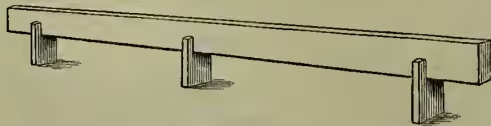
Boat-building.—Boats are usually built by eye, but occasionally their shape is delineated on paper by a series of curved lines. In the latter case these lines are transferred to the floor of what is termed a 'mould loft,' and the drawing made of full size—i.e. of the size that the boat is actually to be. From this drawing moulds of the cross sections are made, as shown by fig. 6; a is a notch to fit over the keel. The stem, stern-post, and keel are then cut out of the required shape, and tenoned together. They are then fixed on building stocks consisting of blocks of wood, or of what is known as a 'deal' secured edgeways in a horizontal position on uprights (see fig. 7).
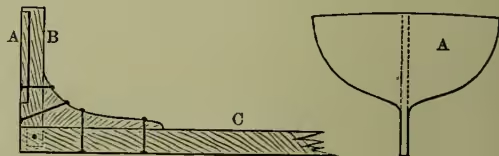

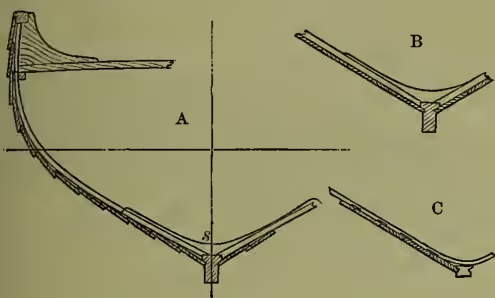
The stem and stern-post, besides being tenoned to the keel, are further temporarily connected at their upper ends by a fore-and-aft batten of wood. The stem and stern-post are held in position on the stocks by struts extending to floor and beams in the roof of the shop. The transom (see fig. 8) and moulds of the cross sections are then fixed into their proper places, and secured to the fore-and-aft batten and to the roof by struts. The moulds are then further secured by ribbons or bands of wood temporarily bent round their outside edges. These edges and the stem and stern-post are then marked (see b, b, b, fig. 6) to represent the width of the plank, the latter usually being about 5 inches wide, with about inch overlap, termed the land in clencher-built boats (sometimes termed clincher or clinker). The bottom plank, known as the garboard strake, is first fitted into the rabbet or groove cut in the keel, stem, and stern-post to receive it, and nailed at intervals of about 3 inches. A plank is then taken and held over the upper edge of the garboard, and marked round with chalk or pencil. The plank is then removed and sawn through by the chalk line, care being taken to provide for the overlap. The plank is then further cut to the right width to fit the marks on the moulds, b, b, stem and stern-post, and then planed and edges bevelled as required to fit round the curve of the moulds. The plank is held in position by a series of wooden clamps, set up by wedges, as shown in fig. 9. The edges of the plank are then nailed together at intervals of 3 inches, the nails being clenched on the inside on rooves (small copper rings). When all the plank is on, the timbers or ribs are put in; these are usually made of American elm on account of its straight grain, flexibility, and toughness. The ribs having been cut to the required size, are put into a steam kiln (which is a long box supplied with steam from a boiler) until they are sufficiently pliant to be easily bent round the bilge of the boat inside. The timber is now nailed (from the outside) to the plank, each nail being clenched on a roove. After the timbers have been fitted and nailed, the 'in-wale' (a batten of wood inside the gunwale) is fitted over their heads, and nailed and rooved to the gunwale strake. A bearer or stringer is then fitted round the boat inside, to take the seats or thwarts, the latter being further secured to the sides of the boat by oak-knees. In the case of boat-building without moulds, the garboard strake is fitted as already described, and also the next strake. Each succeeding strake is fitted in the same manner, the boat-builder giving such a curve to the bilge and sharpness to the bow or stern as his judgment and experience may direct; and often a 'rule-of-thumb builder' turns out a handsomer boat and better model than the man who works by lines. Fig. 10, A, shows in detail the construction of a clencher-built boat; s is an oak-knee floor fitted to the sides of the timbers when the bottom of the boat is so sharp that the timbers cannot be bent round over the keel.
In a carvel-built boat the edges of the plank meet as shown by fig. 10, B. The seams are caulked with oakum or cotton, and payed with pitch or marine glue. Racing-boats and canoes are usually carvel-built, but the plank is too thin to admit of caulking, and a strip of canvas or wood is worked over the seams inside. When a strip of wood is used, the work is termed ribbon carvel (fig. 10, C).