Boiler, the name given to a vessel in which steam, usually for a steam-engine, is generated. In its simplest form, it consists of a close vessel made of metal plate, having apertures for the admission of water and egress of steam, fitted with apparatus for showing the level of the water and the pressure of the steam, and in connection with a furnace, either internal or external. When water is boiled in an open pan, the temperature of the water and of the steam rising from it remains at or very near 212° F., and the tension or pressure of the steam is no more than sufficient to make its way into the atmosphere, being exactly equal to that exerted in all directions by the atmosphere itself—namely, 14.7 lb. per square inch. In a close vessel, on the other hand, the temperature and pressure to which we can raise the steam are only limited by the strength of the vessel or boiler against bursting.
The form of a boiler is determined by two considerations—namely, strength to withstand internal pressure, and efficiency in producing steam; and the object of the designer is to combine in one apparatus sufficient strength to work safely at the proposed pressure, with such a form and arrangement as shall abstract the maximum of heat from the gases of combustion, and at the same time be in all respects suitable to the special circumstances of the case. The globular form is that best adapted for strength, and was the earliest to be used. It presents to the fire, however, the minimum area in proportion to its contents, and therefore has a minimum efficiency. After spherical boilers, cylindrical ones came into use, at first set on end, and afterwards laid on their sides, and later on, these were furnished with internal cylindrical tubes for furnaces. Watt's 'wagon boiler' (so called from its shape) was used for many years, but being quite unfit for any but the lowest pressures, it has long been discarded; and the 'egg-end' boiler, or plain cylinder with hemispherical ends, also much used at one time, has now almost disappeared on account of its small evaporative efficiency. At present, it is quite common to use a working steam-pressure of 60 to 80 lb. per square inch in ordinary factory boilers, and in some cases this is already greatly exceeded, while the tendency to use higher pressures seems to grow yearly. Already in marine work and elsewhere pressures of 120 to 150 lb. per square inch are as common as half those pressures were fifteen years since. Under these pressures, the only forms of boiler which can be used without heavy and expensive internal stays to prevent the danger of bursting, are the globular and the cylindrical. The former shape is rejected for the reason already given, and the latter form is used almost invariably in the construction of modern boilers, as will be seen from the examples given below. The ends of the cylinders, when it is necessary to make them flat, must, of course, be strengthened by stays.
Boilers may be classified in several ways—as (1) Horizontal and Vertical; (2) Internally and externally fired; and (3) Plain, Multitubular, and Tubulous. Large boilers are almost invariably horizontal, but small vertical boilers are often used. They are employed in Steam-cranes (q.v.) and other situations where great length would be an inconvenience, and otherwise very frequently when small powers are required, especially for temporary purposes. In Great Britain, where moderately good fuel is used, boilers with an internal furnace are generally preferred; but on the Continent the common brown coal is much inferior to our fuel, and a correspondingly larger quantity of it must be used to generate a given volume of steam. As the size of a furnace limits the fuel which it can burn, this frequently involves having a much larger grate than could be conveniently arranged inside the boiler, and on this and other accounts boilers are, on the Continent, more frequently externally fired than in this country. Under the head of 'plain' boilers come all ordinary cylindrical boilers, with or without internal furnaces, horizontal or vertical. They are the cheapest and simplest which can be made, and, if properly proportioned, possess a considerable evaporative efficiency. When it is necessary, however, to economise fuel, or space, or both, 'multitubular' boilers are frequently used. These derive their name from the fact that in them the flame and gases of combustion are made to pass through a great number of small tubes (surrounded by the water) on their way to the chimney. The steam-generating power of a boiler depends greatly on the extent of surface which it presents to the flame, and it is obvious that a great number of small tubes present a much larger surface than one large tube occupying the space of them all. Thus, with the same heating surface, a multitubular boiler will occupy much less space than a plain one, and at the same time the efficiency of its surface is found to be greater. It is, however, necessarily more expensive and more liable to get out of order. Tubulous boilers differ from multitubular boilers in not only containing tubes, but consisting of them, and having no large cylinders whatever. Their chief advantages are (a) their great strength, for it is easy to make a metal tube strong enough to withstand pressures far higher than any at present in use; and (b) the peculiarity, that if any accident happens or explosion occurs, it will only be to one tube at a time, and not to an immense boiler shell (as with the common boiler), and its evil consequences will thus be greatly reduced. For this reason tubulous boilers are often called 'safety' boilers. It will be readily understood that there is no distinct line of demarcation between the three classes of which we have been speaking, but that, on account of the immense variety of boilers which have been designed and constructed, those of one class pass through gentle gradations into those of the next.
The commonest form of boiler for factories, &c. is that known as the 'Cornish,' and shown in fig. 1. It consists simply of a cylindrical shell, a, a, enclosing a much smaller cylinder, f, f, called a flue. The ends of the flue are open, but the space between it and the shell, which contains the water, is of course closed up and made steam-tight. The fire-grate, d, is in the interior of the flue, and at the end of it is a brick bridge, c, made so as to cause the flame to impinge on the upper side of the flue.
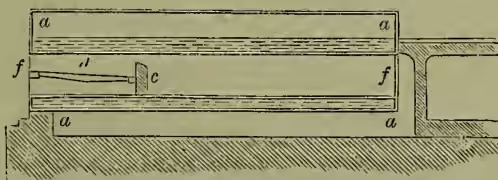
The boiler is set in brickwork; and the flame, passing out at the back end of the flue, is made to traverse the whole length of the boiler twice through brick flues projecting before passing away to the chimney.
The Cornish boiler has often two internal flues or tubes, which is a much more advantageous construction than that shown in fig. 1. A Cornish boiler with two flues is known as a 'Lancashire' boiler. In the 'Galloway' boiler, a very excellent modification of the Cornish, which in outward appearance it exactly resembles, there are two furnaces, but these join together in one chamber just behind the bridges, and the gases are made to pass through a space considerably narrowed by side pockets projecting inwards in order that they may be well mixed. From this point to the back of the boiler there is just one flue, made oval in section, and crossed by a considerable number of vertical taper tubes, which form a direct communication between the water beneath and that above the flue. These tubes (called 'Galloway tubes') both promote circulation and strengthen the flue. Multitubular boilers of many kinds are used, both for stationary engines and other purposes, but the largest number of those constructed are certainly for steamers, and a common type of marine boiler is shown in fig. 2. The shell, a, a, is cylindrical, and contains one or more cylindrical furnaces; c is the fire-grate; d, a brick bridge; e, a combustion chamber or flame-box; f, the tubes through which the flame passes back to the front of the boiler; and g, the smoke-box at the base of the funnel. The line k, k, shows the ordinary level of the water in the boiler. On board ship it is of course an object to take up as little space as possible with the boiler and machinery, and at the same time to have boilers which shall use as little coal as possible, both because of the saving in cost, and because of the saving in the room taken up by coal. For all these reasons, marine boilers are invariably multitubular.
The varieties of vertical boilers are as numerous as those of horizontal. When dirty water, or water containing much insoluble sediment, has to be used (as e.g. in steam-cranes frequently), they are of the simplest construction, with nothing but an inner fire-box and an outer shell (both cylindrical), the space between them being filled with water all round and over the top of the fire-box. If clean water can be had, however, and it is desired to be at all economical of fuel, some kind of multitubular vertical boiler must be used, and of these probably the best is that known as the 'Field' boiler, and shown in fig. 3. The peculiarity of it consists in
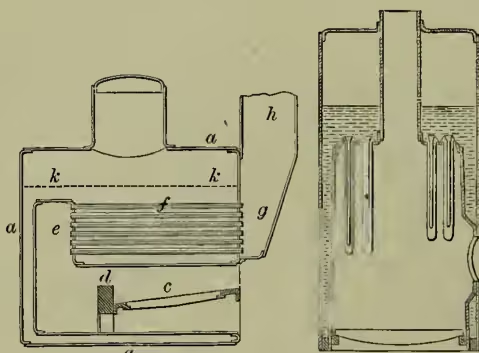
Fig. 3.
the tubes, which are closed at the bottom and hang down from the top of the fire-box over the grate bars, containing inner tubes of much smaller diameter. The latter are intended to aid the circulation of the water, which passes down the inner tube and up again through the annular space around it, where, being most exposed to the action of the flame, it is hottest. Of the different varieties of tubulous boilers, those best known are perhaps the Babcock and Wilcox, the Root, and the Howard boilers. The great difficulty about all of them is the obtaining sufficiently free circulation for the water and the steam formed below its surface. But this difficulty seems to have been overcome in those first mentioned. Locomotive boilers are always multitubular, for much the same reasons as marine boilers. The boiler of a single locomotive often contains 1500 or 1800 square feet of heating surface, and occasionally as much as 2000 square feet.
The principal test of the efficiency of a boiler is the quantity of water (generally expressed either in pounds or gallons), which it will evaporate from and at a temperature of , with the consumption of one pound of coal. Of course, this varies very much with the quality of the fuel, but with good pit coal (not dross), a Cornish boiler often evaporates 6 to 8 lb. of water per lb. coal, and a multitubular boiler, such as fig. 2, about 10 or 11 lb. per lb. coal. Good Cornish or Lancashire boilers, however, often attain as great economy as those of any other type. The best rate of combustion on the grate varies with the construction of the boiler, from 10 to 18 or 20 lb. per square foot of grate surface per hour, and much more with forced draught, as in a locomotive.
Until very recently boilers were almost invariably made of wrought-iron plates riveted together. The parts most exposed to the action of the flame were made of the best quality of iron, and the other parts of inferior quality, according to their position in reference to the flame. Now, however, for all first-class work, and work where high pressures are to be used, the common material for boiler construction is 'mild' steel made by the open hearth process, and having a tenacity of about 28 tons per square inch. Copper is often used in the fire-boxes of locomotives, but seldom in any other description of boiler. Brass boiler tubes are sometimes seen, and on account of its better conducting qualities, brass is to be preferred to iron, but its dearness prevents it superseding iron in the great majority of cases, and there are other drawbacks to its use.
Every boiler has, to render it complete and workable, a number of fittings or mountings, of which the following are the principal: A glass gauge to show the level of the water inside the boiler, and gauge-cocks for the same purpose; a gauge to show the pressure of the steam; a valve for admitting water; a cock at the bottom for emptying or 'blowing off'; a valve for the discharge of the steam; one or two safety-valves, weighted so that when the pressure of steam in the boiler reaches a certain height, they open and allow the steam to rush into the air; a door by which a man can get in to clean the boiler, &c.
In order to induce a current of air through the furnace so that a proper combustion may be maintained, stationary boilers are generally provided with a chimney of considerable height, and made of brick or sheet-iron, to which the products of combustion are conducted after they have left the boiler. In locomotive boilers, and in some other cases where a sufficiently tall chimney cannot be made use of, a very powerful current is made by the ejection of the waste steam through a blast-pipe with a contracted nozzle at the base of the chimney. To prevent loss of heat by radiation, and the consequent waste of fuel, boilers should always be covered, in all parts exposed to the atmosphere, with felt or some non-conducting composition.
For further details see also BOILING, GAS AND GASES, INJECTOR, SAFETY-VALVE, STEAM, and STEAM-ENGINE.