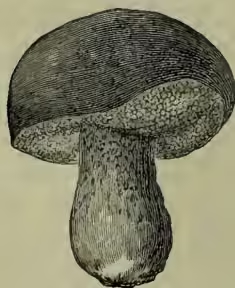
Boletus, a genus of Hymenomycete Fungi (q.v.). The older botanists included in it the numerous species now forming the genus Polyporus (see AMADOU, DRY ROT, and POLYPORUS) and other genera; but even as now restricted, it includes about one hundred European species. Most of the species resemble the common mushroom and other species of Agaricus in general form, but are distinguishable at a glance by the pore-like surface occupying the place of gills. Unlike Polyporus, the whole spore-bearing tissue (hymenium) is easily detached. Some of the species are edible. B. edulis is much used in France, also in Germany, Hungary, Russia, &c. It is the ccps ordinaire of the French markets. It grows on the ground in thin woods of oak, chestnut, or beech, and sometimes in mountainous districts, in places covered with moss, heath, or grass. In moist warm summers it sometimes appears in prodigious quantities. It has also been partially cultivated by inclosing a portion of a wood, and watering the ground with water in which the plant has been steeped, thus, in fact, sowing its minute spores. In Britain it is comparatively rare. The cap is smooth, 6 or 7 inches across, with a thick margin, varying in colour from light brown to brownish black; the tubes at first white, then yellow, and finally yellowish green; the stem thick and solid, beautifully reticulated. The tubes are removed along with the skin and stem, and only the flesh of the cap is eaten, which is firm, white, delicate, of agreeable smell, and is prepared like the common mushroom, dried to flavour sauces, ragouts, &c., or eaten raw with salt and pepper. It is wholesome and nutritious, and is certainly to be reckoned one of the very best of the edible fungi.—B. scaber is another edible British species, but much inferior.—B. aeneus is the ccps noir of the French markets, and B. aurantiacus is the girolle rouge or roussille. They are used like B. edulis. Forms of which the flesh turns blue when broken and exposed to the air, should be avoided as probably poisonous.