Boom'erang, a wooden missile used by the aborigines of Australia in hunting and in war. It is of hard wood, bent in a curve, and is from 2 feet to 2 feet 9 inches long by from 2 to 3 inches broad. It has one side convex, the other flat, with a sharp edge along the convexity of the curve. The curve varies greatly in different instruments.
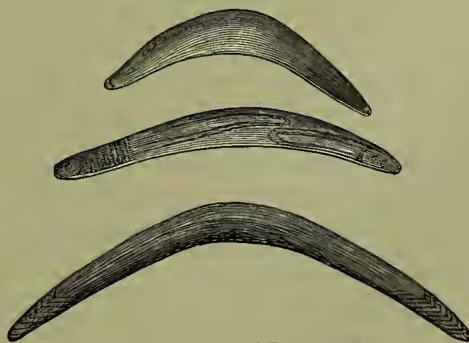
When to be thrown, it is taken in the hand by the handle (which has cross cuts on it), and held up at arm's length over the shoulder. With the convex edge forward and the flat side down, it is then thrown directly onward with a strong quick fling, as if to hit some one 40 yards in advance. The hand is drawn back at the same time, with a movement like that in the 'screw-back' stroke at billiards. The missile slowly ascends in the air, whirling round and round, and describing a curved line of progress till it reaches a considerable height, when it begins to retrograde, and finally, if thrown with sufficient force, falls 8 or 10 yards behind the thrower, or it may fall near him. This surprising motion is produced by the bulged side of the missile. The air impinging thereon, lifts the instrument in the air, exactly as by hitting the oblique bars in a windmill, it forces it to go round. It should be added that the path of the boomerang can be varied by the will of the thrower, and that the sweep of no two boomerangs exactly agrees. The force with which it flies is great; the Rev. J. G. Wood has seen a dog killed on the spot, and nearly cut in two by the stroke. The ingenuity of the contrivance, and the skill with which it can hit the mark aimed at, are very extraordinary as coming from almost the lowest race of mankind. Attempts have been made to derive it from some hypothetical high culture, but the intermediate forms between it and the war-club or battle-axe have been found in its own country, and there are good grounds for considering it really a native invention developed through such stages to its present form. 'Various missiles,' says Tylor, 'have been claimed as boomerangs: a curved weapon on the Assyrian bas-reliefs, the throwing-cudgel of the Egyptian fowler, the African lissan or curved club, the iron hungamunga of the Tibbás, but without proof being brought forward that these weapons, or the boomerang-like iron projectiles of the Niam-Niam, have either of the great peculiarities of the boomerang, the sudden swerving from the apparent line of flight, or the returning to the thrower.' Sir Richard Burton (in The Sword) alleges that some Indian throwing-sticks fly back.