Boots and Shoes. The foot-coverings of the human family are exceedingly varied in form, and they are not less diverse in the material out of which they are made. These differences are not merely due to the caprices of fashion and the influence of traditional costume and habit, but they owe their existence in large measure to the conditions of climate, and to the necessities of the daily life and occupations of their wearers. It must be at once obvious that the foot-coverings which would be sufficient and healthy amid tropical sands, would be most unsuitable for withstanding the rigours of a Greenland winter. The lightest sandal, which simply defends the sole of the foot, is appropriate for the one condition, while the other demands the closest, most warm, and water-tight covering which can be devised. The elementary foot-covering is the sandal, which consists only of a pad or sole shaped to the sole of the foot, and held on by straps or thongs. From the sandal grows up the slipper, in which straps and lacing are dispensed with, and a sufficient 'upper' of leather or other soft material is provided to keep the article on the foot. The ordinary short shoe is the next development, it being laced, buttoned, or otherwise fastened on the foot; and in the boot the upper is continued so as to embrace more or less of the leg.
The sandal is the most ancient foot-covering of which we have any record, and examples of very ancient manufacture, taken from Egyptian mummies, are preserved in public collections. The shoe frequently referred to in the Old Testament, and which played an important part in buying and selling, and in other social usages, was a sandal.
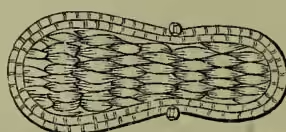
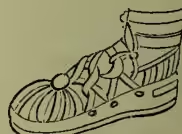
The common sandal of the ancient Egyptians (fig. 1) consisted of stripes of papyrus plaited into a kind of mat, and that form remains the type of sandal of plaited grass or straw worn to this day by multitudes in Central Asia, India, China, and Japan. The sandal was the ordinary shoe of the ancient Greeks, an ornamental example of which is shown in fig. 2. In Greece, shoes were used only in exceptional circumstances, and long boots lacing up the front were worn by hunters. Sandals (soleæ) were the everyday wear of the Roman populace; the patricians wore shoes (calcei) of black leather; red leather shoes were reserved for senators; and the long boot or 'buskin' (eothurnus), reaching sometimes to near the knee, and frequently supplied with a thick sole to add to the apparent stature of its wearer, was appropriated to tragedians and hunters. Sandals and slippers continue to this day to be the staple foot-gear of oriental communities, and great wealth of ornamentation—inlaying of wood in sandals, and elaborate embroidery in gold and coloured silks, with fantastic curling of the toes—are characteristics of the richer productions of the eastern tradesmen.
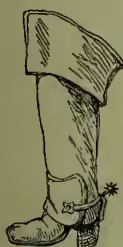
Jack-boot.
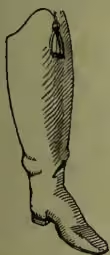
Hessian Boot.
In medieval times, shoes with long pointed toes were worn by the high-born; and towards the end of the 14th century these points became ridiculously elongated, so that there appeared to be a long strap projecting from each foot. Different kinds of half-boots were worn by the Anglo-Saxons and Anglo-Normans; and in the reign of Edward IV., if not earlier, the boot proper, with tops and spurs, was established as an article of knightly dress. In the reign of Charles I., a species of boot, exceedingly wide at the top, made of Spanish leather, came into use; and with Charles II. the highly decorated French boot was introduced as an article of gay courtly attire. Meanwhile, the jack-boot, as it is called (see JACK), had become indispensable in the costume of cavalry soldiers and horsemen generally; and by William III. and his followers it was regularly naturalised in England. Fig. 3 is a representation of this highly characteristic boot, which we readily associate with the civil and foreign wars that distracted the 17th century. This huge species of boot remained in use in British cavalry regiments until comparatively recent times, and, in a somewhat polished and improved form, it is still worn by the Horse-guards. The jack-boot is almost entitled to be called the parent of the top and some other varieties. Boots with tops of a yellow colour were so commonly worn by gentlemen in the 18th century, as to become a peculiarity in the national costume of the English. When Philip, Duke of Orleans, and other revolutionists of note, affected to imitate the sentiments and manners of the English, they ostentatiously wore top-boots. Among jockeys and fox-hunters, top-boots are likely to remain in permanent use. What perhaps contributed to break up their general use, was the introduction of the Hessian boot as an article of walking-dress. Worn over tight pantaloons, the Hessian boot was a handsome piece of attire, giving, undoubtedly, an elegant appearance to the nether costume. A representation of a Hessian boot, with its tassel, is seen in fig. 4. Boots of this shape were worn by English general officers in the early part of the French war, and somewhat later. At length they were superseded by the well-known Wellington boot, which, as its name imports, was introduced by the great
Duke, as a simplification, under the loose military trowsers. When the name of Blücher was given to a half-boot, the Wellington was almost entirely abandoned in England in consequence of the universal use of short ankle-boots. It is still largely used in some continental countries and in the United States.
The shoemaking industry of the United Kingdom, which has to do principally with boots and shoes made of leather, is divided into two departments—one the old handicraft, the other a factory industry. For many reasons the ancient domestic craft of shoemaking is dying out. Machinery and appliances for every operation are being gradually perfected, and although no machine work can equal in combined solidity and elasticity the productions of a first-class craftsman, superior operatives are comparatively scarce, and the products of the factory are at least even in quality, and much cheaper than hand-made boots and shoes.
Shoemaking as a handicraft is a sedentary and contemplative industry. The foot to be fitted being duly measured, the upper leathers are cut out and sewed together, an operation called 'closing.' The 'stuff' for the soles is then cut out of tanned oxhide, the pieces being the insole, the outsole, and the lifts of the heel. These are steeped in water; a last or foot-model suitable for the boot or shoe to be made is chosen, and to the bottom of it the insole leather is nailed; and then by pulling and hammering it is moulded accurately to follow the contour of the last-sole. The edges of the insole are then pared and rounded down; the upper is drawn tightly down over the last, and its lower edge is nailed temporarily over the edge of the insole. A narrow strip of leather, the welt, sufficient to run round the whole sole excepting the heel part, is then selected, and the three edges, sole, upper, and welt, are by an inseaming stitch sewed together. The welt then forms a band to which the outsole is sewed around the edges. The heel lifts are built up, and sewed and nailed together; and thereafter the finishing operations include the burnishing of the sole and edges, the insertion of eyelets or buttons in the uppers, &c.
The shoe-trade as a factory industry only grew with the development of the sewing-machine, and now, except for repairing, there is scarcely such a thing as hand-sewing in the uppers of shoes. The great difficulty which, apart from hand-sewing, at first lay in the way of applying machinery to shoemaking, was in the fastening together of the sole and the uppers. Early in the present century, one Randolph, and a little later, the celebrated engineer, Sir M. I. Brunel, patented methods of fastening together soles and uppers by means of metal pins and rivets. The upper leather was drawn well over the insole, the outer sole was then applied, and the whole pinned together and riveted by the point of the pins coming against, and being turned by an iron-shod last inside. The germs of the modern sewing-machine were embodied in a patent secured in 1790 by Thomas Sant, the object of his invention being to sew boots and shoes; but the sewing-machine was not applied to boot-making till after its success in ordinary stitching was demonstrated. A machine for sewing together soles and uppers was patented in America by Blake, and as subsequently improved by Mackay, it became the apparatus which, for the period during which the patents were current, dominated the factory shoemaking industry. The Blake-Mackay machine sewed through outsole, upper, and insole at one operation; but as the corporation owning the machine held the patent right for machine-sewed boots and shoes, improvements by outsiders were for the time barred. Now there are in operation many varieties of sewing-machines, some of which sew welted boots in all respects like the hand-made product.
Factory-made boots and shoes are now entirely cut out by machinery, the uppers are sewn by strong sewing-machines, and soles and uppers are fastened together either by (1) sewing, (2) pegging with wooden pegs, (3) riveting with metal pins, or (4) screwing by means of the Standard screw machine. The latter most ingenious apparatus uncoils a reel of screwed brass wire, inserts it into the sole, and cuts off the wire flush with the outsole with remarkable rapidity; and for solidity and durability the work leaves nothing to be desired.
Both in the United Kingdom and in the United States, the factory trade in boots and shoes has since 1860 undergone a remarkable development. In America, the trade is generally distributed throughout the New England states, with its headquarters at Boston, Massachusetts. In the United Kingdom, Northampton is the capital of the industry, the other towns in which it forms a prominent feature being Leicester, Stafford, Norwich, Bristol, Linlithgow, and Maybole. A large export trade is carried on from the United Kingdom to the colonies.