Bordure, in Heraldry, a border surrounding a shield (fig. 1), generally said to occupy one-fifth of the field. Though sometimes an independent bearing, it is often a difference of a cadet; and the differencing of cadets by bordures, according to a definite system of rules, has never ceased to be in use in the heraldry of Scotland. There is a great variety in bordures. Besides being engrailed, invected, wavy, &c., they may be parted in many ways and charged. A bordure compony or gobonated—i.e. divided into sixteen squares (fig. 2)—is often an indication of illegitimacy; and in later times a bordure wavy has been used in England
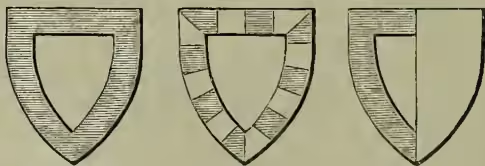
Fig. 2.
Fig. 3.
(not Scotland) with the same significance. A chief or a canton is sometimes placed over a bordure: but this is not done when the bordure is a mark of cadency. It then always surrounds a coat, and may even surround a quartered coat, a very frequent arrangement in Scotland.
When, however, a coat having a bordure is impaled with another, the bordure is omitted along the line of impalement (fig. 3).