Borers, a name applicable to many beetle-like or Coleopterous insects in the family of wood-eaters or Xylophaga, but peculiarly applicable to the genera Ptinus and Anobium. The larvæ eat their way through wood, and when that happens to be furniture, the species of Ptinus, &c. come to have some practical human interest. They are mostly inconspicuous animals, resting during the day in the larval tunnels, active and roving at night. Ptinus fur is common all the world over, and both as adult and larva much too common in the experience of herbarium keepers, insect collectors, owners of stuffed birds, not to mention wearers of furs, and housewives generally. They are most readily got rid of by the lure of a damp cloth or by vegetable matter left in the room over night, and destroyed with its attracted victims in the morning. The larva of Anobium striatum does great damage to furniture made of soft wood. Its little round tunnels, looking as if made by a drill, and full of the finest powder formed from the devoured wood, are familiar enough.
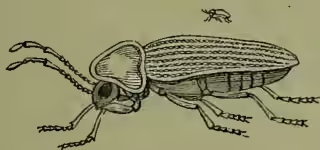
Natural size, and magnified.
The larva rests after a while, spins a silken cocoon, sleeps and grows for a time at the bottom of its hole, and finally emerges a miniature beetle, a dark-brown insect, with a proportionately large thorax overlapping the head, but not measuring in all much above a line in length. Like its relatives in this family, it pertinaciously feigns death when touched or alarmed, an instinct probably at first due to a pathological panic and paralysis, but now normal, habitual, and doubtless of advantage. Other species (A. tessellatum and A. pertinax), also found in furniture, but likewise, as is indeed usual, on trees, have in their adult stage some importance in the history of superstition as insects which produce a knocking noise, regarded as a presage of the approach of death. The adult is wont to knock against the wood with his upper jaws, but these 'blows, which are taken for the knocking of Death himself, are nothing but a knocking of the male at the door of his loved mate.' The larvæ should be smothered. There are many other genera of borers, Lymexylon navale on ship-timber, Ptilinus on books, Ape on oak furniture, and so on; but the point of interest is the general habit of the family. See DEATH-WATCH, also BORING-ANIMALS.